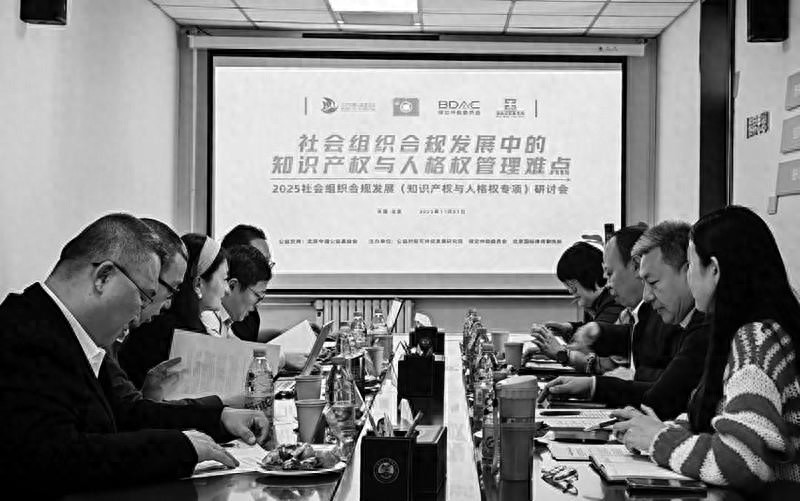
Recently, a 2025 seminar on the development of public-interest social organizations (intellectual property rights and the right to personality) was organized by the institute for sustainable development of the public service times, the preserving arbitration commission and the beijing state attorney's office。
A sample of the national public fund for public benefit project, the social worker brand project of the social services agency was used by industry experts and front-line practitioners. At the conference, the findings of the study of intellectual property and personality rights of charitable organizations, 2025, and the publication of social organization compliance, were published as public goods。
First-line data insight: research on intellectual property of 2025 charitable organizations
On 10 september 2024, the institute for sustainable development of the public service times published a study on the intellectual property rights and the rights of the personality of charitable organizations, which mobilizes the resources of the institute to disseminate the survey questionnaire. As at 10 september 2025, the project team had recovered 370 questionnaires and 304 valid questionnaires. The type of institution covers national and local public funds, non-public funds, local district and county charitable associations, and front-line social services. Nearly half of the respondents to the valid questionnaire were heads of agencies, three were heads of agencies for dissemination or compliance, and there were agency directors。
Among the research institutions, guangdong (28), beijing (22) and jiangsu (19), which together account for 37. 2 per cent of the total, are among the most concentrated areas of intellectual property resources of charitable organizations. In terms of regional distribution, east china has the highest regional distribution of research institutions, with 43. 2 per cent, followed by south china and north-west china, and a relatively small number of north-east and south-west china. “the number of research institutions ranked ahead is mostly in economically developed regions, such as guangdong, beijing, jiangsu and shanghai, reflecting the relative relevance of intellectual property development of charitable organizations to regional economic levels and innovation capabilities.” li qing, director of the press and editorial department of the public service times, stressed that it was important to state that this did not represent the true level of intellectual property administration for charitable organizations throughout the country, since the study was intended to serve only as a reference for research because of the limitations of samples and channels。
Only 29. 9 per cent of registered trademarks are owned by research institutions, and only 2. 6 per cent are registered by research institutions. With regard to legal resources, the coverage of legal advisers is still adequate and their effectiveness needs to be enhanced。
With regard to the management of the institutional intellectual property system, only 0. 7 per cent of research institutions have received training, the implementation of training in intellectual property rights, periodic evaluations and policy updates is extremely low, and most research institutions have not yet established a systematic intellectual property management system. “increased awareness of the rights and interests of recipients and volunteers has been achieved, in particular the coverage of close to 60 per cent of the right-to-view protection agreements for recipients. There is, however, much room for improvement in the use of beneficiary stories (funding scenes) and in the protection of the boundaries of intellectual property and personality rights around volunteers.” li qing indicated that the current challenge of managing intellectual property and personality rights of charitable organizations is largely perceived by research institutions as a shortage of talent and financial constraints。
The project group considers that the current intellectual property and personality management challenges of charitable organizations are mainly at the core of three dimensions: first, awareness, lack of awareness of the value of intellectual property rights such as patents, copyrights and the need to respond to ex post facto prevention; second, capacity, acute shortage of professional staff, insufficient financial resources and difficulties in accessing professional services; and third, institutional: inadequate protection systems, gaps in training systems and inadequate management processes。
Social organization perspective:
Advantages in knowledge management in compliance development
“conformation of social organizations needs to be built on the stage of development with gradual progress.” as a funder's representative, the director of the beijing china-do public interest foundation and secretary-general tan xingyu, who has been closely following the development of social organization compliance for many years, believes that many social organizations were at a grass-roots stage and were operating irregularly, but that, with their expansion and complexity, it was difficult in the long run to move from “heavy quantity” to “heavy quality” under policy guidance, allowing them to develop gradually。
According to tan sung-woo, both personality and intellectual property rights are the focus of subsequent developments in social organization compliance. With regard to the protection of the right to personal status, there are links between the registration of client information, the use of images, the vigilance of new types of abuse, such as ai technology, the protection of intellectual property rights, the correction of “public service responsibility” errors and the protection of the risk of the use of pirate material and the loss of its own branding programme。
The vice-president of the chinese institute for social assistance pointed out that social organization development was now shifting from “incremental expansion” to “increased efficiency”, and that the development of social organization compliance was a necessary path in the rule of law process. At its core was the construction of a three-tiered system of compliance, including mechanisms for the administration of intellectual property and personality rights, which was not only a passive option for regulation, but also a strategic choice for enhancing credibility and achieving sustainable development。
The second director of the public benefit project of the china foundation for social welfare, wang vulva, combined with the first line of practice, reveals three core dilemmas for social organizations in the area of intellectual property and compliance with human rights: one is the conflict between the dissemination of public goods and the preservation of dignity in relation to the protection of the rights of the person, where public service financing is often caught in the trap of “selling bad marketing” and excessive exposure to the privacy of beneficiaries in exchange for flow; the other is the loss of intellectual property rights, the unwitting nudity of public-interest assets, the blurring of volunteer outcomes, unclear boundaries for the commercialization of the recipient's work and the lag in brand protection, which are three main points of pain; and the other is the difficulty of compliance costs, with limited resources limiting the development of small and medium-sized institutions。
During the communication phase, representatives of several front-line agencies shared their feelings and current difficulties。
The director of the sunshine community service centre of beijing city has shared a number of practical cases and dilemmas: short video platforms promote easy-to-image disputes, which are still subject to complaints even if they are authorized; clients are under pressure to protect their information, they cannot be held accountable when collecting sensitive information, such as identity cards; there is a risk of leakage when volunteers come into contact with the information; and institutions are concerned that they are not sufficiently restrained despite their confidentiality agreements。
Wang mannan, a 14-year brand social worker project, has also raised a number of practical compliance challenges, such as the difficulty in registering the project's brand, the copying of the programme, the ambiguity of the design rights of the logo, and the fact that social organizations often choose to "sort off their assets" in the absence of legal teams and rights-based funding。
Professional practice perspective: practical recommendations for management of socially organized production
In the context of professional practice sharing, the recognition of the unique advantages of arbitration in resolving competing disputes between infringement and breach of the right to intellectual property and personality disputes in the public good by the new minister of development of the arbitration commission, deng li, systematically explains the unique advantages of arbitration and proposes targeted solutions: ppi disputes often have the characteristics of “professionality, secrecy and complexity”, and traditional litigation is prone to long cycles and high costs. Arbitration is an option based on the advantages of professional efficiency, flexibility and confidentiality, and strong cross-border enforcement. “the final system of arbitration avoids delays in the second instance of litigation and significantly shortens the defence cycle.” dunley's new introduction, “arbitration can meet the needs of social organizations for privacy protection and parties may agree on arbitration rules to achieve an integrated resolution of related disputes”
The partner of the beijing state attorney's office, takashi, has made a number of recommendations for compliance in the context of legal practice and case law: in the area of copyright compliance, attention should be paid to clarity of tenure and risk pre-emption. In the area of trademark protection, an institutional path is established for “registration rights + regulation of use + monitoring defence”。
At a time when general artificial intelligence is flourishing, takashi is particularly alert to ai content generation risks. He suggested a response: that ai generated content that reviewed the legitimacy of the original material and avoided the use of tort material for secondary creation; that it established an ai usage norm that clearly generated property rights, such as agreement on copyright ownership or limited internal use; and that ai was used with caution to create links or cases, avoid invoking false evidence, multiple authentication of web-based information and protection against the “discretion” of ai's fictional content。
The seminar concluded with a presentation by zhao myung-chung, senior researcher at the institute for sustainable development of the public service times, on behalf of the institute's guests, on the work programme of the institute for sustainable development of the public service times, the “social organization compliance” public service support products and the recruitment of expert volunteers. It was described as a multi-media platform for the dissemination of ideas, policies and cases of compliance, the sharing of tools, reflections and practices on compliance, the recruitment and organization of a large pool of expert volunteers concerned with the development of social organization compliance, and the development of a professional compliance development public interest for social organizations in support of volunteerism. Hebei miga's lawyer, ishi hong, shared her feelings as a volunteer expert representative. “with the strong support of partners such as the pac, on the day of the publication of information on the recruitment of expert volunteers, 27 experts signed up, 20 of whom were practising lawyers, 2 accountants and 2 human resources practitioners. We are heartened by this, which means that the social forces concerned with the development of social organization compliance are not few, and that it is not hypocritical for social organization to achieve low-cost, efficient and consistent development.” zhao indicated that the next step in the institute's work would be to promote the online operation of the social organization compliance system, organize professional training of professional volunteers in charitable matters of public interest, and bring professional volunteers together with front-line social organizations as soon as possible。