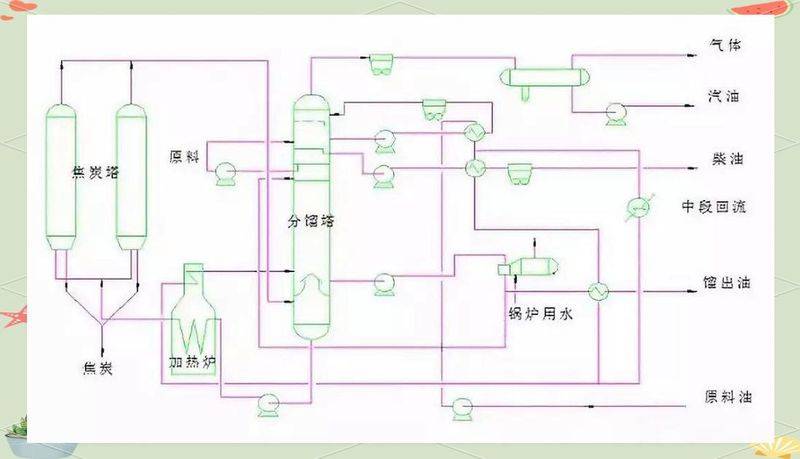
How does crude oil from 2018-05-11 become oil? Why would different processes produce the same material in different products? What's the specifics of each process? The basic route from crude oil to oil is typically: (a) to divide crude oil into different direct distilled fraction oils, as required by the boiling point of the different products, and then to remove the suboptimal components of these fractions, as required by product quality standards; and (b) to generate the required components through chemical reactions, thereby obtaining a range of qualified petroleum products. The processes commonly used for petroleum refining are constant decompression distillation, catalytic fragmentation, delayed focal, hydrogen fibrosis, solvent leaching, hydrogen refining and catalytic restructuring. Common decompression distillation 1. Raw material: crude oil, etc. 2. Products: cedar oil, crude diesel oil (gas oil), slag oil, asphalt, line reduction. 3. Basic concept: constant decompressive distillation is the combination of constant and decompressive distillation and is essentially a physical process: raw oils are divided into oils (referred to as fractions) in different areas of boiling point by evaporation capacity in the distillation towers, and some of these oils are blended, additives are added to the plant in the form of products, and a significant proportion of them are raw materials for subsequent processing units. The constant decompressive distillation is the first process of oil processing at the refinery, referred to as a process of crude oil, consisting of three processes: a. Desalinization, dewatering of crude oil; b. Common pressure distillation; and c. Pressure abatement distillation. 4. Production process: crude oil is generally salty and watery and can cause erosion of equipment, so that it is pre-salinized with desalinized and dehydrated pre-treatment, usually with decomposition and water, prior to entry into constant pressure reduction. The crude oil is formed by flow meters, heat exchangers, distillation towers in two parts, in one part of which it forms tower top oil, through coolers, flow meters, and finally enters the tank area, which is the chemical light oil (so-called plaster oil); in the other part of the base oil, which is formed through heat switching, which enters the compressor, the pressure tower, which forms three parts, and in the other part of diesel fuel, in the other part of the wax oil, in the other part of the tower; and in the other part, through the compressor, which reduces the pressure tower, is further processed to produce a line, wax oil, sludge and asphalt. The respective rates are around 1 per cent for plaster oil (light gasoline or chemical light oil), around 20 per cent for diesel fuel, around 30 per cent for wax oil, around 42 per cent for slag oil and asphalt, and around 5 per cent for the first line. The constant pressure reduction process does not produce gasoline products, in which wax oil and slag oil enters the catalytic crack and produces finished oils such as gasoline, diesel and kerosene; plaster oil is sold directly for the production of solvent oil by other small enterprises or for subsequent deep processing, generally for the catalytic rehabilitation of solvent oils or extraction of extraction compounds; and a reduction line allows direct adjustment of lubricants. 2 only 10 to 40 per cent of the gasoline, light oils such as kerosene and diesel, are available after constant decompressive distillation of crude oil, while the rest are heavy distillation and residual oil. If more light oil is to be obtained, heavy fractions and residual oil must be reprocessed. Catalysing is the process most commonly used to produce gasoline, diesel, which is mainly produced through this process. This is also the most important production chain for petroleum refining firms in general. 1. Raw materials: slag oils and wax oils account for about 70 per cent of the material, and catalytic cracking is generally based on pressure-reducing fraction oils and caracon oils, but as crude oil increases and the demand for light oil increases, most petrochemicals begin to compress the slag oils in the raw materials and even to make them directly from constant slag oils. 2. Products: petrol, diesel, pulp (heavy distillation oil), liquid acetene, liquefied gas; respectively, 42% gasoline, 21. 5% diesel, 5. 8% acetene, 8% liquefied gas and 12% oil. 3. Basic concept: catalysing is the main process for processing heavy oils (e. G., slag oils) into light oils (gas, kerosene, diesel fuel) under the presence of catalysts and is the main secondary processing tool for the refining process. It's a chemical process. 4. Production process: slags and tars go through feedstock oil buffer tanks into lifting tubes, depositioners, regenerators to form hydrocarbons and enter distillation towers. A portion of the gas enters the crude gasoline tower, absorbs the tower, air pressurers enter the condensed tank, and is produced by re-absorbing the tower, stabilization towers and final refining of the gasoline. A portion of the oil and gas is channelled through the distillation towers into the diesel gas tower, which is then refined to produce diesel fuel. A portion of the oil and gas went through the distillation tower into the oil cycle and eventually produced the oil. A portion of the oil and gas is transported through the distillation towers into the liquid hydrocarbon buffer tanks and formed liquid gas via desulphur sorbent tanks, sand filters, water wash tanks, desulphurol pumping towers, pre-alkali washes, mesamine recyclers, desulphurized pumping towers, buffer towers, and finally into the liquid hydrocarbon tanks. Some of the hydrocarbons enter depropane towers through liquid hydrocarbon buffer tanks, reflow towers, deethane towers, pre-propane towers, reflow tanks, and eventually enter the circa ball cans to form liquid propaz. The liquid is reprocessed through further processing in polypropanium workshops. Delayed cocalation (abbreviated) is a deep thermal fissure process and is one of the means of treating slag oil. It is the only process capable of producing oil coke and cannot be replaced by any other process. In particular, the special needs of certain industries for high-quality oil coke have led to a continuing importance of the focal process in the refining industry. 1. Raw materials: delayed cocaling and catalyzing similar decarbonization processes to change the hydrocarbon ratio of oil, which can be heavy oil, slag oil or even asphalt, with lower quality requirements for feedstocks. The main conversion processes for slag oil are delayed cocaling and hydrogen cleavage. 2. Products: the main products are wax oil, diesel fuel, caramel carbon, crude gasoline and some gases, the respective shares being 23-33 per cent wax oil, 22-29 per cent diesel, 15-25 per cent caramel carbon, 8-16 per cent crude gasoline, 7-10 per cent gas and 1-3 per cent external oil. 3. The basic concept of cocalation is the use of depleted hydrogen heavy oils (e. G., depressurized sludge oils, fissure oils, asphalt, etc.) as raw materials for deep-hot fission reactions at high temperatures (400-500°c). A portion of the slag oil is converted into gaseous hydrocarbons and light oils through a crack reaction; another part of the slag oil is converted into coke as a result of the condensation reaction. Because of the weight of the raw materials, which contain a substantial quantity of aromatic hydrocarbons, and because of the more stringent conditions of the focused reaction, the condensed reaction is significant, generating more coke. 4. The production process for the delayed-focal unit of the production process is divided into focal and defolio components, which are continuously operational and defocal. Since industrial installations typically have two or four coke towers, the entire production process remains continuous. A. Preheating crude oil, which is corroded raw material (pressure-reducing slag oil) first into the feedstock buffer tank and then pumped into the heating furnace to heat up to about 340 ~350 °c. B. Preheated crude oil enters the bottom of the distillation tower, where the oil produced by the coke tower is exchanged for heat (not exceeding 400°c at the bottom). C. Raw oil is pumped together with recycled oil from the bottom of the distillation tower, pumped with thermal oil into the radiation section of the heating furnace, heated to the temperature (around 500 °c) required for the cocal reaction, followed by a focal reaction via the four valves entering the coke tower from the bottom. D. The raw materials react in the coke towers to produce coke concentrations in the coke towers, and the oils come from the top of the coke towers into the distillation towers, where they are exchanged for heat with the raw oils, after which they receive gas, gasoline, diesel and wax oil. The bottom cycling oil and raw materials are then re-focused. The underlying principle of heavy oil lightening 4-hydroxide is to alter the relative molecular quality and the hydrocarbon ratio of the oil, which is often carried out simultaneously. There are two ways to change the hydrocarbon ratio of oil: decarbonization and hydrogen. 1. Raw material: 2. Products such as heavy-mass oils: light-mass oils (carine, kerosene, diesel or raw materials for catalysing, fissioning, alkyl) 3. The basic concept of hydrogen cleavage as a hydrogen-added route in the process of oil processing is the recharge of hydrogen gas from the outside to increase the hydrocarbon ratio of oils with the presence of catalysts. Hydrogen cracking is in essence an organic combination of hydrogen-added and catalytic cracking processes that, on the one hand, transform heavy oils into light oils such as gasoline, kerosene and diesel, on the other hand, prevent the generation of large amounts of coke, such as catalytic cracking, and that, on the other hand, the sulphur, chlorine and oxygen compound impurities in the raw materials can be saturated by adding hydrogen. Production processes vary according to the state of the catalyst in the reactor and can be divided into fixed beds, boiling beds and suspended beds. (1) a fixed bed with a hydrogen-fissified fixed bed means that a catalyst in the form of particles is placed in the reactor to form a static catalyst bed. Raw oils and hydrogen gas are warmed up and pressured up to the condition of reaction and enter the response system with hydrogen refining to remove desulphur, nitrogen, oxygen impurities and diolene, followed by hydrogen fissionation. After cooling, separation, pressure relief and distillation, the product for the purpose delivers a device that separates gases containing higher hydrogen (80%, 90%) for use as recycled hydrogen. Unconverted oils (known as tail oils) can be partially, completely or not once passed. (2) the boiled boiled boiled boiled boiled boiled bed (also known as boiled bed) process is a process of hydrogenization by which catalysts with a certain particle size are driven by fluid flow speeds to form gas, liquids, solid three-bed layers, thus allowing full exposure of hydrogen, raw oil and catalysts. Boiled bed processes can treat raw materials with higher metal content and charcoal value (e. G., pressure-reducing slag oil) ... And allow for the deep transformation of heavy oil; but the reaction temperature is high and generally within 400 ~450°c. Such processes are complex and have not yet been industrialized domestically。(3) the hp process is a hydrogen-added process that is refocused to adapt to very poor materials. The rationale is similar to the boiling bed, where the basic processes are pre-mixed with fine powdered catalysts and raw materials, then move up from the bottom to the reactor with hydrogen gas, the catalyst is suspended in liquids for hydro-fissification reactions, and the catalysts flow from the top of the reactor with the product. The unit is capable of processing various types of heavy-quality crude oil and general crude oil slag, but it is heavily invested. The process is currently under development in the country. 5 solvent leachate is a pre-treatment process for poor slag oil. Excavated from the distillation of crude oil, the pressure-reducing slag oil (and sometimes from the constant slag oil) removes the glue and bitumen from the process of refining an oil product that removes the asphalt while producing it. 1. Raw material: heavy oils, such as pressure-reducing oils or oils, 2. 3. The basic concept solvent leachate, such as leachate, is a petroleum refining process for the processing of heavy oil, which is based on heavy oils such as decompressed slag oil, extracted as solvents from hydrocarbons such as propane, butane, which can be used as material for heavy lubricating oils or cracking raw materials, and residual leachate for road asphalt or other uses. Production processes include extraction and solvent recovery. The extracting part generally follows a process of extraction, or a two-part extraction process. There is less propane in asphalt and heavy leachate solutions, more propane in light leachate solutions with a single evaporation and vapour recovery, and more propane in light leachate solutions with multiple evaporation as well as vapour or critical recovery and vapour recovery to reduce energy consumption. The critical recovery process uses propane to reduce energy consumption more by reducing the evaporation condensation of propane by settling and separating light leachate from the bulk of propane in the critical towers at close to the critical temperature and slightly above the critical pressure (96. 8°c for propane and 4. 2 mpa for critical pressure). The domestic solvent leachate process is dominated by the deposition of two sections of the leachate process, the critical recovery leachate process and the supercritical extraction solvent leachate process. (1) two parts of the deposition process, two parts of the deposition process, were developed on the basis of the conventional segment of the leaching process. Based on a study of the specific nature of the pressure-reducing slag oil, it is noted that conventional propane leachate is not fully exploited. This resource, a new leachate process has been developed (2) the solution capacity of the leachate solvent is reduced by temperature and the solvent is reduced to low when temperature and pressure are close to the critical condition, when the propane solvent is cooled and can be recycled directly without evaporated recovery. (3) the ultracritical fluid extraction from the hypercritical solvent leachate process is based on the abnormally balanced properties and abnormal thermodynamic properties of the extraction system near the critical area, which, by altering parameters such as temperature, pressure and so forth, causes a drastic change in the degree of mutual solubility of the components of the system, resulting in the separation of components by the technology 6 plus hydrogen refining means generally that certain petroleum products that do not meet the requirements for use are reprocessed through the hydrogen process to meet specified performance indicators. Precision raw materials: gasoline, diesel, kerosene, lubricants, petroleum wax, etc., which contain more harmful impurities such as sulphur, oxygen, nitrogen, etc. Precision products: refined and modified products such as gasoline, diesel, kerosene, lubricants, petroleum wax, etc. The basic concept of hydrogen refining is a generic term for catalytic modification of various oils under hydrogen pressure. It refers to the hydrolysis of various types of non-hydrocarbon compounds in oils under conditions of a certain temperature and pressure, catalysts and the presence of hydrogen, and thus their removal from oils for the purpose of refining oils. Hydrogen refining is mainly used for the refining of oil, the main purpose of which is to improve the performance of oil use through precision. 4. Processes for hydrogen refining in production processes typically include three components: reaction systems, oil-for-heat generation, cooling, separation systems and recycling hydrogen systems. A. Respond system feedstock oils mixed with new hydrogen, recycled hydrogen, and converted to reaction products for heat, enter the heating furnace in the form of gaseous amalgamation (referred to as pre-compost hydrogen), heating to reaction temperature into the reactor. The reactor input can be either gaseous (when refined gasoline is produced) or gaseous (when refined diesel or oil heavier than diesel is produced). Catalysts within reactors are typically layered for cold hydrogen to control the reaction temperature. Cyclical hydrogen and oil mixtures react with hydrogen through each layer of the catalyst bed. B. Generate oil-for-heating, cooling, separation-system reaction products from the bottom of the reactor and enter the high-pressure separators after they are reheated, cooled. The cooler is preceded by the injection of high pressure washing water into the product in order to dissolve the ammonia and part of the hydrogen sulphide generated by the reaction. The reaction product separates hydrocarbons from the high pressure separators, with the gas being recycled hydrogen, which, in addition to the main component hydrogen, is composed of small quantities of gaseous hydrocarbons (non-condensed) and unsolved hydrogen sulphide; the liquid product is hydrogen-generated oil, which also dissolves small quantities of gaseous hydrocarbons and hydrogen sulfide; the oil is produced by decompression into the low pressure separators and further isolates components of gaseous hydrocarbons and separates products from the distillation system into eligible products. C. A small portion (about 30 per cent) of the recycled hydrogen system that is separated from the high pressure separators and the circular hydrogen compressor is fed directly into the reactor for cold hydrogen, while the remainder is sent to be mixed with raw material oil for recycling in the plant. In order to ensure the purity of the cycle hydrogen and avoid the accumulation of hydrogen sulfide in the system, hydrogen sulfide recovery systems are commonly used. Hydrogen sulfide is generally absorbed with ethanolamine, eugenic fluids (absorption fluids) are recycled, desorbed hydrogen sulfide is sent to sulfur-making devices for recovery, and purified hydrogen gas is recycled. 7 catalysing 1. Main raw materials: prune oils (light gasoline, light chemicals, light stabilization oils), which are generally produced at refineries, and in some cases can also produce the product at station stabilization. The quality of the sulfur is low and the colour is close to colourless. Main products: high octane-value products such as gasoline, benzene, toluene, dibenzo-biphenyl (which are the main raw materials for the production of synthetic plastics, synthetic rubber, synthetic fibres, etc.), and large by-product hydrogen. 3. Basic conceptual reorganization: the reordering of the hydrocarbon molecules into a new molecular structure. Catalysing retrofitting units: using direct retort oil (i. E., plaster oil) or a mixture of secondary processed gasoline as feedstock, and acting as a catalyst (platinum or polymetal), by dehydrocyclicization, hydrogen fissification and isomerization, the hydrocarbon molecules have been rearranged into new molecular structures, with the primary purpose of producing c6-c9 aromatic products or high octane-value gasoline, and using by-product hydrogen for thermal decomposition, delayed charging or diesel refining for secondary processing. 4. The production process, based on the rationale for catalytic restructuring, consists mostly of pre-processing and catalytic restructuring of raw materials in a complete set of industrial devices. Reorganization units for the production of aromatic hydrocarbons also include aromatic extraction and aromatic distillation. A. Pre-treatment of raw materials by cutting the raw materials into distillation range suitable for reorganization requirements and removing impurities harmful to the catalyst. Pre-treatment includes pre-blown arsenic, pre-restillation, pre-helicopteration. B. Catalysing the pre-treated refined oils by rearranging the raw oil molecules at a certain temperature or pressure using a multimetal (polymerium, platinum, platinum) catalyst to produce the main reactions of desalkanes, aromatics, isomerization and so forth, with the aim of increasing aromatic hydrocarbons or increasing the octane value of gasoline. Reaction system processes, which are widely used in industrial restructuring units, can be divided into two main categories: semi-reproductive processes for fixed-bed reactors and continuous processes for mobile bed reactors。