In a variety of scenarios such as industrial motion control, network terminals, vehicle-borne ethernets, the ethernet phy chip is the central hub linking the mac layer to the physical transmission network, whose signal-driven type directly determines the equipment's ability to resist interference, its power-consuming performance, hardware design complexity and long-term operational stability. The dominant phy chips on the market are divided into two main categories, current and voltage, which appear to differ only in signal transmission vehicles, but which differ substantially in terms of underlying working principles, hardware circuit design, practical application scenarios. This paper will take into account the core differences in the analysis of the reasons why the severe current-type phy is more advantageous, while at the same time exposing the state-produced current-type phy to represent the hard nuclear technology power of the product, the fcp114x series。
I. Core differences between current type and voltage phy
The essence of phy is the completion of the conversion of digital and physical transmission signals, and the differences between the two types of chips are rooted in differences between the signal-driven vehicle and the work logic, thus extending the full range of performance, design and cost differences。
1. Differences in rationale
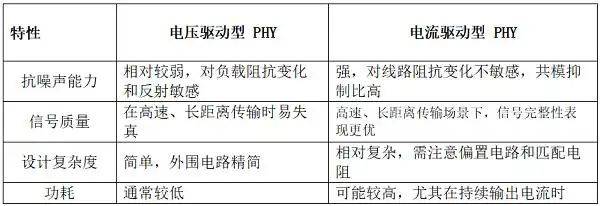
The nature of the current type is different from the voltage type phy, as evidenced by the signal drive:
The current type relies on external voltage source-driven signal currents, which represent data through current changes。
• direct output of voltage signals within the voltage type, expressed as data through voltage changes。
(1) current-mode driver:
The internal equivalent of the current-type phy chip is a constant current source, which can be exported with a preset constant current. This type of chip requires external offset voltage (normally through a network transformer centre pump) and external terminal resistance to convert current signals to transmitable voltage signals。
(2) voltage-mode driver:
The internal equivalent of a voltage phy chip is a voltage source with an autonomous voltage output capability, which can be directly exported to set the level (e. G. 0v, 3. 3v), indicating a logical signal。
2. Hardware design differences
The central sign for distinguishing between two types of phy circuits and for the implementation of hardware design is the connection to the network transformer centre head。
(1) current-driven:
Typical models are: ksz8721, dp83848, lan8740, fcp 1140/2/5
The centre pump must be connected to a power track (avdd or vcc), which provides a biased voltage for the current drive inside phy to form a current circuit. The end-to-ground connection (usually 49. 9 times) must be made between the differential signal lines at the end of the phy to match the electrical resistance used to convert current signals to standard voltage signals, which should be located close to the phy chip。
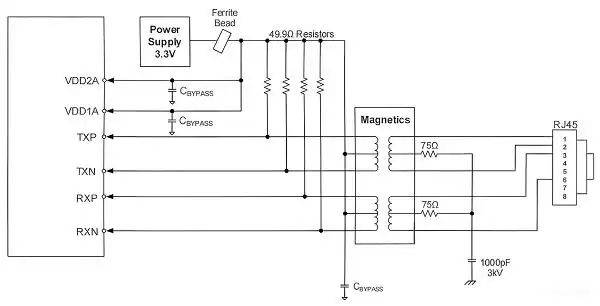
Typical current-type phy-port circuit
(2) pressure-driven:
Typical models are dp83826, adin1200, yt8522, jl1111
The centre's head is connected by an electric capacity. This capacitor provides a low resistance circuit for high frequency signals and acts as a means of communication in direct circulation. Compared to current-type phys, there is usually no need to add terminal matching resistance between the differential signal lines at the phy end (td+/td-), as the chip is usually integrated within (specifically, a comparison of the chip manual description or a comparative reference design)。
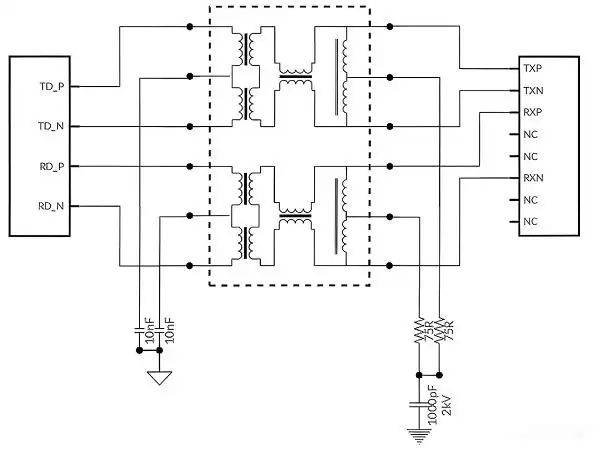
Typical voltage phy portal circuit
3. Apply differences and fit scenarios
Phy, voltage type: suitable for consumption of electronics, general household network, short distance indoor equipment, low cost and easy to debug
• phy, which is suitable for industrial exchanges, on-site bus, ethernets, internet terminals, etc., and which are highly resistant, low-capacity and long-range stability。
Ii. Strength advantage of the core fcp114x series (phy)
The single chip current phy, fcp114x series (fcp1140/fcp1122/fcp1145), designed specifically for the 10/100m ethernet, perfected the core advantages of the current phy, while at the same time providing an in-depth optimization of the industrial landscape to the extreme。
Response to complex electromagnetic environments
The fcp 114x series, driven by the natural advantage of the towed current, has a super strong commodular noise suppression capability, which can guarantee 100 mbps-free transmission at the rate of 100 mbps, even in plant electrical interference, high-voltage equipment radiation, and complex wire beams on board. A combination of hp auto-reverse, direct and cross-grid lines need not be manually switched to further enhance deployment flexibility; internal cable diagnostics, precision detection of network short circuits, break-out and failure positions, reduce on-site transportation costs。
2. Combining energy efficiency and performance
The current-type phy telecommunications stability is excellent, and the fcp 114x series has been refined on this basis:
Compatibility of ieee 802. 3az energy efficiency with ultimatum standards, automatic reduction of power consumption in idle conditions, perfect battery adaptation for power supply, low power consumption network terminals
Flexible power structure, io voltage supports a wide range fit of 1. 8v-3. 3v, with an inner 1. 2v pressurer (disable), which supports both a simple 3. 3v streamlined design for power supply and an external high-efficiency power supply to further reduce system power consumption
Supports routine power outages, energy detection of power outages (edpds) with many low-capacity modes, automatic hibernation when no data is transmitted and prompt response is awakened。
3. Matching demanding scene needs
The fcp114x series does not stop at the basic telecommunications level, but superimposes a number of industrial needs functions: