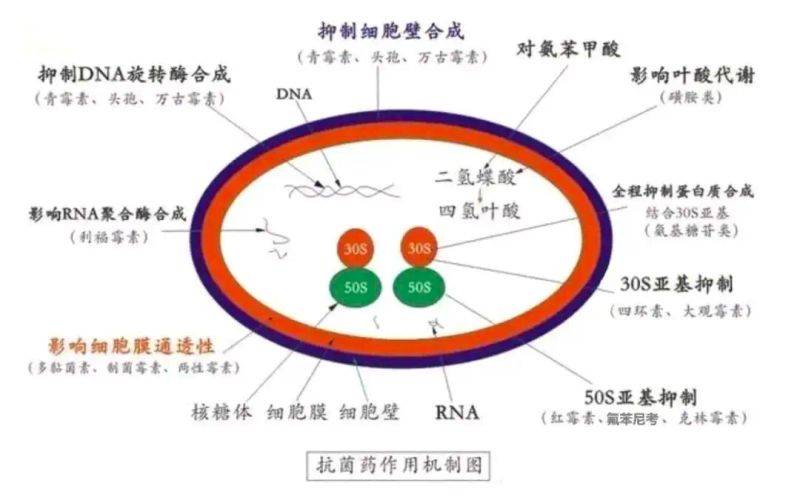
Mechanisms for the functioning of antibacterial drugs
Interrupting the biological and chemical metabolism of bacteria through specific properties affects their structure and function and deprives them of their ability to grow and reproduce normally, thereby inhibiting or killing bacteria。
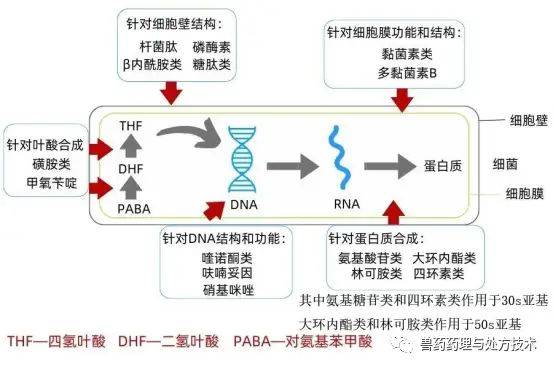
I. Suppression of the synthesis of bacterial cell walls
The bacterial cell wall is located outside the cell membrane and is a resilient structure that sustains the integrity of the shape of the bacterial cell ... It adapts to diverse environmental changes and interacts with the organism. Human cells, on the other hand, have no cell walls, which is why antibacterial drugs that inhibit the synthesis of bacterial cells are virtually non-toxic to human cells。
Penicillin, fascinin, phosphoxin, cyclic carcinide, vancin, bacterium, etc. Play a role by inhibiting cell wall synthesis. The chemical structure of penicillin is similar to the chemical structure of the capiscin, which is an antibiotic of beta-neamide, one of the mechanisms used is to combine penicillin with proteins, to inhibit transmutation, to hinder the interlinking of the peptide, to cause bacterial cell walls to fail, to lose the barrier, to enter cells with extraterrestrial water, to cause bacterium cell swelling, deformation, and to break up, and therefore to inhibit the synthesis of bacterial cell walls is a fungicide。
Ii. Changing the permeability of the cytogenesis
Pyramid antibiotics, such as polymixin e, contain several anionoid polar cells and a fatty acid straight chain, which combines the anion with phosphorus in the uterus, which impairs the membrane function and causes bacterial deaths due to the presence of bacterial substances; anti-facter sexcin b combines selectively with the ectosterol in the fungal cell membrane, forming a hole, changing the membrane permeability, resulting in the death of fungal proteins, amino acids, nucleic acids, etc。
Iii. Depressing protein synthesis
Nutrient sugar is the site of protein synthesis. The bacterial nuclei are 70s nuclei complexes and can be detached to 50s and 30s yaki. For human cells, the nuclei are 80s, and the nuclei complex is detached from 60s and 40s. The nucleus of human cells differ from the biological, biological and chemical functions of bacterial nuclei, so anti-bacterial drugs can selectively affect the synthesis of bacterial proteins without affecting human cell functions。
The synthesis of bacterial proteins consists of three stages of initiation, extension of the platinum chain and termination of synthesis, carried out through the nucleo-glucose cycle in the mother's body. The drugs inhibiting the synthesis of proteins act in different stages of the synthesis of bacteria:
1 initial phase: amino-antibiotic inhibition of 30-syaki and 50-sysiki synthetic kinetic compounds
2 pyramid chain extension: tetracycline, antibiotics combined with a nucleus 30s-a, preventing the combination of aminomate trna in 30s, or a, hindering the formation of a pelican chain and thus inhibiting the synthesis of proteins; chloroacin and choccocin inhibiting lysergic transfer enzymes; large ring ester inhibiting transposition enzymes
3 ending phase: amino-antibiotics prevent the termination factor from combining with level a and prevent the synthetic aluminum chain from being released from the nuclei, hindering the nuclei cycle and synthesis of abnormal, non-functional apricotal chains, thus contributing to microbicide。
Iv. Impacts on nucleic acid and folic acid metabolism
The quinone type inhibits bacterial dna spinase, thereby inhibiting bacterial dna reproduction, inhibiting the bacteria from being bacterified; and the rna polypolytic enzyme, on which bacteriaal dna is dependent, is inhibited by the lephopinian heterogeneity, hindering the synthesis of mrna and destroying bacteria。
Bacteria do not use folic acid in the environment, but must synthesize their own folic acid for use in bacteria. Bacteria are fed by gills, aminophosphate, dihydrocillic acid is produced by dihydroflurate, dihydroflyl acid and aziny acid are produced by dihydrofolate, tetrahydrofolate is formed by dihydrofolate, and tetrahydrofolate is used as an adjoining enzyme for a unit of carbon。
Sulfamide is similar to the structure of ammonium benzoate and competes with ammonium benzoate for dihydrobutyric acid enzyme, which affects folic acid metabolism in bacteria and prevents bacteria from growing and breeding due to lack of nucleotide synthesis in bacteria。
Use rules
I. Rational use of antibiotics
The use of appropriate antibacterials is explicitly indicated and appropriate doses and treatments are used to achieve the killing of pathogenic organisms and control of infections, together with measures to increase the immune capacity of patients and prevent adverse reactions, in particular to avoid bacterial resistance。
Ii. Aspects of the unreasonable use of antibacterials
Optimal drugs that are ineffective or infective; insufficient or excessive quantities; continued drug use after the fungi has produced resistance; premature withdrawal or infection control has taken many days without timely stoppage; failure to convert to other effective drugs in the case of secondary infections of resistant bacteria; incorrect delivery of drugs; continued use of drugs in the event of serious or allergic reactions; inappropriate joint application of antibacterials; neglect of essential surgical treatments based on antibacter resistance; no indication or indication of unwanted preventive drugs; neglect of therapeutic efficacy/price ratios。
Iii. Implications of rational use of medicines
Adaptive conditions for the application of antibacterials and combinations; antibacterial aerodynamics and drug ergonomics; anti-infection experience; antibacterial doses, treatment and delivery methods; antibacterial reactions and prevention; bacterial resistance and prevention; application of antibacterials in special cases, etc。
Basic principles for antibacterial applications
Early establishment of pathological diagnosis of infectious diseases。
2. Adaptive disorders, antibacterial activity, pharmacokinetics and adverse reactions familiar with selected drugs。
3. Reasonable use of medication in accordance with the patient's state of physical, pathological and immune status。
4. Reasonable use of commonly used antibiotics。
5. Select appropriate delivery programmes, doses and treatment procedures。
6. The application of antibacterials is subject to strict control or is avoided to the greatest extent possible in cases of: local drugs for preventive medicine, skin, mucous membrane; persons whose causes of infection or fever are unknown; and joint antibacterial drugs。
7. Emphasize the importance of comprehensive treatment
V. Empirical application of antibiotics
The early application of antibacterials for empirical anti-infection treatment is important when pathogen is not known; the selection of broad spectrum antibacterials is used to maximize the use of microbicides; in serious infections, combinations are often used, with common fungicides such as β-nitriamide, aminoquinone, hydroquinone, polyazole, etc.; and in specific infections: sulfamide, clinoxin, nitrazine, and leifou applications are more widespread. In the empirical application of antibiotics, potential pathogens should be judged on the basis of clinical information. Different broad spectrum antibacterial drugs vary in terms of antibacterial activity, and antibacterials should be selected on the basis of such factors as drug adaptability, antibacterial activity and resistance variability。