I. Targets or applicable conditions for forests
The model is applicable to the dominant function, which combines eco-efficient breeding objectives with the precious species-fatal neptunium business model. In terms of the geographical distribution of eucalyptus trees and sauerkraut, the areas suitable for cultivation are mainly in guangxi, guangdong, hainan and fujian in the south of the country. In terms of ground conditions, it applies to the 150-350 m low-altitude hilllands, with the development of acidy red, yellow or red borders made of granite, sand shale, etc., which grow more rapidly in deep-dry, well-watered and fertile soil。
Target forests
In the preceding period, we have constructed the same-age mix of sauerkraut and euphoria trees, harvested small run-off materials from the euphoria tree through three harvests, and in the later stages we have been able to eliminate jamming trees by selecting, nurturing and choosing the target tree, making full use of natural renewals, gradually channeling the forest into near natural forests, which have a mixed structure dominated by sauerkraut, and euphemism to achieve sustainable forest cover (50 cm or more). A “long-term, short-term benefit combination” and “economic and eco-efficiency convergence” approach is used for the short-term harvesting of eucalyptus trees, with three harvests of >300 m3/hm2 > small run-off > 300 m3/hm2 and the development of valuable tree species of low-value halom, with a forest fraction density target of 150 - 225 / hm2 and a reduction of harvest savings of > 300 m3/ hm2 for sustainable forest management。
Iii. Full-cycle nurturing process schedule (characterized by time process)
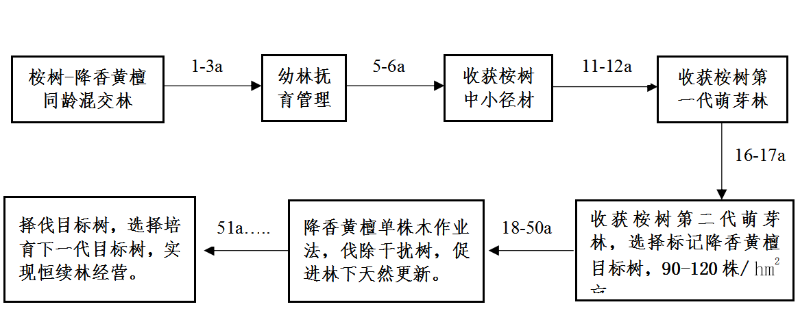
1. 0 - 3 years: construction of a mixed scavenger-fast scavenger forest, with a one-year-old scavenger type of tree, using a broad-line 4 m wide and a narrow 2 m narrow line; afforestation density of 840 scavengers/hm2 and 1665 scavengers/hm2; three years of continuous weeding after afforestation, fertilization of a herb tree, and a good drying of scavengers for scavenging scavengers; strengthening of new scavengers to avoid interference and destruction by human animals。
2. 6-16 years: in the 6th, 11th and 16th harvests of eucalyptus trees, care is taken to protect the aroma from damage; after the apricot harvest, the apricot sprouts are managed and the apricot tree is breeched for two years and fertilized twice; in the 16th year, the target tree 90-120/hm2 of the apricot tree was marked and operated using the target tree method, cutting off the jamming trees, and reforming the target tree up to 5 m or more。
3. 16 years later: every five years or so, as a manager period, the trees are constantly cut down around the saloon target tree, providing a good growth environment for the saloon target tree, promoting natural renewal under the forest, and the target tree with a chest size of up to 50 cm after harvesting, gradually forming a near natural forest, mainly for saloon. The target of the herring is greater than 50 cm in diameter and the breeding cycle is greater than 60 years。
Iv. Demonstration of small forest class practices
1. Status of forests
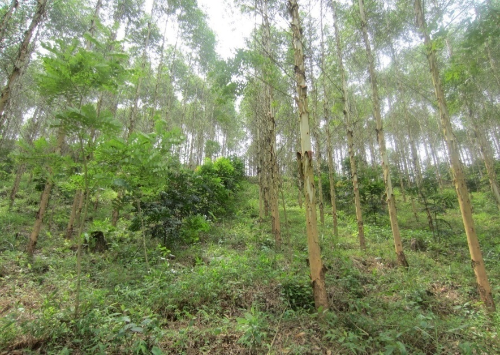
The model forest, located at the qingshan experiment centre of linko college, china, covering an area of 96 acres, has now completed its first budding forest harvest, with a concentration of 1575 / hm2 trees, a reduction of 795 / hm2 safroles and an average tree height of 2. 2 m; an average tree height of 6. 9 m, an average chest size of 5. 6 cm, an average tree height of 1 m per year and an average chest growth of 0. 8 cm per year。
Business history
In 2010, mixed forests were formed using a wide-banded 4m wide and 2m narrow; afforestation density was 840 / hm2 down on a herring, and 1665 /hm2 on a herring tree; caves were specified at 50 cm x 50 cm x 30 cm, with a tree type being a year-old container. After afforestation, the scavenging pits were raised for three consecutive years; fertilized the eucalyptus tree twice, and scavengers were plugged in and reformed. The first generation of eucalyptus was harvested in 2016, with a second generation of budding forests being nurtured, with a seedling of up to 1 m doing a planting exercise and fertilizing, and re-forming the sauerkraut。
3. Target forest phase
In the early stages of the construction of a co-mingled forest of the same age as the sauerkraut tree, which was rapidly growing in a shaded environment, favourable conditions were created for its growth. Circumpolarally run eucalyptus forests and green forests are dynamically run from fast-growing forests to top-class communities, leading to the formation of near-natural forests with an inter-age complex structure dominated by the reduction of falconium. Under the “long-term, short-term benefits combination” approach, shear trees are harvested in the short term, with three harvests of small track >300 m3/hm2 in herring trees; and shelve valuable species with high-value track materials, with a target of 150 - 225 herbal forests/hm2 and a target diameter of 50 cm, with a target tree (90 - 120/hm2) yield of 300 m3/ hm2。
4. Design of a full-cycle culture process
V. Rationale of the operation
Based on the restoration of ecological principles and near-natural forest business theory, combining the biological and ecological characteristics of different species, using eucalyptus as a pioneer species (growth speed, canopy), using tree crown shades to protect precious species from flavouring (with biological nitrogen fixation, larvae tolerance in the larvae, and moderate oscillation in favour of good dry formation) and operating dynamically from fast-born forests to top-class forests through the cyclical operation of euphoria and seedling forests, to achieve the goal of “short-term integration ... With short-term breeding” and to develop it into a stable and high-yielding top or transition forest for sustainable operation。