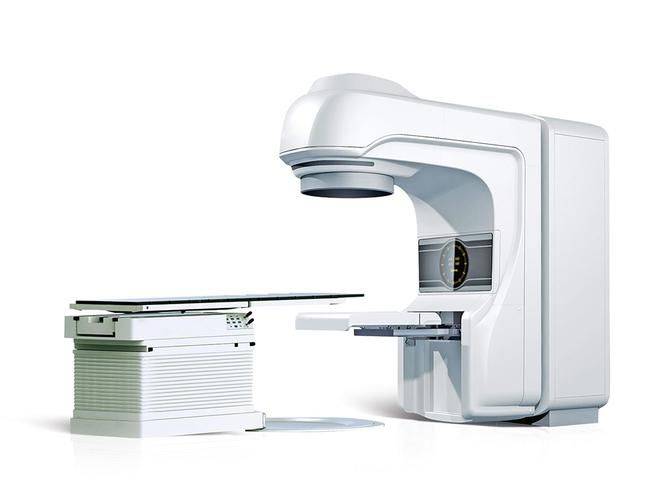
(b) accelerator-carrying-carrying particles (e. G. Electronics, protons, etc.) – subject to electrical field power, increased speed and increased energy; in relativist theory, any particle can only reach the speed of light indefinitely and can never exceed the speed of light e = mc2=−() of which e is an acceleration energy, e is a static energy, v is a particle velocity, c is classified as a medical accelerator at an accelerator at an accelerator of an acceleration particle type by c — electronic straight-line accelerator: output photo-electronic — electron, energy adjustable, treatment flexibility, new technology development fast — electronic accelerator: all characteristics of a straight-line accelerator, magnetic deflection control electronic target direction, x-rays of varying strength, x-rays with x/e sharp/tonic function. Mechanical complex proton/heavy particle accelerator: prague peak accelerator: straight line, rotation use: accelerator (type, rotation) designed to provide diagnostic nuclides to pet 4 medical electronic straight accelerator (type accelerator) electronic straight accelerator is an accelerator using microwave technology to accelerate electrons with a straight-line motion orbit. Accelerator methods: accelerator mode — accelerator field moving forward with accelerator electronics — accelerator — elekta accelerator (meda) is a representative of the accelerator mode — establishment of multi-stage accelerator, e-subaccelerator — wave accelerator — varian, simens — 5 e-line accelerator basic works under unified and coordinated control of the high-pressure pulse-modulation system, on the one hand, “microwave source” injects microwave power into the accelerator tube and establishes a dynamic accelerator field; on the other hand, “electronic gun” discharges electronics in the accelerator tube in a timely manner. The phase of the electron and dynamic electric field and the speed of progress (walk wave) or exchange (wave-based) are accelerating and obtain the required electronic energy. Accelerated electrons are exported from the window of the deflection and radiation system for high-energy electro-rays and, if targeted, high-energy x-rays. Core three components: accelerator microwave system: generation, transmission, control of microwave frequency in treatment range e-launching system: control of the number, angle, speed, timing of electrical launch; eight assistive systems: 1. High-pressure pulse-modulation system 2. Vacuum system – maintaining a high vacuum in the area of electronic motion and in the accelerator tube (avoidance of electro-oxidation; loss of energy from electronic collisions with air; polar fire) 3. Beam flow control system — electronic beam focus, medium, bias; 4 radiometric system — all-out electronics or x-band conversion and average-out; temperature automatic control system 8. Speeding up the flow of the electro-trading system vela vel (acceregnation of the speed of the speed of the flow) the acceleration of the field and the acceleration of electronics moving forward can be sustained and energy enhanced. *the internal voltage of the metal drums is equal, the internal electric field is zero, and the electron can only accelerate at an acceleration of the d. It was therefore suggested that the acceleration principle would be called the “walk acceleration principle” if it were to be combined with the electronic movement to keep the electronics in d. Question: how can we sustain energy growth when electron quality is low and electronic speed is close to light speed when dozens of kevs accelerate? Microwave acceleration radar applications found that microwaves can stimulate an electric field with a vertical mass (tm01) in a round wave tube and can be used to accelerate electronics; their field distribution is as shown in the figure: but the field spreads "phase speed" more than light speed in a round wave conduit; to use the field for synchronized acceleration of electronics, it is necessary to reduce the pace of the transmission of the electric field. < < light speed < v electron speed = v < light speed ppm phase velocity indicates the speed at which the phase moves in the direction of transmissiona (b) the establishment of the θb11 wave acceleration field: the cyclical insertion of perforated circular membranes in the round-wave catheter, changing the synthesis conditions of the tilt and reflection waves, slowing down the electromagnetic field and achieving a synchronous acceleration of the electron, described as: during the synchronous acceleration process, electronics are moving faster and faster in the direction of the wave field, which is designed to spread faster and faster when the electronic speed is approaching the speed of light, the speed of the wave can be designed to be equal to the speed of light and the maintenance of the electron remains near the peak. In that sense, electronics seem to move around the peaks, gaining constant energy. 15 the wavehouse field follows the increased speed tube axle, changes the rules of the time 16 accelerator tube longitudinal flow characteristic λλab17 electrons accelerate (energy) process within the wave accelerator: the kinetic power of the gill electrons is about 10-40 kev, at a rate of 0. 17-0. 37c; the gill acceleration to 1-2mev is about 0. 94-0. 98c, with an increase in the back energy and a slow increase; and the electron speed is about 0. 99 c, with a constant electric wave rate equal to the speed of light and an increase in energy. 18 autostructivity: theoretically, wave speed can be synchronized with the acceleration of the electron, which is in fact impossible, with the electron being slightly faster or slightly slower than the electric field. Relatively synchronized, absolutely slippery. The electron velocity that is injected into the accelerator tube is hardly the same as the initial speed of the wave, and cannot be injected simultaneously to the same phase: during the accelerator setting, it is not possible to maintain an absolute equivalent of the accelerator theory that only electrons within a phase of 1/2 accelerators can achieve an "automatic steady acceleration" effect. The interlocking principle and the interlocking unit: the frequency of electron injection cannot keep pace with changes in the wave field, with tens of thousands of electromagnetic oscillations within an electron injection pulse, the electron being evenly distributed at each phase of the wave, with only one quarter acceleration phase requiring the deployment of the interlocking unit in accordance with the automatic steady phase principle. Zirconium is generally located at the beginning of the accelerator, in a cluster segment, where the injected electrons form an electronic beam by grouping, where the balance position of the phase is reasonably balanced and the speed is gradually increasing and the energy continues to increase after entering the main accelerator segment. Electronic capture factor: 70% - 80% 20-line wave-accelerator tube structure thallium is a disk-charged wave guide, i. E., a circular disc with intermediate beams in a smooth round-wave conduit with a certain pattern, which reduces the speed of the wave, which is a slow-wave structure. Based on the characteristics of the wave field being synchronized with the accelerator electron, the line voltage speed booster is typically designed in the first and second two segments: pre-acceleration segment (column segment): the charge distance set in the preceding paragraph is closer and the stimulating wave field phase is slower to meet the synchronous acceleration conditions when the electron initial speed is slower; the initial paragraph also provides for the interpositioning of electrons into the injection accelerator; main acceleration segment: when electron energy reaches 2mev, because its speed is close to the speed of light, the phase of the wave field does not need to increase to equal the speed of light, so that a flat-structured charge wave guide can continuously accelerate the electron. 21 the geometric dimensions of the charger are critical to the technology of the waver accelerator, which determines the internal diameter, thickness, aperture and spacing of the wavemagnetic field and the distribution of the phase accelerator according to parameters such as the required microwave frequency and the speed of the wave field phase (cm level)。the difference between the gill and membrane inner diameter affects the speed of the wave field, the larger the phase, the slower; the smaller the phase, the faster. membrane aperture 2a (generally 0. 1 ~ 0. 13 wavelengths) depends on the strength of the field (the gradient of the field) and the amount of the aperture is smaller; however, the colour spread is severe and the frequency is difficult. The membrane spacingd has a significant impact on the intensity of the wave field and the higher the power of the wave field, the closer the microwave power is used, and the best distance is present: there are between 3 and 4 modules per wavelength and it is subject to the working mode (one quarter of a wavelength of one quarter of a wavelength of two thirds of a wavelength. motion thickness t has a small effect on phase velocity and is typically 2-6 mm thick (depending on mechanical strength and high-frequency shock penetration) is the primary feature of the 22-line wave accelerator tube, the first parameter to be identified: the conversion of microwave energy to electro-beam energy 1 dispersional feature the presence of different phase velocity (allowing range of rated power, multiple random reflections) and the simultaneous forward transmission of the wave accelerator characteristic to minimize its inherent properties. When a value is fixed, the smaller the wavelength, the weaker it is. 2 microwave power conversion to electronic beam output energy (40%) + accelerator wall energy consumption (50%) + remaining (10%) accelerator tube conversion efficiency: accelerator-output electronic beam-carrying energy/injection microwave power (energy) the 23-line accelerator is a schematic of microwave power from microwave power sources that is fed back through the wave-guided transmission system to the accelerator, creating a start-up wave accelerator field, keeping it synchronized by controlling the speed of the electron, which is like riding on the peak of the wave, moving in parallel with the wave, and is constantly accelerating. The remaining power of the wave is absorbed by the water load through the output coupling. The central hole of the disc is a microwave and electronic beam channel. Shortcomings of 24-line wave acceleration are based on one of the disadvantages of the acoustic wave-guided accelerator piping: a decline in the field strength index: a low average energy gain in the length of the unit, a long total length, a large volume (roller structure) wave loss of two: a 25-stop accelerator method at the end of 10 per cent of microwave power at the end of the line theoretic model: an exchange of dynamic field "relay" acceleration methods objects a series of cylinder poles with the same frequency power sources, and a reasonable adjustment of the distance between the frequency and the suture, allowing the electronic to accelerate continuously. 26 wave-based characteristics27 wave-based accelerator tube28 improvements: the end end of the accelerator tube does not match the load, while the short surface allows microwave reflection at the end, the reflecting microwave moves in the reverse direction of the electron accelerator, and if the accelerator structure is also located at the beginning, the above-mentioned reflectivity is re-reflected at the beginning, and if the length of the accelerator tube is appropriate, the reflection wave and the inflow wave phase is aligned, increasing the input wave and forming a stationary state within the accelerator. • accelerator energy in units of length increased significantly and the length of the accelerator tube was short. Small size: construction of a branch structure of 29 in the wave field establishment of a wave field consisting of positive and reverse wave waves synchronized acceleration conditions: adjacent acoustic field strength and direction have been replaced interchangeably, electronics have been at an acceleration phase and electronic energy has continued to increase. = the time of the electron crossing a cavity equals the time of transformation in the direction of the field strength, i. E. The half-cycle of the cylindrical wave at wave oscillation is co-ming in reverse, the microwave frequency is high, the single-frequency radium field does not advance in parallel with the accelerated electron, there is no slide and no automatic stabilization problem the acceleration process loses electronics, is free of clustering, has a dispersive effect, captures less than 30% efficiency — solutions: accelerates the monochrome structure of the tube by increasing the initial speed of the electron to near the speed of light, mainly by accelerating the energy plume, but the output electron is a high-energy dispersion. • resolution