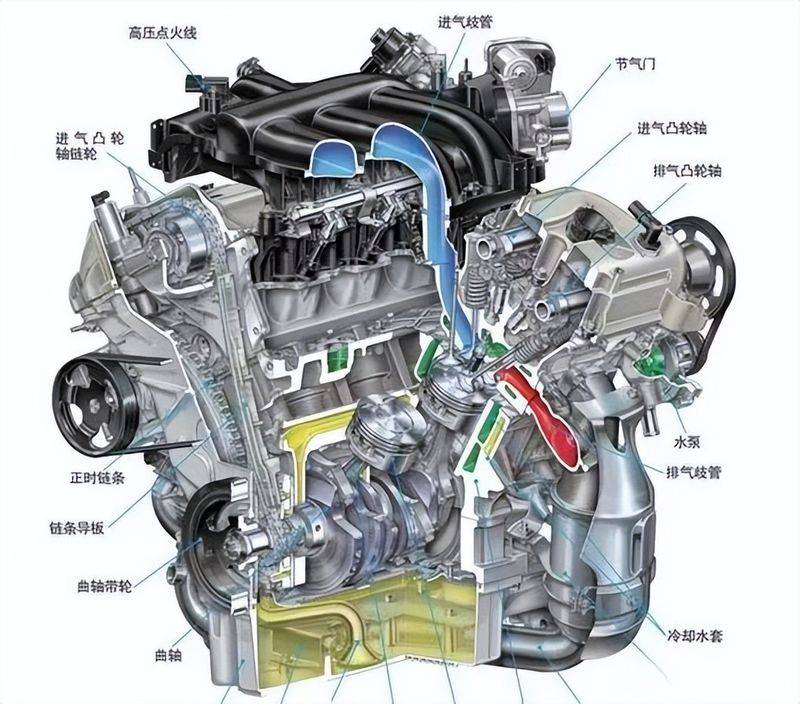
Section i. Basic terms for engines
1. Stopping point: means the widest distance from the top of the piston at the centre of the rectangular axis, i. E. The highest position of the piston。
2. Downpoint: means the nearest, or lowest, position of the piston at the centre of the decorative axis of the top of the piston。
3. Pistol process (s): points the distance between the upper and lower stop points, corresponding to 180° for each journey。
4. Curve axis radius (r): distance between the pointer axis and the connecting centre at the lower end of the pole to the centre of the curve axis。
5. Work volume of cylinders (vh): means space volume from top to bottom of piston。
6. Combustion chamber volume (vc): means the space volume on top of the piston when the piston stops。
7. Total volume (va): means the volume of space on top of the piston when the piston ends. Va = vc+vh
8. Engine charge: pistols cleaned from top to bottom are referred to as tank charge or tank work yon
Quantities, as indicated by the symbol vs, the sum of the volume of work in the various cylinders of the multi-cylinder engine, called engine charge, with the symbol vl(l)
Means vl = πd 2 si/4x10 6d for cylinder diameter (mm); s for piston process (mm); i for cylinder number;
9. Compression ratio (ε): the ratio of the total volume of the cylinder to that of the combustion chamber。
=va / vc = (vh + vc) / vc = 1 + vh / vc
10. Valid power: the power of the engine exported externally through a ship is called a power power, expressed in pe in kw。
Pe = te. N/9550 te is a valid rectangular (n. M.); n curvature (r/ min)。
11. Fuel consumption rate: means the quality of fuel consumed in 1h per 1kw effective power for each engine
It's a unit. Be=bx10 3 /peb fuel consumption (kg/h) in unit time for engines, and pe is power for engines
Section ii classification of engines
Internal combustion engines can be divided into two main categories of piston internal combustion and gas turbines, depending on the form of the main components that convert thermal energy into mechanical energy. The former can also be divided into a double piston and a rotating piston. Combustion internal combustion engines are most widely used in cars, and are currently the type of engines produced by most companies. Automobiles can be classified according to different characteristics。
(1) depending on the fuel classification used, it can be divided into liquid fuel engines (gas, diesel, etc.) and gas fuel engines (e. G. Natural gas engines, liquefied petroleum gas engines, etc.)
(2) categorized by ignition, can be divided into pressurized and ignited engines。
Diesel is characterized as having a self-fired point that is lower than that of gasoline under the same conditions and is therefore activated by a pressure-fired (self-fired) ignition. Diesel can normally be injected directly into the tank of the engine, which is mixed evenly with the compressed air, and is self-fired at high temperatures, known as the pressurized engine。
Gasoline is characterized by a higher self-burning temperature than diesel fuel, and therefore a ignition is used. (b) force the ignition of gasoline with spark plugs, known as ignition engines。
(3) within engines, each conversion of thermal energy to mechanical energy must be carried out by inhaling, compressing and inputting fuel so that it can burn and expand and then exclude the generation of exhaust gas from a series of processes called a work cycle. Where the piston goes to four single layers, it completes a four-string engine, and the piston goes to two single layers, it completes a two-string engine。
(4) by the number of cylinders and the way they are organized, there is only one tank called single-cylinder engine and two or more cylinders called multicylinder engines. There is a straight column and a v。
(5) classify by cooling mode, depending on the cooling mode, allowing for water and wind cooling。
Section three. Four-string engine work
I. Rationale for the 4-string petrol machine
The work cycle of the 4-stroke engine consists of four pistons, i. E., gas, compressed, functional and exhaust。
(1) gas intake process burn indoor inhalation of air and injection of gasoline. In the air, the gas door opens and the vent door closes. As the piston moves from its top stop point down, the volume of the cylinder above the piston increases, thus reducing the pressure in the cylinder to below atmospheric pressure, i. E. Creating a vacuum pressure in the cylinder. In this way, combustible gas is inhaled through gas pipelines and gas doors. The gas pressure in the gas tank at the end of the inflow is approximately 0. 075 ~ 0. 09 mpa. Flammable blends of gas that flow into the cylinders because of exposure to the surfaces of high-temperature machines, such as the walls and pistons, and mixing with the high-temperature residual gases left in the previous cycle, the temperature rises to 370-400k。
(2) the compression process is required to reduce the volume, density and temperature of the combustible mixture of gas that is inhaled in the cylinders in such a way as to allow for rapid combustion in order to generate greater pressure, so that the engine can generate greater power, which must be compressed before combustion. In the process, the entry and exhaust doors are closed, and the warp drives the pistons upwards from the bottom stop, which is known as the compressed journey. At this point, the mixed gas was compressed to a very small space above the piston, i. E. In the combustion chamber. Flammable mixed gas pressure pc rises to 0. 6 to 1. 2 mpa with a temperature of 600 to 700 k。
(3) during this journey, the inflow door remains closed. As the piston approaches the upper end. The spark plugs on the hood of the gas tank send out electric sparks that ignite compressed combustible gas. Following the combustion of combustible gas, large amounts of thermal energy are released, with a rapidly increasing pressure and temperature of about 3-5 mpa and a corresponding temperature of 2,200 to 2,800 k. High-temperature, high-pressure gas boosts the piston movement from top to bottom, rotates arcs and outputs mechanical energy through a pole. In addition to maintaining the engine itself to continue its exercise, the rest is used for external functions, with an increase in the volume of the cylinders, a decrease in the pressure and temperature of the cylinders, a decrease in pressure to 0. 3 to 0. 5 mpa and a decrease in temperature to 1,300 to 1600 k。
(4) the exhaust gas generated by the combustion of a combustible gas shall be removed from the cylinder in order to continue its compulsory discharge into the atmosphere after the lower point and then move up. When the piston reaches the upper end, the exhaust process ends and the pressure in the cylinder is slightly higher than that in the atmosphere during the venting process, about 0. 105 ~ 0. 115 mpa. At the end of the exhaust, the exhaust temperature was about 900 to 1200 k. Due to the size of the combustion chamber, it was not possible to exhaust the exhaust at the end of the vent, which left a portion of the gas called residual。
Based on the above, the four-scrambling petrol machine completes one cycle through the four-scrambling, compressed, functional, exhausting. During this period, the pistons moved back and forth over four journeys and the curves rotated for two weeks。