


Helium (he) is a depleted and scarce natural resource that is widely used in areas such as aerospace, nuclear industry and is an irreplaceable strategic resource for national security and the development of high-technology industries. As a poor helium country, helium reserves account for only 2. 1 per cent of global reserves and its supply is mainly dependent on imports, with external dependence of over 98 per cent. At present, helium is found mainly in the form of natural gas in the basins of mew, sichuan and tari wood, of which sichuan is far from being the only gas field to date to have industrialization of helium. In order to secure the supply of helium, the new type of helium resource, water soluble helium in geothermal systems, has received widespread attention in recent years. India has achieved the industrial production of helium extraction from geothermal fluids, and the exploitation of helium in our helium-rich geothermal system would greatly improve the condition of helium poverty。
The helium content of the helium-rich helium system is 1. 54 vol. Per cent, which is the highest helium concentration currently found in the western part of the tibetan plateau, exceeding the helium field (he=0. 25 vol. Per cent) and well above the industrialization standard for helium use (he=0. 05 – 0. 1 vol. Per cent). However, the current cause studies for helium-rich geothermal systems are very limited, thus limiting the exploration, exploitation and evaluation of helium-rich geothermal resources。
In response to these problems, the vice-researcher of lee yanyan of the chinese academy of geology (first author, co-news), the researcher of zhao ping of the qingzhi plateau institute of the chinese academy of sciences (co-news), doji of the geological mineral survey and development agency of the tibet autonomous region, and zhang shigeo of the fifth geological survey of the tibet autonomous region carried out a detailed field geological survey of the helium-rich helium display area of the public, and carried out systematic and comprehensive sampling and analysis, which resulted in the following results and awareness:
(1) the water chemistry type of the helium-rich helium geothermal system is na-hco3-cl, and the water-rock reaction is the main geochemical process that controls its formation; thermal temperature is 106-118°c, which belongs to the meso-temperature geothermal system, and the heat-storage is a white-coloured granite; the helium-helium heat fluid is derived from atmospheric precipitation and ice-melting water at an altitude of approximately 5366 m。
(2) the water solubility helium is expressed as a shell source characteristic, and a comparative study of different bodies of rock found the highest levels of u, th and k of white granite exposed in the study area, considering the high radioactive granite to be helium. In addition, the rock has a high radiogenic heat rate of 5. 24 mw/m3 and is therefore the main source of heat for helium-rich geothermal systems。
(3) since its formation, helium has been better preserved by the protection of sandstones, gravel rock, mixed masons and the new generation of masons by producing helium through radioactive decay. Since the dawn of the middle and new world, the rise of the tibetan plateau has been accompanied by a permeability of precipitation in the atmosphere along the main fractures, absorbing thermal energy released by the decay of radioactive elements on the one hand and dissolving helium to form helium-rich thermal fluids on the other. Since the time of renewal, new construction activities have accelerated the deep cycle of atmospheric precipitation and, when the cycle reaches a certain level, helium-rich thermal fluids move up along the main fractures, ejecting from the surface into surface heat displays such as hot springs and springs. High-level radioactive rock bodies, tectonic systems and surface heat displays are considered to be indicators of the search for helium-rich geothermal resources。
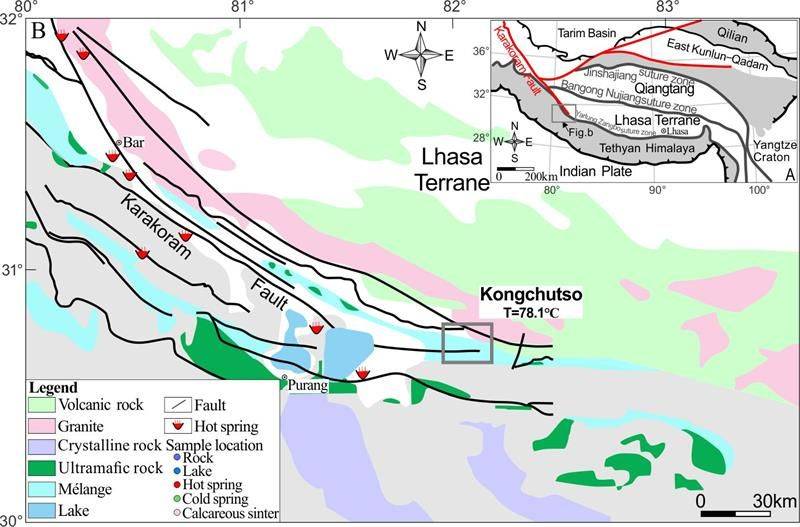
Figure 1 (a) land tectonic patterns in the tibetan plateau (modified from liu et al., 2010; xu zhiqin et al., 2011); (b) geological summary map of the western section of the junction of the jarucheb river and location of the study area (modified from liu et al., 2010; liu fei et al., 2020)
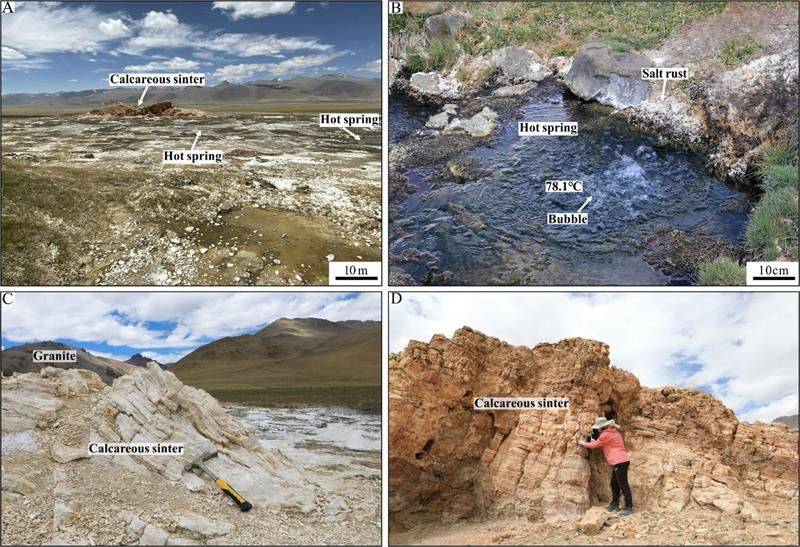
Figure 2
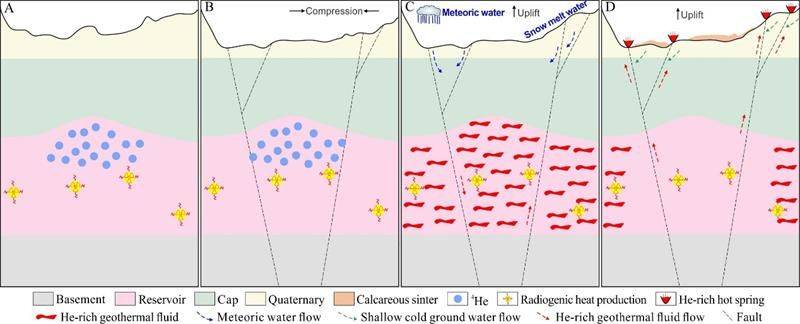
Figure 3: distortion of helium-rich geothermal system
The results of this study are important indicators for the evaluation and exploration and exploitation of helium resources of helium-rich helium-rich helium systems. The study was co-financed by the ministry of science and technology in its second research project on integrated scientific study of the tibetan plateau (2019qkk0804) and by the national fund for natural sciences (u21a2015, 42002299). The results were published online in march 2024 in geohermics, an internationally renowned journal of geothermal science, with the following information:
Li, y. Y., zhao, p., dor, j., zhang, h. C., 2024. Multi-isotopes (h, o, sr, and li) and element geochemistry coNo, no, no, noHelium-rich field in western tibet, china.
Full text link: https://doi. Org/10. 1016/j. Geothermics. 2024. 102986.



