


The difference between black and white cameras and colour cameras is, in short, between qualitative quantitative analyses and the application of dirty patterns。

One, color camera core
In 1974, bryce bayer, an engineer at koda, proposed a new scheme to set up a colour filter array (color filter array, cfa) in front of the image sensors, with single colour filters placed on each pixel at intervals. This allows each channel to get a picture of a part of the missing value and then fills the value of the vacancy through various plug-ins, leading to colour images。
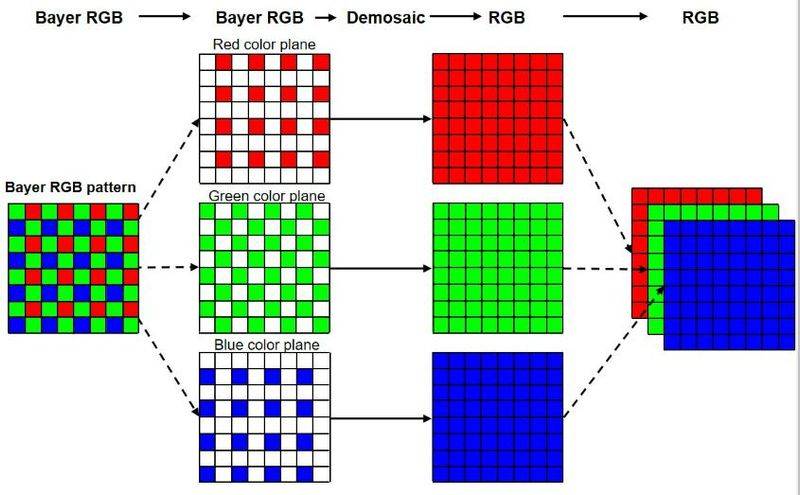
Bayer arrays are one of the main techniques for achieving colour images of ccd or cmos sensors. It simulates the sensitivity of human eyes to colour and filters light using a colour filter array of 1 red, 2 green 1 blue。
The vast majority of colour camera imaging cores are covered by a small coating called "by ear filter arrays" in front of the image sensor (cmos/ccd). This layer of filter consists of small blocks of red (r), green (g) and blue (b) colours, the rationale being that each pixel point receives only one colour of light. The colour filter enables different pixels to obtain different colour information, thus synthesizing colour images by plug-in algorithms。
Colour cameras through the bayer array are able to obtain colourful images, and some applications that require high levels of detail and colour imaging, such as security surveillance, photography and so forth, have been adopted. From this point of view, the world of black and white cameras is dark and heavy, giving people an unhappy experience. So what's the point of having a black and white camera
Two, a short panel of colour cameras
To understand the significance of the presence of black and white cameras, let's look at the short panel of colour cameras。
The colour camera using the bayer array, while capable of obtaining a rotten pattern, revealed significant limitations under fluorescent imaging. Because this layer of filters absorbs or reflects other wavelength light while passing a particular colour, which is equivalent to a “mitigation”。
This leads directly to the existence of two natural short panels of colour phase opportunities: signal decay and poor cell noise. The presence of a filter layer absorbs/reflects some of the effective fluorescent signals that should have reached the chip, reducing the sensitivity of the entire chip. Under fluorescent imaging conditions where the signal is weak, this signal decay further reduces the noise ratio of the final image, affecting the quality of the image and the accuracy of the quantitative analysis。
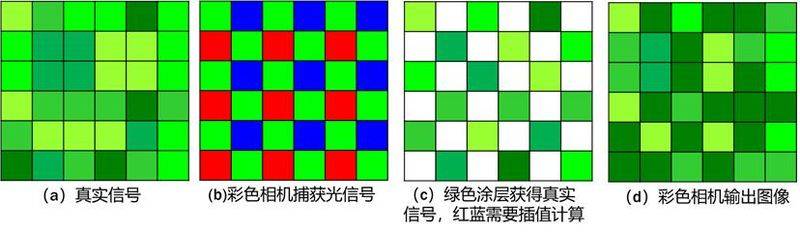
As shown in the figure below, it shows the "bear filter" at the core of the colour camera. Each box represents a pixel filter (r-r, g-green, b-blue). It can be seen that, in different colours, only pixels of matching colours allow light to pass, while pixels of other colours absorb/reflect the light, which is the basis for the colour camera to capture colour information and the reason why it loses light signals。
Three, the advantage of black and white cameras
The black and white camera, without the colour filter, captures every pixel of the wavelength into the light, without distinction, and directly records the true greyness of the light. This “pureness” means that it is adding。
Thus, the advantage of black and white cameras is twofold: maximizing light efficiency and laying the foundation for high-value noise. Without filtration absorption and reflection, the injection light is used most efficiently and is particularly suited to capture extremely weak signals. In fluorescent imaging, as many photons as possible can be captured, providing a solid basis for the acquisition of high-confidence noise images。
The chart below compares the imaging effects of the same microscope system at the same time as the flash 4. 0 lt3 black and white camera and the colour camera at the pisons under the same conditions (20x/0. 4, sample: colon cancer cells + edu fluorescent)。
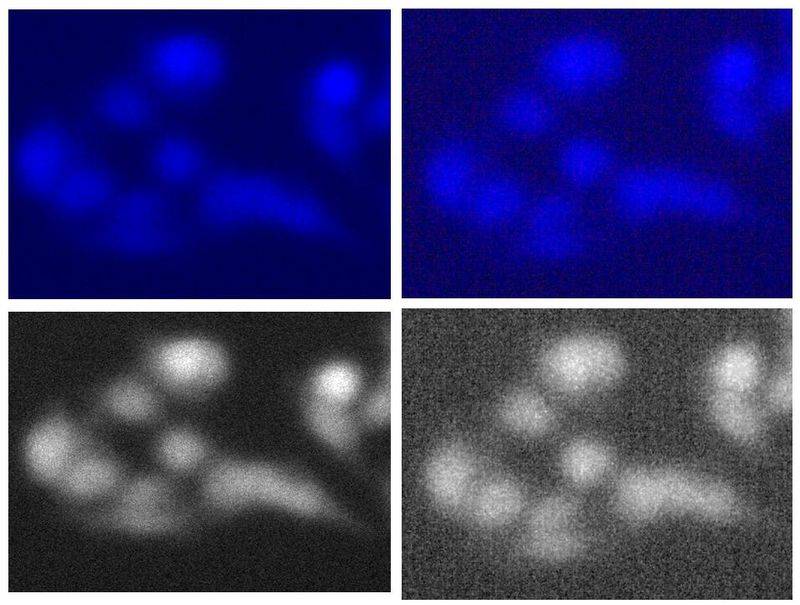
Top left (perfect chrysophone) and bottom left (with grey scale): thanks to 6. 5 μm of large pixel design and the photon capture capability of non-film tablets, images have very high levels of noise, cell profiles are clear, details are rich, and colours are clearly distinguished after pseudo-synthesis。
Top right (colour camera colour) and bottom right (grey scale): although pixel size is smaller (2. 2 μm), the image background noise is relatively visible due to signal loss and plug-in algorithms caused by filters, and the detail is less clear than the signal-to-noise performance。
It is this fundamental difference in the principles of imaging — “reduce” guess and “additional” light — that determines that black and white cameras can provide a more primitive, realistic and high-quality data base in the application of faint light signals。
So black and white cameras and colour cameras are not essentially good or bad, but simply evolve the performances they seek from different applications。
And here we're going to analyze some of the common fault areas of the camera。
One: the smaller the dimension, the higher the resolution
We often think that the smaller the size of a meta, the more pixels there are, the higher the resolution. This is true in theory, but in practice, effective resolution is the truth。
By way of example, a colored camera of the bayer array, labelled 1. 4 million pixels, actually captures only about 700,000 pixels, and red and blue, each from about 350,000 pixels, because the above-mentioned description absorbs or reflects light. The rest of the color depends on the algorithm "brain to brain." this has resulted in a virtual discount on the effective resolution of colour cameras。
As shown in the figure below, black and white cameras such as flash 4. 0 lt3 (pixel size 6. 5 μm) have no significant difference in resolution performance, even better in detail, than colour cameras with much smaller pixel size (2. 2 μm)。
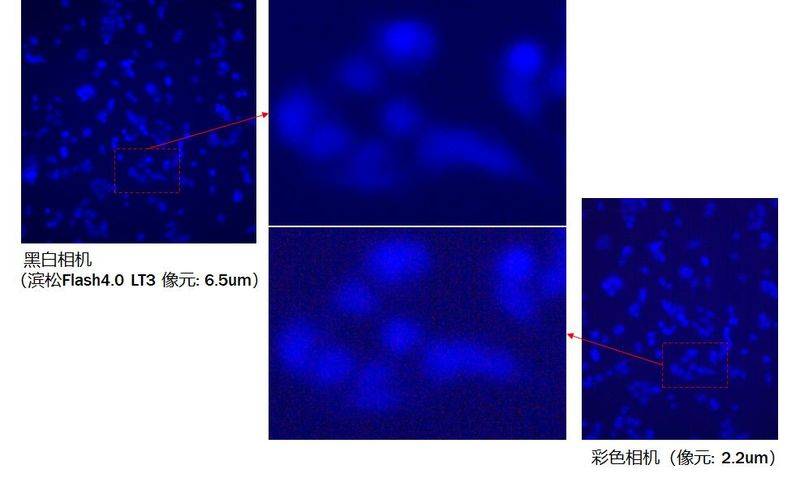
Every pixel of the black and white camera is carrying out a real, complete signal collection, with no information plug-in. Thus, under the same optical conditions, their real ability to reduce the details is often superior. This is why many people wonder why the pine camera is larger in size and less pixels, but eventually the imaging details are better or less different。
Error 2: binning significantly enhances image effects
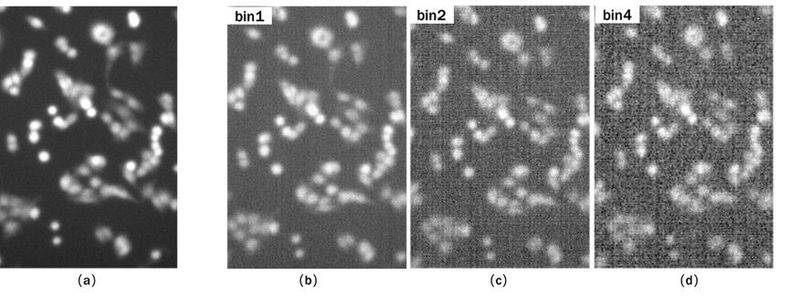
Binning (pixel consolidation) is a technique for increasing the sense of light and the noise ratio by combining adjacent pixels. However, this technique has limited effect on colour cameras。
Because binning (e. G., 2x2) is performed on colour cameras, it is combined with pixels of different colour filters. While this increases the area of equivalent light, it combines signals of different wavelengths and is still unable to escape the inherent signal decay of the plug-in algorithm. The increase in its belief-noise ratio is far less significant than on a black and white camera。
As shown in the figure below, with the increase in the binning steps, the details of the image of the colour camera will become very blurred and the noise ratio will rise below expectations. In contrast, a black and white camera at flash 4. 0 lt3 (pixel 6. 5 μm) on the binning, while keeping details, can achieve a qualitative leap in the noise ratio。
Mistake 3: black and white cameras can only produce black and white images
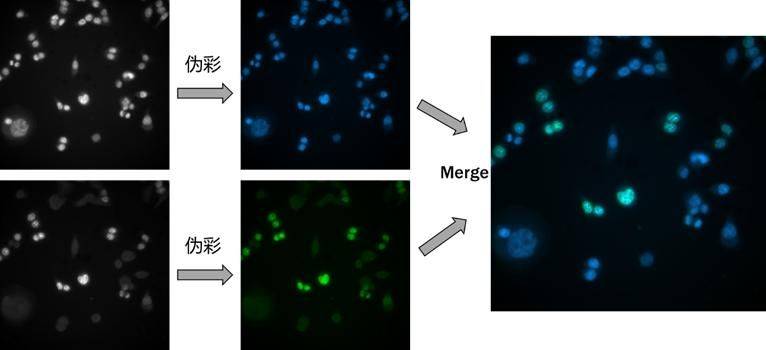
The truth is that black and white cameras can also produce colour images. The coloured image obtained by black and white cameras is more real than it is by sub-channel collection and later synthesis techniques。
Through the rotation of filters from different corridors, samples are collected separately for well-informed, high-quality greyscale images under each channel. Using specialized software (e. G., hclmagelive in pisons), the greyscale images of the different corridors are easily synthesized into clear pseudo-colour images。
As shown in the figure below, this chart clearly illustrates the unique process of achieving high-quality colour imaging by a black and white camera of flash 4. 0 lt3 pixel size 6. 5 μm: it first directly captures the original greyscale image of high resolution, high-belief noise ratio, and then synthesizes it into a colour image rich in information and clear in detail through flexible, controlled channels combined (merge). This method is not only simple and flexible, but is more prominent in the quality and resolution of the final image and is particularly appropriate for fluorescent imaging applications that require precise analysis。
So, the main application scene for black and white cameras is the collection of real faint fluorescent signals to obtain the most authentic image data。



