In the early winter, the guillin is still warm. In the fields of sha river village, the town of the two rivers in the quino region, a mustard crop is soaked that the leaves shine in the light of the sun and are green。
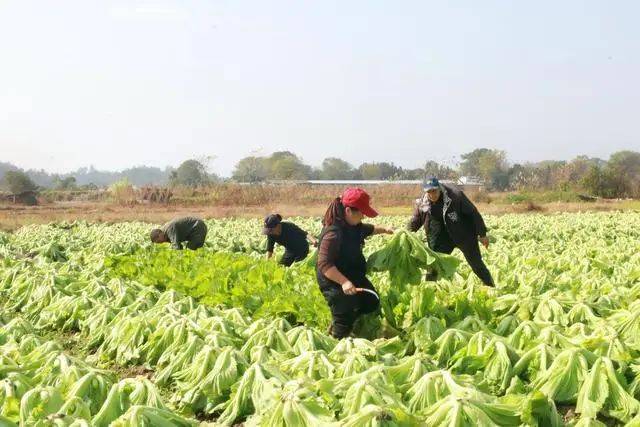
Workers collect mustard. Reporter liu xin
On 8 december, journalists arrived at the mustard farm in hasha village, where more than 10 workers were travelling with sickle knives, carefully harvesting them and turning them over, waiting for the next load while the sun was just a little bit dry. “this is the fourth and last batch of mustard this year, and today we are collecting 40,000 pounds of mustard.” the head of the base, dun zhijun, demonstrated the harvesting techniques on the ground, “the sickle must be kept at a certain distance to avoid damage to the straw affecting the mustard quality”
Looking closely, journalists have noticed that the root of mustard is intact and that the leaves are mostly insect-free and of good quality. “we have effectively ensured the quality of mustards by using the `organic + biological control' model, from sowing to harvesting. Deng zhijun told journalists that the mustard they had planted was a variety of varieties selected by the guangxi agricultural institute, with thick leaves, thick stasis, strong resistance to disease and low fibre. At the same time, specialists at the institute regularly conduct field guidance on planting techniques, pest prevention and treatment, which gives them a “concertative pill”。
“we have been proactive in opening up the market and this year we have entered into an order to supply 300 tons of mustard every month with the sourware processing company in xinda county, hunanyong county. Currently, about one and a half months of output, but still a little short of demand.” dun zhijun has taken up a newly harvested mustard channel and, although this year it is the first time that a large-scale crop is being grown, with an average acre production of only 6,000 pounds, it has reached three quarters of the production period. “according to the end of the harvest, the purchase price is now 0. 5 per pound. The purchase price will be higher between $0. 7 and $1. 1 during the season of april-october”
A stable order also directly benefits the villagers in the neighbourhood. “i think it's good that i'm from the village next door, as old as we are, can't go out to work, collect mustard here, not much manual work, $120 a day, and take care of my family.” aunt li, age 62, said that she was skilled in loading mustard. It is understood that the base-owned companies have been engaged for a long period of time to provide day-to-day care and collection for the poor, the surrounding villagers, who require at least 10 workers per day, directly leading to the employment of the surrounding villagers at the door of their homes。
With the launch of a transport vehicle loaded with mustard, the base began preparations for planting in the coming year. “we have orders in hand, and we are solid in our hearts, and we plan to expand our cultivation in the coming year, and we are willing to bring in the farmers who want to come to us to make a mutual fortune.” deng zhijun said。
“in addition to vegetable cultivation, since autumn and winter, we have been living up to 13,000 acres of winter clearing land through a `paddy-cui-cui-paddy-cui-cui-cui-cui-cui-cui-cui' rotational pattern, bringing about a double harvest of `mibags' and `basket baskets'.” the vice-president of the two towns, yang ying wei, said. The town, based on the advantages of a mild climate, abundant rainfall and fertile soil, has led farmers to use the short cut-off period after the rice harvest to grow fast-growing vegetables such as mustard, vegetable heart and so forth, both to reduce the idleness of the land and to improve the soil structure, and to make farmers “money bags”。