Gb 4351-2023, which was officially implemented in 2025, and which added fire types f and adjusted the categories of applicable fire types such as dry powder extinguishers, water-based fire extinguishers, etc., resulting in numerous disputes and areas of error。
Based on the latest standards, this paper identifies the applicable fire extinguisher principles and minimum allocation benchmarks for different types of fire, and amends the requirements of the design code for the configuration of construction fire extinguishers gb 50140-2005, which can serve as a reference for the design of fire extinguishers。
Key points:
(1) only dry powder extinguishers are adapted to category c fires. Clean gas extinguishers and carbon dioxide extinguishers no longer apply to category c fires。
(2) the minimum allocation benchmark for category c fire may be implemented in accordance with category b fire sites。
(3) fire in category f applies only to water-based fire extinguishers。
(4) the current criteria do not yet support the calculation of fire extinguishers for category f fire, which can be performed by reference to category b fire。
(5) dry powder extinguishers are the most widely used fireplaces and are used in most cases。
I. Principles applicable to fire extinguishers。
(1) fires in category a are usually characterized by shallow depth fires, and fire extinguishers applicable to category a fire are mainly dry powder extinguishers, water-based fire extinguishers, clean gas extinguishers, etc。
(2) the fire in category b is mainly a surface fire, and most of the fire extinguishers currently apply to category b fire recovery。
(3) fires in category e are usually associated with fire in category a (or category b) and fire extinguishers in category e are mainly: dry powder extinguishers, carbon dioxide extinguishers, clean gas extinguishers, and some water-based fire extinguishers。
(4) in accordance with the provisions of the portable fire extinguisher gb 4351-2023 and the drilling fire extinguisher gb 8109-2023, only dry powder extinguishers can be used to extinguish category c fire; only water-based fire extinguishers apply to category f fire。
(5) principles applicable to fire extinguishers for different categories of fire, see table 1 ~ 3。
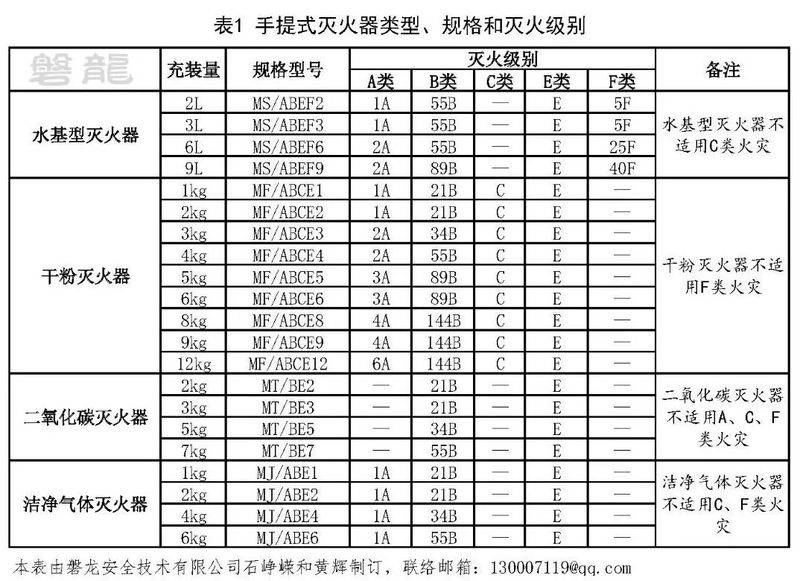
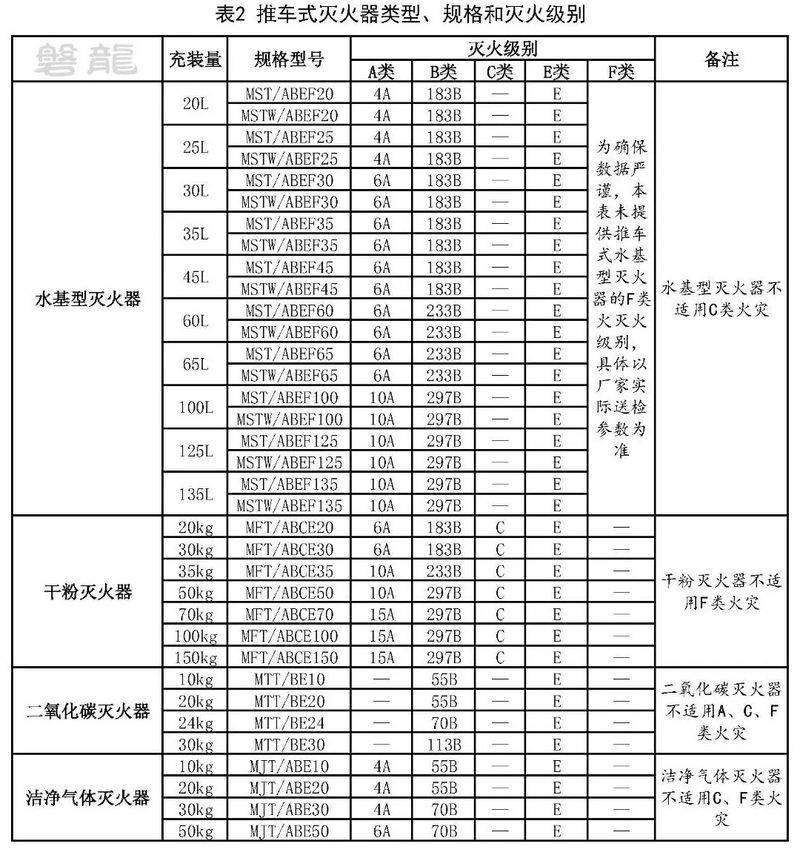
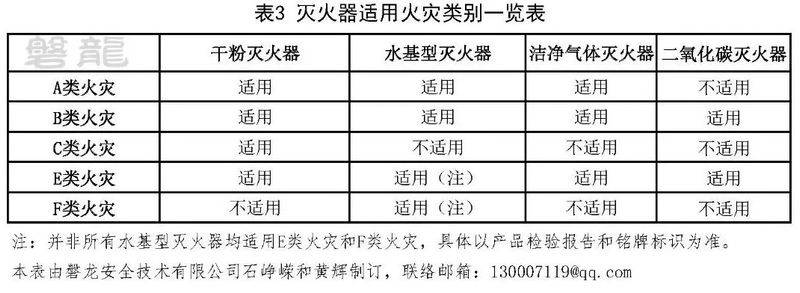
Note 1: the dry powder extinguisher described here is a dry powder extinguisher (model mf/abce), commonly known as abc dry powder extinguisher. Dry powder extinguishers are the most widely used fireplaces and are used most extensively。
Note 2: not all water-based fire extinguishers are covered by fire types e and f, which are based on fire extinguisher inspection reports and signs。
Note 3: there are currently no generic fire extinguishers for category d, and in practical applications, specific fire extinguishers for specific metals should be selected on the basis of the type, physical state and characteristics of the specific application site and metal and determined by experiments。
Ii. Benchmarks for minimum deployment of fire extinguishers。
(1) gb 50140-2005, the design code for the configuration of construction fire extinguishers, defines the minimum allocation benchmarks for fire extinguishers in category a and category b fire sites。
(2) standard test models and fire-fighting levels for fire types c, e and e have not yet been identified through fire-fighting tests in all countries of the world and the assigned baseline values for fire types c and e are usually based on fire-fighting levels for categories a and b。
(3) although handheld fire extinguishers gb 4351-2023 and pusher fire extinguishers gb 8109 - the parameters of the pilot model for all levels of fire type f have been identified, but the relevant design criteria have not yet been established for the minimum allocation of fire extinguishers for fire type f sites and therefore the number of fire extinguishers can not be calculated by fire type f at this time. Considering that fire in category f is close to fire in category b, it is recommended that the minimum allocation benchmark for fire in category f be applied by reference to fire in category b。
Iii. Description of classifications。
The fire classification gb/t 4968-2008 defines fire as six different categories based on the type of combustible material and the combustion properties, and applies to fire suppression and fire prevention areas such as the selection of fire extinguishers. Minimum deployment benchmarks for fire extinguishers, including minimum fire extinguisher levels for individual fire extinguishers and maximum protected area for unit fire extinguishers, are relevant to the type of fire and hazard level. These are described below。
(i) category a fire。
(1) type a fire concepts and characteristics。
Category a fire refers to a solid substance fire, which is usually organic in nature and generally produces thermal residuals during combustion, such as burning fires such as wood, cotton, wool, flax, paper and its products. Category a fires are the most widespread。
(2) fire extinguishers of category a fire shall be applied。
Solid-material fires often have shallow depth characteristics, and fire extinguishers for such fires are usually adhesive or overlayed or more rapidly effective. Fire extinguishers applicable to category a fires are mainly dry powder extinguishers, water-based fire extinguishers, clean gas extinguishers, etc. Of these, dry powder extinguishers are the most widely used。
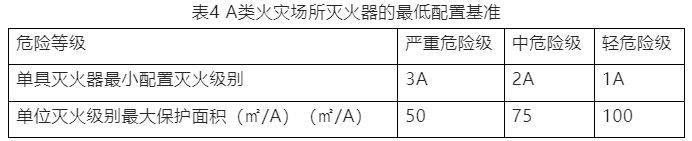
(3) the minimum allocation of fire extinguishers for category a fire sites。
The minimum allocation benchmark for fire extinguishers for category a fire sites is based on article 6. 2. 1 of gb 50140 - 2005 design guidelines for the configuration of construction fire extinguishers, see table 4。
(ii) category b fire。
(1) type b fire concept and characteristics。
Category b fire is a fire of liquid or meltable solid substances such as gasoline, kerosene, diesel, crude oil, methanol, ethanol, asphalt, paraffins, etc。
The fire in category b is mainly manifested in surface vapour combustion of flammable liquids and has certain type c fire characteristics。
(2) fire extinguishers of category b shall apply。
In the early stages of the fire, most of the fire in category b was a simple surface fire with lower internal temperatures, which were not easily rekindled after the fire had been extinguished. As a result, fire extinguishers of type b are of more type than applicable, and almost all types of fire extinguishers can be saved from category b fire。
(3) the minimum allocation of fire extinguishers for category b fire sites。
The minimum allocation benchmark for fire extinguishers in category b is determined in accordance with article 6. 2. 2 of the gb 50140 - 2005 design guidelines for the installation of fire extinguishers, see table 5。
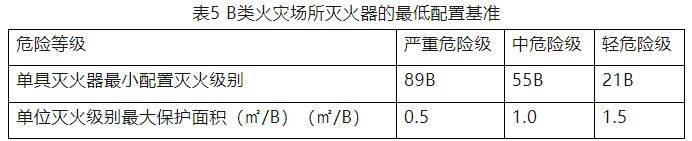
It should be noted that the minimum requirements for the allocation of fire extinguishers for both categories of sites should be met。
(iii) category c fire。
(1) type c fire concept and characteristics。
Category c fire refers to gas fires such as gas, gas, methane, ethane, propane, hydrogen, etc。
(2) fire extinguishers of category c shall be applied。
Under criteria such as gb 4351-2023 and gb 8109-2023, which are portable fire extinguishers, only dry powder extinguishers marked for fire type b can be marked for fire type c and therefore only dry powder extinguishers can be used to extinguish fire type c。
(3) the minimum allocation of fire extinguishers for category c fire sites。
The minimum allocation of fire extinguishers for category c fire sites can be implemented according to category b fire sites。
Given that iso international standards have not yet established a standard test model for fire suppression in category c and that the level of fire suppression in category c is currently difficult to determine accurately, so far, there is no recognition of fire suppression levels for category c fire suppression in the countries of the world and international standards, and there is no provision for a baseline for fire suppression at category c fire sites. As a result, the baseline for the configuration of fire extinguishers was in fact based on the level a and b fire extinguishers. Of course, this is consistent with the objective fact that most fires are category a and category b fires. Since the characteristics of category c fire are relatively close to those of category b fire, the minimum allocation benchmark for category c fire sites can be implemented in accordance with international standards, in accordance with world practice。
(iv) category d fire。
(1) the concept and characteristics of type d fire。
Category d fire is defined as a burning fire of metal, such as potassium, sodium, magnesium, titanium, zirconium, lithium, aluminium magnesium alloy。
(2) fire extinguishers of category d shall apply。
There are currently no generic fire extinguishers for category d, and in practical applications, specific fire extinguishers for specific metals should be selected on the basis of specific application sites and types of metals, their physical characteristics and their characteristics, and determined by experiments。
Fire extinguishers applicable to other types of fire do not apply to category d fire; fire extinguishers applicable to category d fire extinguishers usually use specialized fire extinguishers and structures, and not to other types of fire。
Fire extinguishers in category d apply only to the type of flammable metal marked and only to the first fire; they do not apply to unmarked flammable metal varieties。
(3) the minimum allocation benchmark for fire extinguishers in category d fire sites。
In the case of category d fires, given the factors such as the fact that their standard trial model has not yet been established and that fire suppression effectiveness of fire extinguishers is difficult to measure accurately, the level of fire suppression level recognition of fire extinguishers for category d fires has so far been absent from all countries of the world and international standards. Therefore, the minimum allocation baseline for fire extinguishers in category d fire sites should be determined on the basis of studies of the type of metal, the physical state and its characteristics. Practical applications may be determined on an experimental basis, depending on the specific application site。
(v) category e fire。
(1) the concept and characteristics of fire type e。
Category e fire is a fire with electric combustion, primarily a fire with electric combustion of electrical equipment that is not timely or suitable for power cuts at the time of combustion. For example, in places such as generator room, transformer room, distribution room, instrumentation room and electronic computer room, fire type e occurs when electricity is not cut in time or is not suitable for burning. Category e fires are required to ensure that electrical insulation during fire suppression meets the requirements。
(2) fire extinguishers of category e shall be applied。
Category e fires occur in electrical equipment and are characterized by category a fires, but are less developed into shallow or deep fires. Fire extinguishers for fire type e shall have electrical insulation capability and, in the case of insulation tests, the fire extinguisher shall not pass by a current above 0. 5 ma, or between the torch and the ground。
The fire extinguishers applicable to category e are mainly dry powder extinguishers, carbon dioxide extinguishers, clean gas extinguishers and some water-based fire extinguishers。
(3) the minimum allocation benchmark for fire extinguishers in category e fire sites。
Category e fire means a fire with electrical combustion of objects, and therefore a fire of category e must be accompanied by a fire in category a (or category b) and its minimum allocation of fire extinguishers should not be lower than the requirement for fire in category a (or category b) of the site. In other words, fire extinguishers in the site may be considered as meeting the fire extinguisher allocation benchmark for category e sites when they meet the criteria for category a (or category b) fire allocation。
(vi) fire in category f。
(1) the concept and characteristics of fire type f。
Category f fire refers to a fire of cooking products (e. G. Vegetable and animal fat) in cooking equipment。
Prior to the publication of the fire classification gb/t 4968-2008, category f fires were often considered to be category b fires. However, in practical applications, it was found that fire extinguishers partially applicable to category b fires were not effective in fighting cooking fires (e. G. Plant and animal fats) in cooking equipment. The main reasons are as follows: (a) cooking products (e. G. Vegetable and animal grease) are mostly in a state of condensation and are not simply flammable liquid fires; and (b) equipment (oil pans, fried equipment, etc.) continues to be hot, and plant and animal grease tends to be boiling and easily rekindled when fires are extinguished. Inappropriate fire extinguishers are prone to boiling spills。
The purpose of the fire classification is to facilitate fire recovery, and it is therefore necessary to separate the cooking materials (e. G. Plant and animal fat) in the cooking equipment to be classified as category f fires。
(2) fire extinguishers of category f fire shall apply。
It is clear from the above that fire in category f is clearly different from a simple category b fire, and fire-fighting measures (fire extinguishers) require cooling, boiling spilling, etc. Gb 4351-2023, section 7. 6. 1. 2. 4, of the portable fire extinguisher, states that during fire suppression in category f, no incendiary material shall be spilled and the fire extinguisher shall not be added to cause the fire to increase; the fire shall be completely extinguished and no rekindling or spilling of vegetable oil shall occur within 20m of the end of the spray. Note: fires at heights above 2m and lasting longer than 2s indicate that the fire has increased and can be shown by video recording。
Water-based fire extinguishers, sprayed in the form of water mist (fogilization), with good fire suppression and cooling effects, with a smaller impact on cooking products (e. G. Plant and animal butter), are the best option to save fire types f. Only such water-based fire extinguishers are currently available to fight f-type fires。
(3) the minimum allocation benchmark for fire extinguishers in category f fire sites。
Gb 4351-2023 and gb 8109- the parameters of the pilot model for all levels of fire type f have been identified, and fire fighting products produced by the plant have been marked for fire level f, but the relevant design criteria have not yet defined the minimum allocation of fire extinguishers for fire type f sites and therefore the number of fire extinguishers can not be calculated by fire type f。
Considering that fire in category f is closer to fire in category b, it is recommended that the minimum allocation benchmark for fire in category f be implemented in accordance with the minimum allocation benchmark for fire in category b。