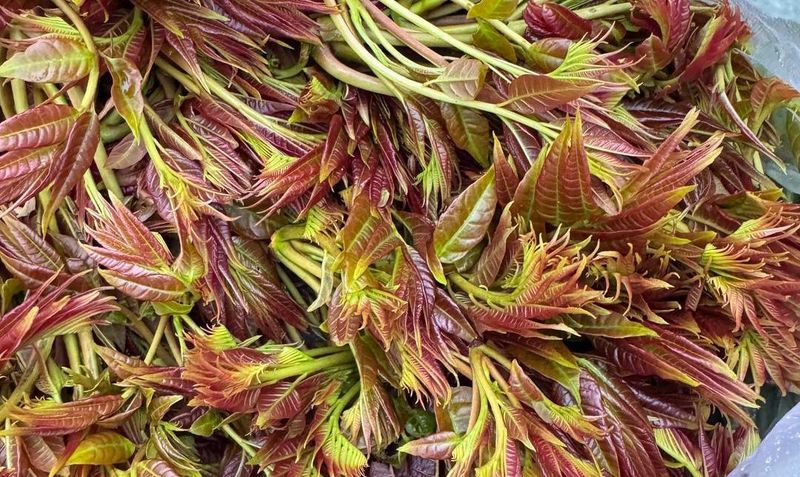
Spring is a season of hope and a time of dynamism in science and technology. When grapes in the field were still sprouting in the spring light of the raisins of lacey, fresh leaves and green onions were already produced in the greenhouse sheds, where they were flourishing. This is not only fertile soil for the development of grape breeding, but also an example of deep integration in productive research. This is the critical time for the management of grape seedlings and the selection of new varieties. Experts and teams of graduate students from science and technology colleges, hand-held laboratory devices, run to the sheds, lay roots in the fields, and carry out research and research on pelicans in order to inject energy and wisdom into the future of the grape industry。
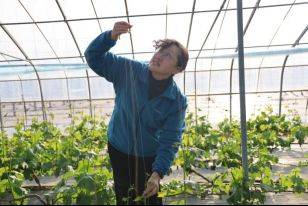
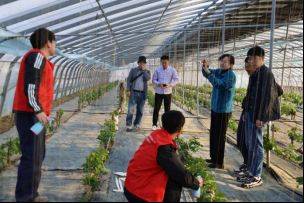
Grape seedlings are slowly swaying in the spring wind at the vineyard planting base in the science complex. The chief expert of the science and technology college, professor liu xin of the aoshima agricultural university, and the resident specialists liu guangchou and zhao fong gui, led team members to carry out experiments on growth regulators to promote growth and woodification. Researchers travel between grape saplings and, with their vast experience and expertise, carefully select the trees for experiments. For each selected piece, an experimental plate is inserted next to it, with detailed indications, and the growth regulation solution of the different proportions is then evenly sprayed on the grapes。
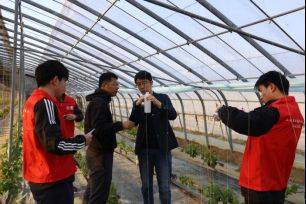
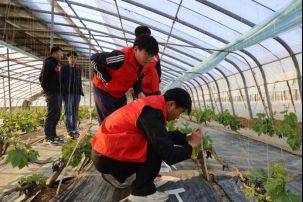
“we have to monitor the growth of grapes and vines on a regular basis, recording indicators such as height, thickness, number and colour of leaves. Through these data, the effects of the different ratios on the growth of grapes are explored, and the best growth control formulations are selected, thus increasing the resistance, growth rate and quality of grapes.” professor liu xin taught team members valuable experience when looking at the growth of grapes。
An integrated platform for productive research was established by the team of professor liu xin of the institute of life sciences of the aoshima agricultural university, in collaboration with qingdao crops co. Ltd., which focuses on the introduction, selection and breeding of virus-free grapes and all kinds of fine gills. The results of the technical research and industrialization of technological results in the field of the vine detoxification industry have been significant. The national centre for scientific and technological conversion of the starfire programme has completed the detoxification of more than 40 varieties of grapes, the largest company in the country。
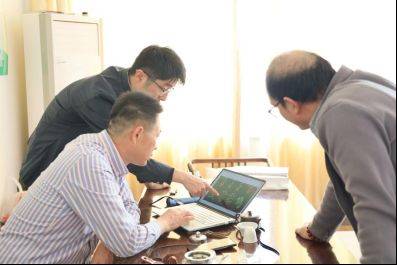
In the field of platinum research, small court teams have been involved in the screening of beneficial microorganisms and the development of biobacterial agents in response to the associated problem of soil acidification and endemic diseases. At the same time, the team carried out research and development on new types of anticoolants and heat-resilient agents in response to adverse climatic conditions such as cold springs and extreme temperatures that may be encountered during the growth of grape trees. These scientific findings have significantly increased the resilience of grape seedlings and laid a solid foundation for their quality production. Led by the science and technology institute, the efficiency of innovation and transformation of results from grape seedlings has been further enhanced, which has contributed significantly to the upgrading of the agro-industry and increased farmers ' incomes. Since the establishment of the complex, around-the-horizon-free grape seeding applications have covered more than 200 acres, boosting agricultural households by more than $5 million。
As a central vehicle for the rural action plan for revitalizing science, technology and innovation, and with the active support of the lacy city council of science and technology, so far there have been five national science and technology colleges in lacey, which have trained over 200 farmers' halls and field schools, trained cooperative workers and farmers in over 15,000 places, further extended the industrial chain at the grape science and technology college, carried out the grape deep processing project in partnership with nine estates, and produced a series of sun roses with whites and brandy wines to boost the population and the collective harvest. In response to the “model for the promotion of science and technology colleges” set out in central i, the association will continue to pursue the 12 schools that have been developed in partnership with universities such as the china ocean university, shandong agricultural university and qingshima agricultural university, so that more science and technology colleges will grow in the countryside。
(people's daily news)