Would a strawberry grow in a completely closed space? Such experiments are being carried out in a tense manner。
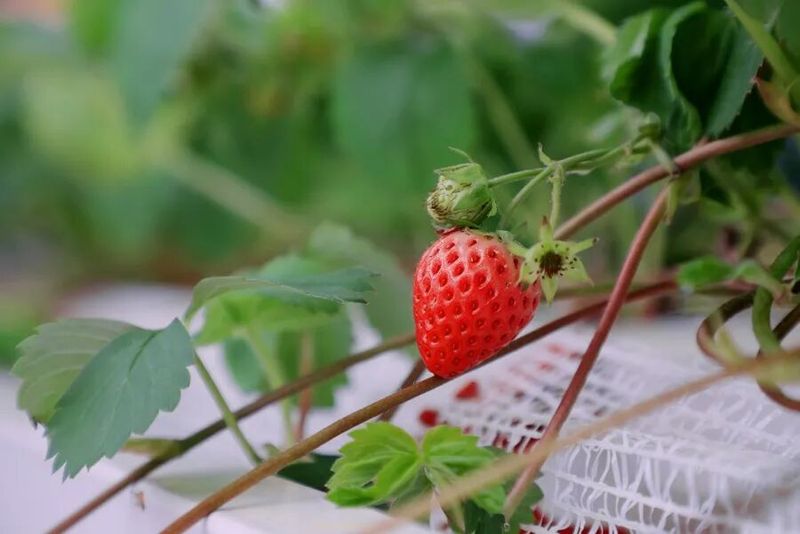
The proposed ecological team chooses the method of seed-flow strawberries cultivation, with an excellent ring control in exchange for a strong taste. It's a lubunpo
In recent days, the launch and inauguration of the 5th multi-agricultural science and technology competition was held at the shanghai agricultural science and technology foundation, where four teams emerged from 22 to the initials and advanced to the finals. The team of sabon farmers from beijing, the team of berries in shanghai and the team of zhejib and the team of ecologists from zhejiang will compete for the final wheel of strawberries in their respective saber farms over the next six months through remote management of the strawberry growing environment。
This was the fifth consecutive “multi-agricultural science and technology contest” and the three-time resumption of strawberry cultivation. Unlike the first race, where strawberries were planted in the hothouse of the plateau, the competition required teams to design and build 50 square metres of plant plants to explore “high-quality, high-yielding, low-cost, low-energy” national strawberries cultivation programmes in small houses where the sun could not be seen。
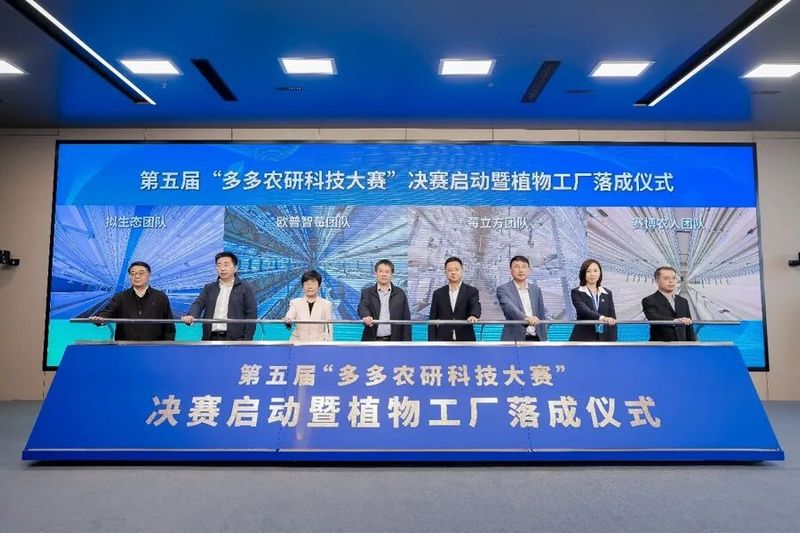
Li gwandeh (left), vice-president and secretary-general of the shanghai federation for modern services; du jinkun (left), director of social services and permanent vice-president of the new institute for rural development, agricultural university of china; zhao zhihui (right-three), vice-president of the shanghai academy of agricultural sciences; wang yu (right-two), project officer, food and agriculture organization of the united nations in china
The opening event was attended by relevant leaders and experts. It's a lubunpo
It's an upgrade to the straight-face industry
Three sessions later, strawberries again became a race crop, but the game changed. The first contest focused on verifying the difference between ai and traditional production, while the current session required teams to consider costs and outputs in a comprehensive manner, marking an industrial drive from technological exploration. “this means that the competition has escalated to the exploration of the `commercialization, replicability, profitability' of plant plant strawberry cultivation.” the competition judges, professors at the chinese university of agriculture, and ph. D. Student mentor he toshien believe that this is a move from `none' to `never'。
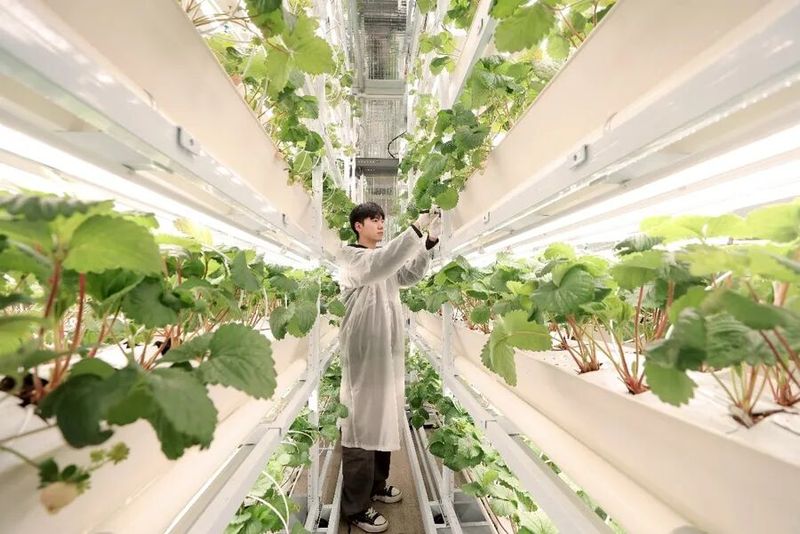
At the end of the trials, the team leader of the berry cube team, he shihi, records the strawberry fruit trail in order to optimize the formal planting phase of the finals. It's a lubunpo
Energy consumption is a core bottleneck that limits the ability of plant plants to reach popular tables with strawberries, and artificial lighting has long dominated energy consumption. To this end, the event was the first time that a photovoltaic energy system had been added to the competition, both to reduce operational energy consumption and to act as a back-up power source. At the scene, i saw three teams that had installed solar panels at the top of the plant plant to absorb the sun to the maximum by tilting a small angle。
In addition to the open source, teams are more focused on “scaling”. The berries cube team, headed by shanghai university of transport, provides a complete upgrade of the reflection film in the inner walls and planting racks of the plant plant and specializes in “retribution” of lost and vulnerable side-to-side light. The empirical data show an increase of about 15 percentage points in the effective photomass of the strawberry coronal following the backlash. The operchberry team, which is supported by opple lighting, has improved the efficiency of power conversion by integrating more than 400 stand-alone small power sources of led lamps into one direct-flow large power source。
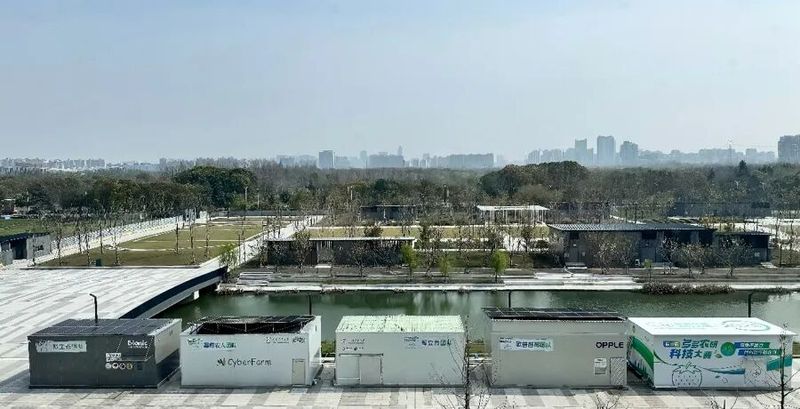
Each of the four final teams designed and constructed 50 square metres of strawberry plants. It's a lubunpo
The site of the attack coincided with the positioning of the shanghai agricultural science and technology (s&t+) valley — a focus on “technology+services” — and the creation of agricultural science, technology and innovation. “the key to the future of agriculture lies in science and technology, the dynamism of science and technology lies in innovation, and in the setting. The multi-agricultural science and technology contest is the platform for linking cutting-edge technology to fields."
Can ai plant strawberries
If light voltage solves “where electricity comes from”, the artificial intelligence algorithm answers “how to plant better”. Can ai plant strawberries? Can it be the best complement? In this competition, the two top teams have given the same answers。
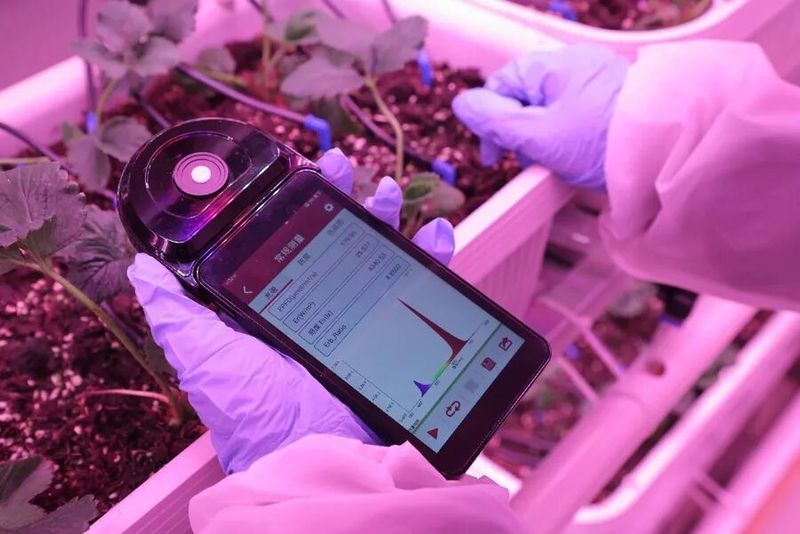
The members of the oprah team collect key data from plant plants using plant photoanalysis. It's a lubunpo
Under the leadership of chang liying, professor at the faculty of agriculture and biology, shanghai transport university, the development of a decision-making system for integrating artificial intelligence models of plant crops with large models is under way and a preliminary validation has been completed in small-scale container plant plants. The small model is responsible for identifying the longness of single strawberries, pests, flowering results and the large model for integrated movement and decision-making. “accurate control of each strawberries can be achieved through the synergy of image identification, environmental regulation and growth management, and single-capture control is already feasible when the density is moderate.” introduction by chang liing。
It is understood that the team is working on localized growth models for different crops. Demand for different crops varies greatly, and an individual model is needed for a category. “although there are mature models of crops such as tomatoes at the international level, direct indigenous use is not appropriate due to environmental and variety differences.” she explained that the team was moving forward with “national production substitution”, from zero to one autonomous modeling, especially for unprecedented items such as strawberries and green vegetables, “this technology logic can be extended in the future to cabbages such as lettuce and green vegetables, achieving efficiency gains, quality stability and continuous production throughout the year”
The team of sabon farmers, composed of seven doctors and three masters from the chinese university of agriculture for five consecutive terms, is implementing the concept of “dialogue with plants.” “just don’t mess around. Captain chen min hui said. The team's desire for ai to become a production assistant like deepseek or chatgpt has been partially realized by developing a system based on the accumulation of planting data and knowledge maps over many years, based on the contribution of ion activity and ionec, to achieve a finely calibrated level of ion concentration, i. E. To determine, through images and sensors, the different stages of strawberry growth, e. G., the separation of buds, the expansion of fruit, and the precise adjustment of the nitrogen ratio in nutrients. The team remotely controlled the plant plant in shanghai in beijing, “like having a cat at home, just take a look at it”. With regard to plant plant prospects, chen min hui believes that using electricity from places such as the qinghai sea, strawberries can stabilize supply over four seasons a year and turn the whole industry around。
From the point of view of the approach, the two sets of technology paths are focused. The berries cube team where chang li-young works emphasizes single-tier control and modelling of domesticization that integrates small large models, and the sabon farmers' team, which interacts with ai, points to the core of intelligent agriculture, which is to make algorithms understand the language of crops。
Explore low-cost, high-quality production
In addition to energy efficiency, high quality is another major consideration. In contrast to the other teams' choice of matrix cultivation, the zhejiang ecological team proposed a plan for the cultivation of shallow liquid run-off strawberries - introducing dedicated tanks and equipment for self-development, significantly increasing space utilization, planning to plant 4,600 strawberries, with an estimated total production of 3,800 kg. For their part, the cybernomists ' team seeks precision and preserves only three fruits per sequence, ensuring that each strawberry weighs more than 30 grams. The “hard target” of the strawberry cube team is more comprehensive: it is controlled at 30 degrees per kilogram of strawberries, yielding more than 0. 4 kg per unit and stabilizing at more than 12 degrees of sweetness。
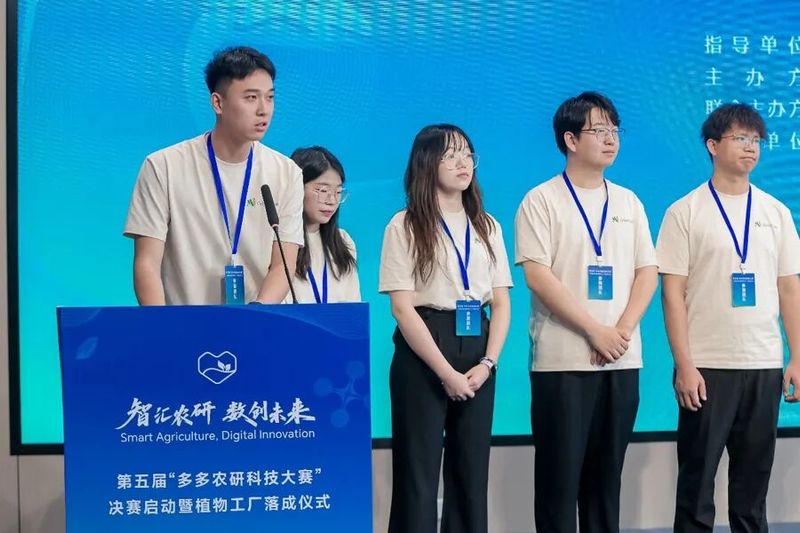
The team of "old generals" sabon farmers, who have been competing for five consecutive terms, this year hopes to transcend the past. Land cloud waves
The first challenge to the team participating in this event is the ability to work together across borders — a plant from zero “hand-to-hand” — as a multidisciplinary chorus of agriculture, artificial intelligence, machinery and construction. Of the four teams entering the finals, the number of business leaders or participants reached three, with a clear trend towards integration in production studies. “it is to be hoped that this competition will bring about more excellence and breakthroughs in agricultural science, technology and innovation, so as to breathe new life into the high-quality development of our intelligent agricultural facilities.”
“we want to encourage more young scientists to engage in agriculture, break industry barriers and take advantage of technological expertise across borders” said many of the responsible officials. This year, central i emphasized the integration of artificial intelligence with agricultural development. As an agricultural-based electrician platform, more and more, through the “billions of support” programme, there has been a sustained scaling-up of innovative inputs to equip farmers with technical and human “two engines”。
Each plant hides its imagination and exploration of the future of chinese agriculture. Which team's technical programmes will produce the sweetest “ fruit” in six months? Strawberry will give the answer。
I'm a great writer