I. Can the northern winter worm and herb grow artificially
It is well known that the winter worm summer grass, as an expensive drug, is uncultivated because of the particularly complex conditions under which plantations are formed, including the natural environment such as high temperatures, low oxygen and high ultraviolet intensity, to form the winter bug summer grass, and because of external influences, which make it difficult to separate the strains。
Ii. How to grow the summer grass of the northern winter worm
In order to grow herbs, which can be grown manually, it is important to know the correct method of planting them:
1. Acquisition of fungi
Access to a highly adaptive and hasty seed source is one of the key conditions for the success of herbicide cultivation in the north, and most producers need to obtain it through seed channels, in addition to being able to separate and cultivate themselves. It is recommended that producers should introduce seeds in formal establishments with scientific competence and testing conditions in order to ensure production effectiveness。
2. Development of a culture base
First, rice or wheat is fed into a plastic bag at 50 or 100 grams per bag, then 1. 5 litres of hot water at 50 °c is poured into the clean basin, and the anti-fouling agent used for the weed is placed in the hot water, which causes complete dissolvation into a nutrient. Finally, the material water ratio (i. E. The ratio of rice or wheat to nutrients) is 1 g: 1. 5 ml in the form of nutrients, which is poured into a plastic bag filled with rice. Upon completion of the separate assembly, each plastic bag was covered with a plastic rope in the centre and in the mouth。
3. Sterilization
An appropriate amount of water is added to the fungicide pot, and the culture bag is placed in the fungicide pan, which warms up to 100°c for an hour. They are removed and cooled and moved into the vaccination room. A high-quality aerosol disinfectant or routine method of 30 minutes of disinfection allows the wearing of disinfectant clothing into the inoculation room。
4. Vaccination
Access to the inoculation room should be promptly closed to prevent the entry of air containing fungi, vaccination tools, the exterior of the bacteria and the hands of the operator, etc., and 75 per cent of the alcohol should be wiped or impregnated. Then, two to three blocks of the fungus of the size of the bean grains are extracted from the vaccination tool, which is connected to the culture base and is just a little tight。
5. Cultivation management
(1) the herb is a low-moderate species with a growth temperature range of 5-30°c for the fungus, with a maximum growth temperature of 15-25°c for the fungus and 18-22°c for the subs. Temperature is generally initially maintained at 15-18 °c shade culture, which rises to 20 °c when the fungus grow to culture 1/2-2/3。
(2) when there is a spasm in the upper part of the culture base, a temperature differential of 10-15 °c shall be given and light-stimulation shall be increased。
(3) 30 minutes after the turnover of 7 to 10 days to sterilize the culture room and then remove the ligature from the middle of the culture bag, fold the bag into a straight barrel with the hand and provide space for the sub-seasonal growth。
(4) when the sub-seat is of up to 1 cm, a small hole may be used to ventilate on the closed film. And keep the temperature at 18-22°c, with a relative humidity of 80-90% of the air。
6. Collection
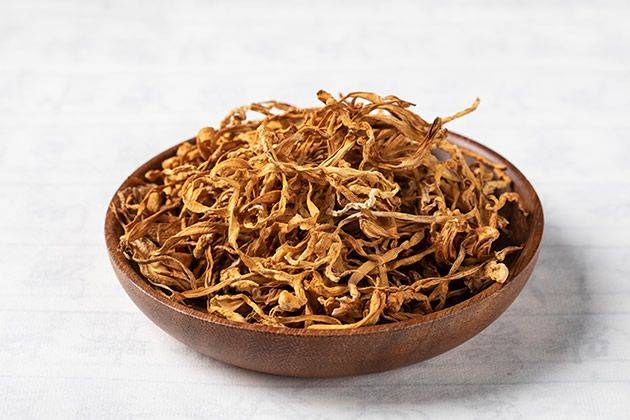
The subseaps are in the form of orange red or orange rods, and when they are no longer growing, they are removed from the base with a small knife or scissors, dried or dry in a timely manner in a cleaning device and are dried and stored in a closed plastic bag or sold。
Iii. Conditions to be met for the cultivation of northern weeds
In addition to observing the correct method of cultivation, some of the conditions for termination must be met, including:
1. Nutrition
The main nutrients available to herbs in the north are glucose, malt, starch, sugar cane, etc., with the optimal use of single sugar or small molecules. Second, soybean powder, protein platinum, yeast cream, etc. Furthermore, organic nitrogen can be used。
2. Water
In production, the water content of the matrix is appropriate at 60-65 per cent and the relative air moisture of the filament culture is maintained at 60-70 per cent, which should be moved to 80-90 per cent when the base is formed。
Oxygen 3
Like other edible bacteria, the growth and development process is also a metabolic process of oxygen-excised carbon, especially where higher oxygen levels are required after the original base has been decomposed, thus maintaining relatively fresh air to ensure adequate oxygen supply。
4. Light
In the early stages of herb growth, strong light has a significant inhibition and injury to herb, so it should remain completely dark in the early stages. It can be given proper light at a later stage and has the effect of accelerating growth。
5. Ph
The northern herb is suitable for acidic environments, the fungus growth stage adapts to the 5. 2-6. 8 matrix, which can be increased to 7-7. 5 when planted。
Temperature
The northern herbivorous silk growth temperature is 6-30°c, the most suitable temperature is 18-22°c, and the original base decomposition temperature is 10-25°c。