I. Required understanding and core challenges
Developing a high-accuracy knowledge base question-and-answer system, centred on solving the problem of the “phantom” of the big language model (lllm) — that is, the model produces content that is not factually correct with confidence. In knowledge-intensive missions, the memory of parameters relying solely on llm is far from adequate. By combining the retrieval system with the generation model, the rag achieves a “dynamic knowledge injection” that allows the model to generate answers based on an external knowledge base, thereby fundamentally improving factual accuracy. A 2026 study systematically analysed the mechanisms for the creation of llm hallucinations, noting that illusions were not accidental failures, but rather systemic products of the current training evaluation system, models that were implicitly encouraged to speculate by self-confidence in the pursuit of “sounding right”, and therefore required an external structure such as rag to provide factual anchorage。
The rag technology is currently evolving from a simple “retrieving-generation” conduit to an integrated layer of presentation, with integrated management of retrieval, reasoning, validation and governance. The following provides a range of systemic options, from foundation to advanced。
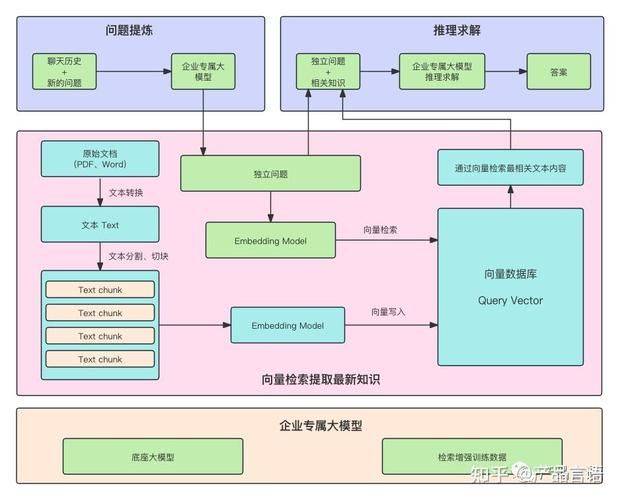
Programme i: basic rag + retrieval upgrade (introduction) 2. 1 core architecture
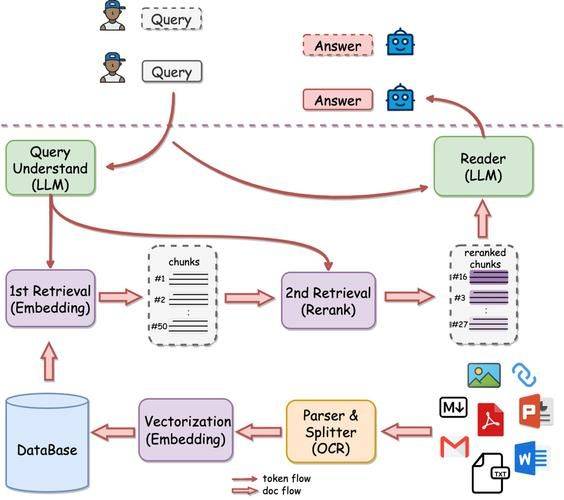
The basic rag uses a three-tiered structure, retrieval-enhanced-generating, which is the starting point for the development of a high-accuracy knowledge base question and answer system:
2. 2 key optimization strategies
(1) mixed search
There are natural limitations to a single search: vector-retrieving is good at capturing semantics, but underperforming in precise matching; keyword-retrieving (e. G. Bm25) is good at exact matching, but lacks semantic understanding. The combination of the two has become the cornerstone of modern rag systems. A study by google research in 2025 showed that mixed search methods had increased by 15-20 per cent over single search methods in mean recipocal rank (mrr) on complex technical and long-tail queries. In terms of modalities for achieving this, late fusion (retribution after search) and earthly fusion (reconsolidation at search level) are the two main paradigms that can be selected in practical application on the basis of query characteristics。
(2) multi-road recall + reorder
Capacity constraints in a single search programme can be avoided by multiple-road recall. In the diffy+ragflow practice, a combination of vector search, keyword retrieval and metadata filtering resulted in a 98 per cent precision match in the area of medical equipment. Reordering further enhances the relevance of top-k results by reordering primary screening results using more robust models (e. G. Cross-encoder)。
(3) query rewriting
There is often a semantic gap between user queries and knowledge base documents. By extending, decomposing or abstracting the original problem through llm, multiple semantic equivalents with different expressions of query variants can effectively enhance the search coverage. Hyde (hypothetic d)The document embeddings approach goes a step further: the llm is used to generate hypothetical answers to the document, then the vector of the document is used to retrieve it, and the search effect is optimized using the more similar characteristics of the answer。
(4) divisional strategy optimization
Document slicing (chunking) directly influences search accuracy. The small-to-big policy is mapped by size text blocks, balancing search accuracy with context enrichment。
2. 3 applicable scenarios and limitations
The basic rag programme is simple and low-cost for deployment, suitable for a small and medium-sized knowledge base and a single jump to a simple question and answer scenario. However, the accuracy rate is significantly limited when dealing with complex tasks such as multi-jumping reasoning and cross-document association。
Iii. Option ii: graphrg + knowledge mapping enhancement (performance) 3. 1 core thinking
The traditional vector rag splits the document into separate pieces, losing the logic between the clips. Graphrag has a significant advantage in dealing with complex relationship modelling, multi-jumping reasoning and knowledge linkages in a multi-document landscape by building knowledge maps to demonstrate modelling entities and relationships。
3. 2 technological architecture and realization
The typical work flow of graphrag consists of three core elements: document-based knowledge mapping, organizational summary of the mapping to support retrieval, and response to user queries through retrieval of data。
Kg-rag (knowledge graph-extended rag) further integrates knowledge mapping with rag in depth, including problem decomposition modules to enhance multi-jumping information retrieval and interpretability, using in-coNtext learning and chain-of-thought hints to generate a visible chain of reasoning. On the mIn the etaqa baseline test, kg-rag achieved a higher accuracy rate for multiple jumps。
3. 3 evidence of accuracy
In the area of clinical questions and answers, which is an area of great accuracy, groundbreaking results have been achieved in the context of the onothetical-based framework of the graphrag:
The framework correctly answered 59 out of 60 clinical questions, and the hallucinogenic rate was more than 61 percentage points lower than sota llm. Another case study in the area of finance showed that graphrag improved the accuracy of the answers by up to 35 per cent, while reducing token consumption。
3. 4 variants
(1) speculation of certainty vs llm extract
For structured data, such as the code library, it is based on an ast (abstract syntax tree) automatically generated definitive maps that significantly outpace llm extracts in terms of multiple jump coverage and reliability。
(2) gc-qa-rag
The 100-degree developer practice programme, which built the dual-engineer structure of the area knowledge mapping + vector database, achieved an answer accuracy of 92. 3 per cent in the financial sector (84. 7 per cent in traditional rag) and delayed response
(3) polyg's self-adaptation map
Using different mapping-crossing strategies for different types of issues, the yield success rate was 75 per cent and the response rate four times higher than the sota graphragm method。
3. 5 applicable scenarios and limitations
Graphrag is particularly suited to situations requiring precise logical reasoning, such as medical diagnostic aids, search for legal texts, financial analysis, and multi-jumping reasoning. The limitation is that the construction and maintenance costs of the knowledge map are high, and synchronized updating of the map is a engineering challenge for frequently updated unstructured documents。
Iv. Programme iii: crag/self-rag + self-correction and feedback (senior level) 4. 1 corrective rag (crag)
Traditional rag assumes that the results are always relevant, but in practice the search may return inaccurate or irrelevant content. The core philosophy of crag is to improve the system's ability to respond to search failures by pre-evaluating the quality of the search and designing a correction strategy。
Crag introduced a “grader” evaluator to measure the quality of the results:
4. 2 self-rag
Self-rag goes further, assessing and adjusting in real time during generation. It produces a special “rethinking tokens” by training llm to self-assess the relevance, support and usefulness of the search results in the process and to trigger new searches as needed。
4. 3 double-stage rag optimization
The method of pre-response and recall filtering is structured in two stages: phase i generates candidate answers, and phase ii is based on candidate answers based on reverse validation and filtering results, thus addressing the problem of potential user intent to undercover and recall low quality。
4. 4 applicable scenarios and limitations
Fits to situations where the quality of the answer is very high and allows for a slightly higher delay. Crag and self-rag performed well in multi-jumping questions and answers (e. G. Hotpotqa, 2wikimultihopqa). The limitation is that additional computing costs and model calls are required to achieve greater complexity。
Programme iv: institutional rag (front) 5. 1 core thinking
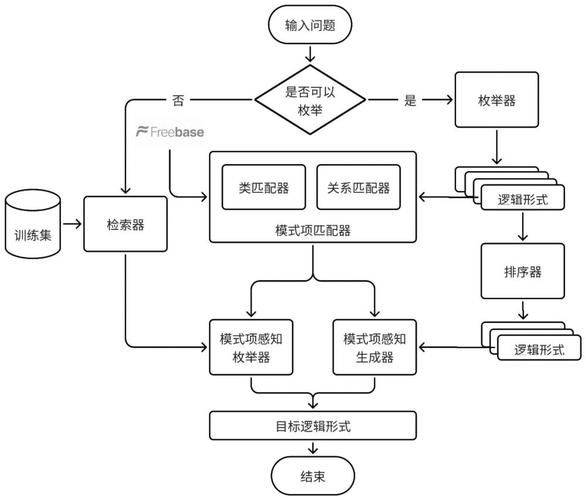
Agenic rag introduced the intelligent body (agent) paradigm into knowledge retrieval, making the system no longer a static “retriev-generated” conduit, but an “ai fellow” capable of autonomous planning, dynamic routing and rethinking adjustments。
5. 2 key technical characteristics 5. 3 empirical effects
The knowledge assistant of databricks uses the agenic structure, up to 70 per cent more than the traditional rag methodology in terms of the quality of questions and answers. Following the upgrading of the agenic knowledge base for entertainment, it was upgraded from a “staff-enabled knowledge base” to “the knowledge base that is capable of governing knowledge and of performing tasks”, which is able to accurately dismantle the core requirements of users (e. G. Time horizon, industry type, content category, etc.)。
5. 4 applicable scenery and limitations
High-end scenarios suitable for complex enterprise-level knowledge management, a multi-source isomeric knowledge base, and the need for autonomous implementation of mandates. Limitations are: high complexity of systems, high demand for llm capabilities and high deployment and optimization thresholds。
Vi. Option 5: spectrum detection and validation enhancements (auxiliary programme)
In any major programme, hallucinating detection and fact-based verification are important complementary layers for ensuring high accuracy。
6. 1 search result validation
The esapiens enterprise-level question-and-answer system introduced the reference verification loop to verify the consistency of references to search results and to ensure that the link between answers and evidence is accurate。
6. 2 declaration level fine particle level validation
The rt4chart framework breaks the model output into a stand-alone, verifiable declaration, a hierarchical validation of the article by context and a reference to “implied, contradictory or unfounded” each declaration. On the ragtruth++ data set, the hallucinogenic test f1 reached 0. 776, an 83 per cent increase over the strongest baseline。
6. 3 real-time white box loyalty monitoring
Latentaudit uses the geometric properties of the meso-diplomatic fluxes of the generator for real-time faithfulness monitoring without the need for additional judgement models. On pubmedqa, the method reached 0. 942 auroc with a delay of only 0. 77 ms。
6. 4 optimization of the chinese scene
Questions and answers to the chinese knowledge base require special attention:
Overview of the latest technological developments (2025-2026): rag has matured into an auditable ai design model
The systematic overview published in 2026 by the computer science review presents a four-stage harmonized classification of “index-research-integration-generation” that locates rag as a mature design model for the construction of a landable, auditable ai system. The synthesis covers the full evolutionary path from the base of victor rg to graph rg, and draws the development landscape of emerging paradigms such as agenic rg, multimedia rg, hybrid rg。
7. 2 dcd: area-oriented controlled rag
Dcd submitted in april 2026
Domain-collection-dThe framework, which structures knowledge and controls query processing through area-oriented design, can achieve precision control over rag system behaviour without changing the bottom language model。
7. 3 graphretriever: integration of text embedding with graph history
MThe gramphretriever system, introduced in 2026, effectively integrates text into the map-wide capability and is capable of handling complex multiple-jump queries。
7. 4 bubblerag: evidence driver of black box knowledge
In response to a black box knowledge mapping scene that does not predict spectrometry patterns and structures, bubblerag addresses semantic case and path structure uncertainties through an evidence-driven approach。
7. 5 seal-rag: fixed budget evidence assembly
In response to the dilution of the context in multiple jump rags, seal-rag assembled evidence within the fixed budget and performed better against the baselines of basic rag, crag, self-rag in hotpotqa and 2wikimultihopqa。
7. 6 llm generates metadata for enhanced retrieval
A system study in 2026 demonstrated the use of llm to generate metadata to enhance the empirical framework of the rag system, which significantly enhanced the quality of retrieval by enriching document metadata。
Viii. Programme comparison and selection suggested rapid validation/poc: basic rag+ mixed search + reordering, with the option of fast-tracking high-precision specialized areas (medical, legal, financial) with a mature open-source framework such as maxkb and dify: the graphrg programme, with clear and complex multiple-drival scenarios of accuracy advantages: graphrg or agentic rag large-scale deployment at the enterprise level: agentic rag, taking into account accuracy, scalability and governance in chinese: it is important to select an optimised embeding model (e. G. Source yuan-eb 2. 0, acge text embedding, qwen3 embedding) and to search for the chinese generic accuracy assurance list
Regardless of which option is chosen, it is recommended that accuracy rates be systematically guaranteed from the following dimensions:
Optimizing dimensions
Specific measures
Knowledge base pre-processing
Document cleaning, smart segment, metadata labeling, go to noise again
Retrieval optimization
Mixed search ( vector + bm25) multiroad recall, reordering
Query enhancement
Query rewriting, query decomposition, hyde hypothetical document generation
Generate control
Binding decoded, de facto verified, quoted retroactively
Paranoia
Search result validation, declaration level validation, real-time monitoring
Continuous optimization