As of 11 may 2026, according to the most recent data, we have applied for more than 2,400 low-altitude economy-related patents this year, covering a number of core areas, such as flight design, intelligent flight control, auto-piloting and airworthiness certification. At the same time, the cumulative number of low-altitude economy-related enterprises registered in our country throughout 2025 was nearly 50,000, up from 138. 4 per cent in the same year, up from almost 10 years of enrolment and growth。
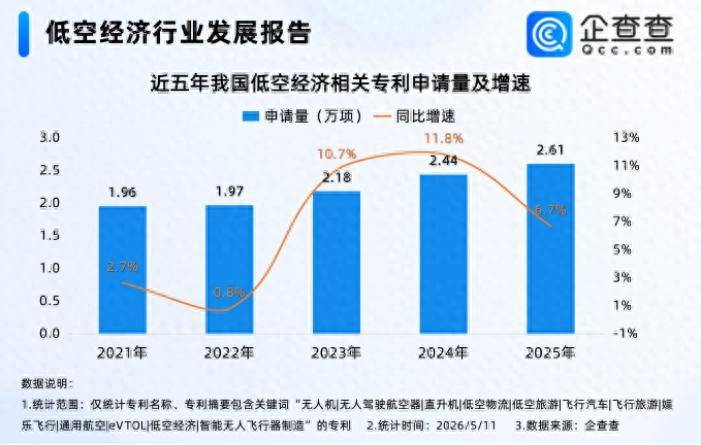
The twin outbreaks of business registration and patent innovation bode well for china’s low-altitude economy to enter a new phase of technology-intensive development, and enterprises are building their technological voice through large-scale patented layouts。
Over 70 percent of the world. Long triangles
According to a consultant's report, the number of patent applications for inventions in china's low-altitude economy increased from 1501 in 2015 to 1,7191 in 2024, an increase of more than 11 times, and the number of annual patent applications for inventions has remained constant at more than 10,000 since 2021. The number of new patent applications for inventions in the first half of 2025 amounted to 11165, an increase of 51. 6 per cent over the same period in the previous year. In 2026, this growth continued to be strong。
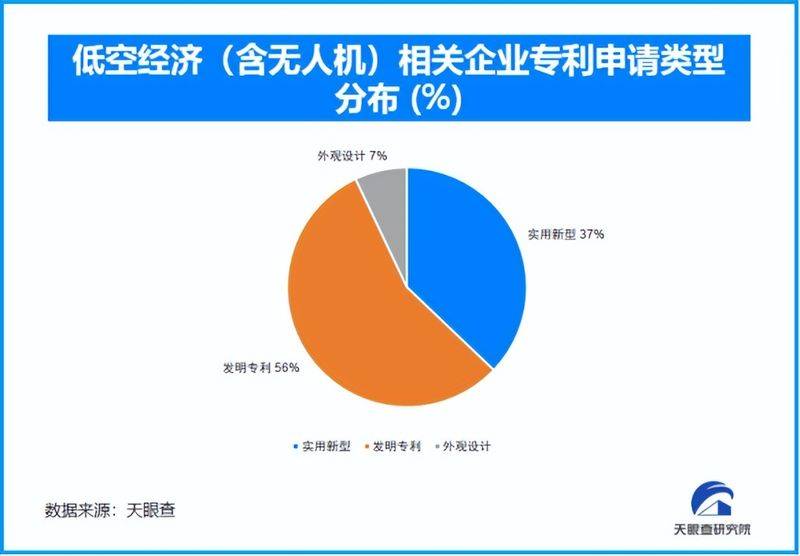
Data from the skywatch professional edition show that the number of relevant patent applications in the low-altitude economy and the field of drones amounted to more than 179,000 by the beginning of 2026. Of these, 56 per cent were patented for inventions, 37 per cent were patented for practical novelty and 7 per cent were designed for appearance。
The volume advantage of patents in our low-altitude economy is also particularly prominent in international competition. The data show that our country is the main source of technology in the low-altitude economy, with more than 70 per cent of the total number of patent applications globally, with approximately 70 per cent of the world's patents in the core areas of drones and the world's largest. China's weekly economic journal reports that the low-altitude economy is the new track of industrial competition, and that a rational distribution of intellectual property rights in this area can promote the health of enterprises and their healthy development, while helping the state to seize the new technological highs。
In terms of the regional distribution of the country, the patents of our low-altitude economy are clearly concentrated. The long triangle, port-au-prince, bay of australia, and kyoutin-yu together brought together more than 70 per cent of the country's core industrial chains。
Among them, the bay of australasia is the absolute leader, and guangdong province is home to over 30 per cent of the country's low-altitude economic industrial chains, which are the country's first; the long triangle, with its strong high-end manufacturing base, has created a full-chain industry cluster covering shipping materials, core parts and components, institution-building and operation services; and kyinzu, relying on the resources of the top aviation research institutes and higher education institutions, holds a central technological lead。
Data from the forward industry institute show that, as of 2025, shenzhen and beijing were awarded 1,018 and 15557, respectively, and that the number of municipal patents in guangzhou, chengdu and nanjing exceeded 5,000. The shenzhen low-altitude economic industry patents are over one third distributed overseas and the share of valid patents is over 34 per cent, with the share of invention patents and the retention rate of valid invention patents for more than five years being higher than the overall city-wide level。
Core technologies such as composing layout, batteries, electrical controls, chips, etc
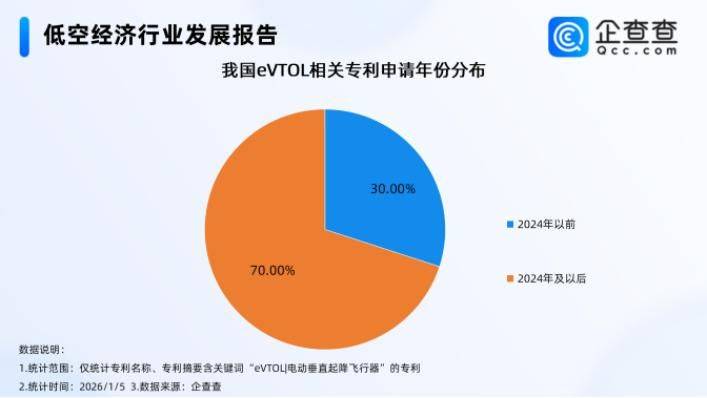
Core technical areas, such as the whole machine, batteries, electrical controls, chips, etc., are becoming the “soldier's game” for the patent layout of enterprises. Of these, evtol, as the core vehicle for low-altitude transport, is one of the most intensive areas of patent layout. Data from the survey show that, as of the beginning of 2026, there were 450 evtol-related patents in existence in the country, of which 70 per cent were patent applications in 2024 and beyond, with over 150 applications per year. The number of patents related to flying cars in the country was 1707, with over 70 per cent of patent applications in the last five years and 412 in 2025, an increase of 20. 12 per cent over the same period。
In the overall technology field, in the patenting of the complete technology, the direction of rotary wing formations, composite wing configurations and foldable flight wings became hot spots. Wao fei long space has issued more than 400 patents around the product ae200, and the patent pool fully covers key technological areas such as overall aerodynamics, structural strength, energy power, flight control and air power systems。
In addition, the number of cross-sectoral entrants is increasing. In january 2026, jiang huai's car published a patent for the invention of a “multi-modular flying car”, while chiri's car published a patent for a “vertical lift-off vehicle” during the same period. The low-altitude economy is attracting an accelerated influx of power from the automobile industry。
Batteries are the “heart” of low-altitude aircraft and their value in the low-altitude economy is expected to be around 15-20 per cent. In the battery area, energy density and safety are the twin objectives of patent enforcement. The current energy density of the main lithium batteries in the industry is only 160-250 wh/kg, with the continuation limited to 30 minutes, making it the biggest bottleneck for commercialization. The patent layout thus focuses on three main directions: energy intensity increase, heat management optimization and structural redundancy。
Solid-state batteries are seen as the dominant direction of future technologies and are the focus of global competition. Sun mingjiu, the chief intellectual property officer of the ningde era, revealed that “more than 1,000 patents on solid batteries are patented, and we need to scale up”. Our country has a dominant position in the patent area for lithium batteries, accounting for 49. 3 per cent of the world's associated patents, of which the ningde era and the billion-latitude lithium can be the “two male” of the domestic battery patent scheme。
On the other hand, from a global patent map, the battery technology area has developed a hybrid battery architecture, an aviation battery management system, a vertical lift-down field charging infrastructure and a predictive energy management track, and the power system patent has been extended to battery package integration, fast-spread heat and energy intelligence management in flight conditions。
The field of electrical control and voltage is the “power hub” and “neurological hub” of low-altitude vehicles. The entire electro-pulsive system (power-bearing, electrical control, speed-retarders) accounts for up to 40 per cent of the total bom. From the global vtol and uam patent maps, the number of patents in the combination of “electronic speeders x fixed wings” is as high as 1,388 and the number of “electronic speeders x rotary wings” is 363。
Source: ai
In the direction of low-altitude communications, navigation chips and so forth, patent layouts revolve around forward technologies such as 5g telepathic integration, low-orbit satellite internet communication terminals, and airborne ai sensor chips. For example, the 5g-a low-altitude communication solution, the integrated open-space network architecture, and the uav 5g radar sensor system are all subject to a large number of patents. The technology accumulation and patent layout of space science and technology in the fields of communications, navigation and remote sensing are at the bottom of the low-altitude economy, and beidou navigation systems have been applied to multiple sites in combination with high-precision positioning techniques。
It was described that chinese patent applications in key areas such as drone communications, low-altitude network structures, which accounted for 17 per cent of the world's related areas, were well above competitors such as high-speed and medium-migrating satellites, and formed a tight network of patent protection through the globalization of major markets such as the united states, europe and japan. China has developed low-altitude communication solutions based on 5g-a technology, and its patent for an “integrated open space network structure” has creatively solved the problem of signal switching between vehicles at altitudes of 1-6 km。
Who's the big professional? The proliferation of patent applications coincided with intellectual property disputes
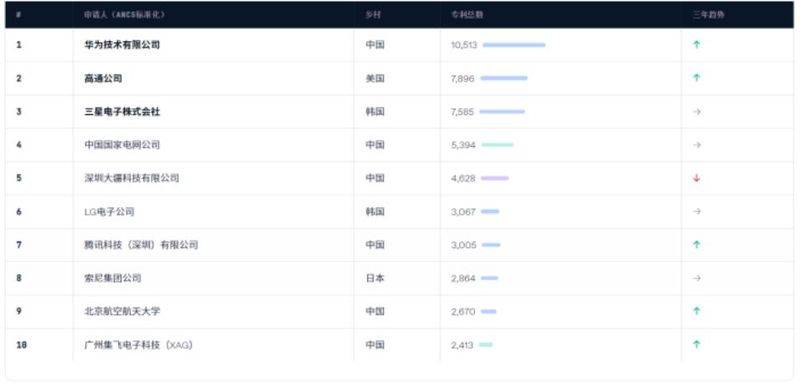
In the patent layout of drones, domestic firms are leading the world with significant head effects. According to patsnapeureka's 2026 uav patent roll, the top 10 applicants worldwide, out of a total of approximately 743,000 uav-related patents, have six seats in chinese enterprises. China is at the top of the 10,513 national electricity grids, taijia, telecommunications, north flight, and ultra-flying technologies。
In the area of agricultural drones, as of 2025, polar flying technology had over 4,100 patents and the global number of applications for agricultural drones over 4,400, ranked first in the country. Moreover, in the global evtol area, the total number of intellectual property and patents on billion voyages is at the top of the industry, accounting for over 13 per cent. The vice-president of smart billion airlines, horsun, revealed that “billion airlines has acquired and is applying for over 1,000 patents”. Companies cumulatively applied for more than 1100 patents at home and abroad, representing approximately 58 per cent of patents on inventions。
Wafe has 73 patents in power systems and 86 patents related to peak flight aviation. The wind future and the volant enterprise have also intensified their deployment in the areas of composite wing formations and flight control。
In the case of battery parts, as of 2024, the number of patents and patent applications in the ningde era amounted to 4. 34 million, of which 254,000 were in the country and 179,000 were outside the country; 10,000 were authorized and currently being applied for, of which 6293 were granted。
With regard to higher education and research institutes, the nanjing university of aeronautics and astronautics ran with 594 patents, followed by beijing university of aeronautics and astronautics (498) and north-west industrial university (411), constituting the “iron triangle” for basic research in low-altitude economies。
The proliferation of patent applications has been accompanied by a concentration of intellectual property disputes. In march 2022, according to the chinese economic journal, billions of air intelligence received in the united states a patent infringement action initiated by npe (a non-proprietary subject, patented but not patented product production agency), with a high amount of compensation claimed. In september 2025, daeji was sued in the united states by cellpin, a company that had had 17 patents for almost no real product over the years, a typical npe feature。
Li wen woo, director of the centre for intellectual property and innovation development of the chinese institute of information and communication technology, stated, with regard to overseas litigation, that “when enterprises face patent challenges, there is a good chance that the plaintiff will withdraw or that we will win.”
At the same time, domestic drone intellectual property disputes have continued. In march 2026, daeji prosecuted the shadow innovation, which involved six patent tenure disputes involving several former daeji core researchers. The njp commented that such disputes reflected the fact that the consumer image industry was entering a phase of intense patent competition and that when a industry began to have a large number of patent litigations, it was becoming mature。
In may 2026, the people's court reported that 19 disputes over patent rights had arisen between two low-altitude economic enterprises in shanghai, and that the intellectual property tribunal of the supreme people's court, through mediation, had innovatively proposed a programme of “pre-licension, post-consultation fees”, which had led to the withdrawal of appeals or prosecutions in all cases。