In high-temperature industrial systems such as electricity, iron and steel, focal, chemical and cement, valves are the core components for flue gas control, fluid break-up and regulation, known as the “sniffing” of industrial pipelines. Valves with different structures, different drivers, vary greatly in terms of sealing performance, heat resistance, anti-dust cards, operating costs, etc. In order to facilitate the selection of enterprises, this paper system provides clear and practical reference for industrial users by combing the product characteristics, advantages and suitability of the main industrial valves, such as the ball valves, the butterfly valves, the lock valves and the pyrotechnic piping valves, as well as by comparing the actual performance of the traditional valves with the popular pipe pyrotechnic pyrotechnic valves under the high-temperature flue process。
I. Ball valves: fast-disable valves, sealed but restricted
Structure and working principles
The ball valves use the sphere as an encirclement, rotate 90° by the center line of the sphere around the pole, open and shut down, with straight passages, small flow barriers and speed of containment。
Core characteristics
:: capable of sealing, stable and low leakage
• a well-structured, fast-opening, fit for scenes that need to be quickly cut off
• resist certain corrosiveness and apply a wide range of media。
Main shortcomings
• limited maximum temperature tolerance, prone to seal failure and spherical deformation at high temperatures
• high-calibre manufacturing costs and weight
• low resistance to dust, ash-resistant, impassable and inappropriate for high dust and gas environments。
Typical fit scenario
Gas, oil, water purification, chemical corrosive liquid pipelines
• rapid cut-off of mid-temperature, clean media, small- and medium-calibre
• not applicable: high-temperature flue lanes, high dust, large-calibre smoke systems。
Ii. Flutter valves: light quantification of large calibre valves, low cost but clear sealing and energy consumption
Structure and working principles
The butterfly valves, which are closed on a circular plate, rotate around a fixed axis to achieve a switch, are simple in structure, light in weight and small in space, and are common valves for large-calibre low-pressure scenarios。
Core characteristics
:: large calibre coverage suitable for large diameter pipelines
• low manufacturing costs and ease of installation
• a faster rate of closure and a small space occupancy。
Main shortcomings
• a general sealing function, which makes it difficult to achieve a tight cut-off and is prone to leakage
• high temperature and deformation of the balconies and wear and tear of the seal surface
• high dust environment, which is highly dusty
• the traditional shutters require 24 hours of sealed wind, with high energy consumption and frequent maintenance。
Typical fit scenario
• municipal ventilation, air conditioning systems, low pressure air pipes
• large-calibre low-pressure fluid scenes with low seal requirements
• not applicable: high-temperature flue gas, environmentally demanding and continuously stable industrial flue streams。
Iii. Conventional lock valves: straight-line lift-down break-through valves with low resistance but high temperature and failure
Structure and working principles
The valves, which rise and fall vertically through the gateboards, break down the pipeline, have a straight flow, have little resistance and are commonly cut-off valves for traditional industrial pipelines。
Core characteristics
• small resistance and smooth passage of media without compromising the efficiency of circulation
• the range of calibres to be applied is wide and universal。
Main shortcomings
• the plate is deformed in a high-temperature environment and the seal is disabled
• lack of special anti-dust designs and high-dust work conditions
• slow start-up speed, insufficient driving power and no self-locking protection
:: untargeted corruption-proof structures, with short lifespans in flue gas-corrosion environments。
Typical fit scenario
• drainage, oils, constant fluid pipelines
• common low-pressure, dust-free and corrosive break-up scenes
• not applicable: high temperature, high dust, strong corrosive flue。
Iv. Popular flueque hydraulic valves: special custom valves for high-temperature chimneys designed for extreme conditions
Structure and working principles
Fluctuation valves employ new hydraulic-driven technologies, with plugs using the oil-shaped composite plate patent structure, which is smooth, rigid and non-transformable at high temperatures. The valve is opened with a complete exit of the pyrotechnic and, when closed, with a rigid and complex seal, a dedicated cut-off valve for the development of high-temperature industrial flue。
Core characteristics
1. Sealed and leak-free, using laser-substance, numerically controlled precision processing, with soft seals + hard seal patent structure: soft seals are high-temperature-resistant grinding graphite root, hard seals are two-way stainless steel-specific orbits and can be sealed up to 99%, completely eliminating leakages and leakages and meeting environmental emission requirements。
2. Switches are flexible, impregnated, hydraulic-driven cylindrical push 17 tons and pull 13 tons, with a strong power that can overcome high resistance and ash resistance; the diamond-shaped composite sheet structure is resistant to push and static, and structurally solves the problem of carding。
3. The long-life design has a useful life of 15 years and can be customized for materials such as carbon steel lined two-way stainless steel, 316 l, 1. 4529 etc., depending on the conditions of the work; open-state plugs outside the flue stream, avoiding direct corrosion of high temperature smoke gases and significantly increasing the lifespan。
4. Operating at very low cost with 3kw power, switch speed of 0. 7 m/m and no electricity consumption when the switch is in place. The average daily electricity cost for the shutters is over $100, the annual electricity cost + the maintenance cost is over $40,000, and the advantages of energy conservation and transport are very clear。
5. Secure, intelligently connected hydraulic systems with limits, self-locks, tops with mechanical anti-deflation devices to prevent downturns; access to dcs systems to achieve on-site + remote automatic control; and manual release in case of emergency。
Typical fit scenario
• iron and steel industry: sintering machines, furnaces, furnaces, high-temperature pyrotechnics
• electricity industry: boilers, devulcanized nitrite, fume gas cut-off from the dust removal system
:: caramel industry: stoves, chemical tailings, corrosive fluelets with tar
• chemical industry: high temperature, toxic, dust-containing crystal-gas pipes
• all high-temperature, high dust, strong corrosive industrial chimneys, such as cement and smelting。
V. Summary of core comparisons of the four main industrial valves
Table
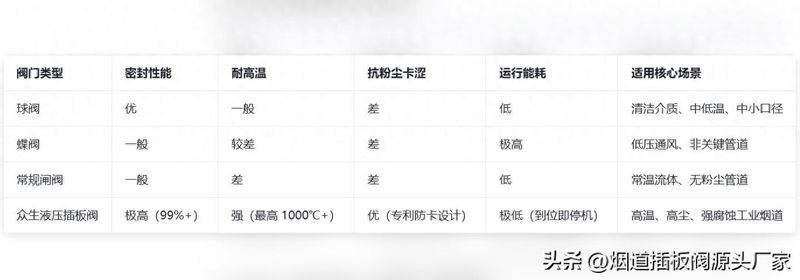
Concluding remarks: industrial valve selection, key look at " status matching"
General valves, such as ball valves, butterfly valves and lock valves, have cost and utility advantages in the context of constant temperatures, cleanness, low-pressure scenes, but in the context of high temperatures, high dust, strong corrosiveness and continuous production of industrial pyrotechnic scenes, there are widespread rigid injuries with poor seals, imperviousness, short lifespans and high energy consumption。
From the point of actual engineering pain, the artificial flueque valves, designed for high-temperature pyrotechnic scenes such as steel, electricity, corrosion and chemicals, have achieved close sealing, impregnated, long-lived and four core breakthroughs of low energy consumption, which are the preferred options for upgrading the traditional valves and provide a reliable guarantee of environmentally sound performance, stable production and reduced efficiency in industrial enterprises。