What's astronomical? Most people speak clearly about mathematics, physics, chemistry, but the knowledge of astronomy is very vague and often confused with meteorology, earth sciences, space science and even astrologers。
The oldest science
Early people are engaged in farming, life is simple, the sun rises, the sun sets, there are no tvs at night, mobile phones can slide, no department stores or night markets can walk, even without lights. But because there is no light, there is no light, the stars of the night are not affected by the light of the world, the bright stars and the magnificent milky way are so clear that they become the subject of stories at night. The ancient greeks associated the stars of the night with a single constellation, and then linked them to myths, which have been so wonderful。
The ancients may have looked at stars and constellations at first, and then found that the constellations of each season were different, for example, from the summer, autumn and winter seasons. Some advanced ancient civilizations look at the sky and give them the power of "the sky", thereby improving their lives and developing strong civilizations with a good life. For example, the ancient egyptians will observe the eastern sky before sunrise, and if sirius is seen rising earlier than the sun (known as sirius rising by the sun), it means that the nile is about to flood. In fact, the nile river is not connected to sirius, which rises earlier than the sun in mid-august each year, when 2,000 kilometres south of the river is being rained in the highlands of ethiopia, the upper nile, by the monsoon, which is responsible for the downstream nile。
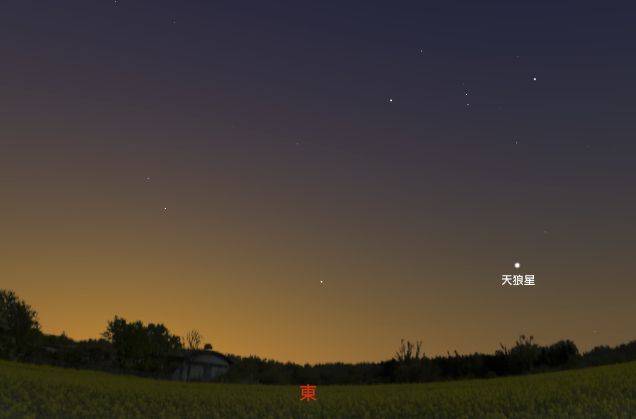
In mid-august each year sirius rises before the sun, and the ancient egyptians know that the nile is about to overflow. (stellarim soft system)
At the end of the day, it was the sun that caused the ethiopian monsoon, which operated directly on the local climate. Astronomy is one of the oldest sciences of the four seasons of change caused by solar operation, which is very important for farming and fishing, with animals migrating in accordance with seasonal changes, and with sunlight of greater duration affecting crop growth。
Scope of astronomy
Early human beings, using phenomena or objects in the sky as part of astronomy, were classified as astronomy, from clouds, lightning, rainbows, dizziness, aurora, to the sun, moons, planets and stars. In recent times, scientists have divided regions in the atmosphere into atmospheric sciences and meteorology, so that phenomena in the atmosphere, such as clouds, rainbows, dizziness and hallucinogenics, are part of atmospheric science. Interestingly, sometimes astronomers are taught when seeing the phenomena of rainbows, dizziness and phantoms, and photographs of these phenomena are published on astronomical websites or magazines, although these are part of atmospheric science。
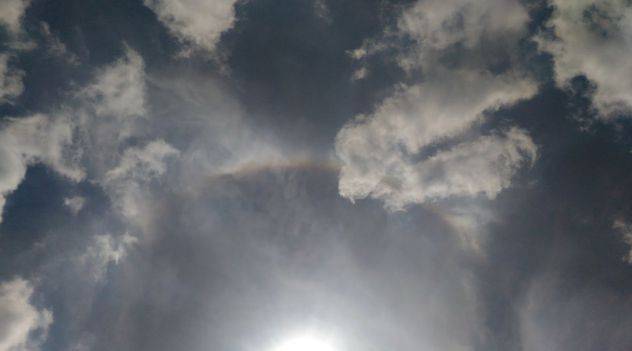
Daylight is a phenomenon in the atmosphere and a result of the reflection of solar light by ice crystals. Photo by li xiu
Since the launch of the first artificial satellite by mankind in 1957, many ships have entered space to explore various bodies of the solar system, and new doors have emerged: space science (or planetary science), which is based on the study of the solar system for planets, satellites, comets, asteroids, dwarfs, etc. In addition, earth science is a study of the earth's oceans, atmosphere and geology, focusing on earth-related research。
Physics is the science closest to astronomy, which is in fact a branch of physics, and astronomers use the knowledge and laws of physics to explain the phenomena we observe. The biggest difference between astrophysics and physics is that physics can normally be experimented in a laboratory, but not in astronomicals, and astronomers can only observe the results of an “experiment”, which may be the exclusive right of the “constructor”
The range studied by astronomy usually refers to areas outside our solar system, including stars, galaxies and the entire universe. There are hundreds of billions of star systems in our galaxy, and the solar system is just one of the hundreds of billions of systems, and, of course, our solar system is covered by a broad astronomy。
The hubble space telescope is a picture of almost one galaxy with a dense body. Image source: nasa
Physics, meteorology, earth science, space science, planetary science and astronomicals are all scientific approaches to research, with different objectives. And astronomy, which speculates on the fate and movement of individuals, is not science, and astronomy is not directly related to astronomy。
Why study astronomy
Why study astronomy? The same question may be asked, why study history? Why study literature, music and art? Meeting human desire for knowledge, understanding the universe, understanding our past and even the future is the same as studying history. For those who like astronomy, the universe is as beautiful as a poem, as a picture, as many people like literature, music and art。
Would you like to know how the stars are coming? How many stars in the universe? How big is the universe? How did the universe come from? Is there really an alien life? These are actually astronomers who study and answer questions. Imagine a child asking how the universe came. If only to tell him that the universe was created in the first place, would children be satisfied with such an answer
Columbus can discover the new continent. Astronomical knowledge is important, in addition to excellent navigational technology! On 30 june 1503 columbus, from europe, arrived in jamaica, where natives initially welcomed them and provided them with food, but later a number of sublime sailors cheated and stole from them, and then stopped supplying them. Columbus learned from the ship's astronomical yearbook that there was a full monthly diet on march 1, 1504, and then told the indigenous people that if they were not fed, god would be angry and make the moon red. On the night of march 1st, the moon became blood red, as columbus had said, and the natives thought god was really angry, so hurry up and provide columbus food。
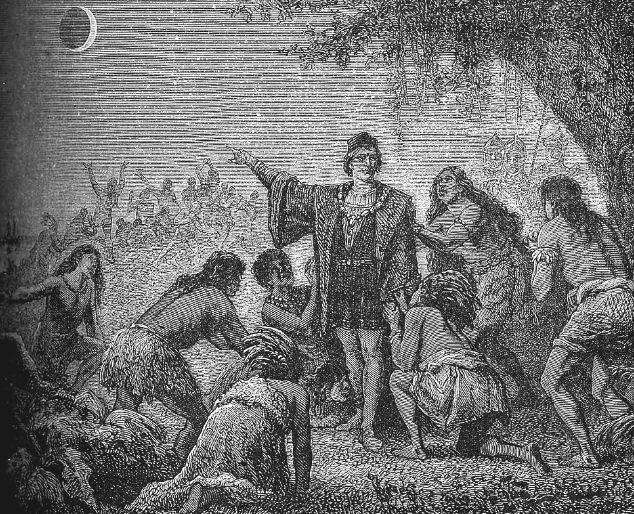
Columbus made jamaica's native name angry, so the moon turned red. Author: camille flammarion
Bacon said, "knowledge is power," and columbus used his astronomical knowledge to allow the natives of jamaica to continue to feed them. Would columbus be able to feed them if he did not know that the eclipse was imminent? If the natives of jamaica knew that the eclipse was imminent, would they be deceived? If one day aliens come to earth and tell us that the planet is about to be destroyed, if we are to provide what we need, will aliens be willing to help us? Do we have enough knowledge to judge whether they are right or wrong? Or are we just gonna be native jamaicans
It's not just the eclipse, but the early humans are afraid of other astronomical phenomena. The eclipse is when the dog swallows the sun, when the people on the ground knock on the drums to drive the dog away, and the comet is a sweep of bad luck. As if the stars were to escape, the meteor shower was like the end of the world, and the stars fell down. But when we know the story of these stars, they become the subject of a lot of people's pursuits, many of them coming all over the world to watch them for the sake of the sun, and comets are the target of people's pursuits, and meteor showers are all the more crowded
Changing human values
In the middle ages, europeans generally accepted that the earth was the center of the entire universe, around which the sun, the moon and the planets orbit. The renaissance copernicus, 1473-1543, put forward the idea that the sun was the centre of the universe and that the earth and other planets were orbiting it. Giordano bruno, 1548-1600) goes even further, saying that the sun is only the centre of the solar system, and that it is just one of many stars in the galaxy。
Is our galaxy the only galaxy in the universe? Edwin hubble, 1889-1953 proves that the sensico nebula is actually a galaxy outside the milky way, and our galaxy is just one of many galaxies in the universe
The universe is so vast, so how did it come? Hubble discovered the more distant galaxies we were, the faster we were away from us, but we were not the center of the universe, but each galaxy was away from each other, which overturned the idea that newton and einstein thought the universe was static. This discovery by hubble was later derived from the big thunder theory that the universe was born about 13. 7 billion years ago, expanding from a very small, very hot point to the present. Will our universe continue to expand? Yes, and it's growing faster! Astronomers are constantly changing our minds from self-centred to accepting possibilities, like all scientific exploration processes, one step at a time towards truth。
Carl sagan recommends that the seafarer 1 (voyager 1), far from the solar system, return to a picture of the earth, which on 14 february 1990 was far beyond pluto's orbit, where the earth was smaller than a painting! If we don't know where the earth is in the image, no one will be able to find our home。
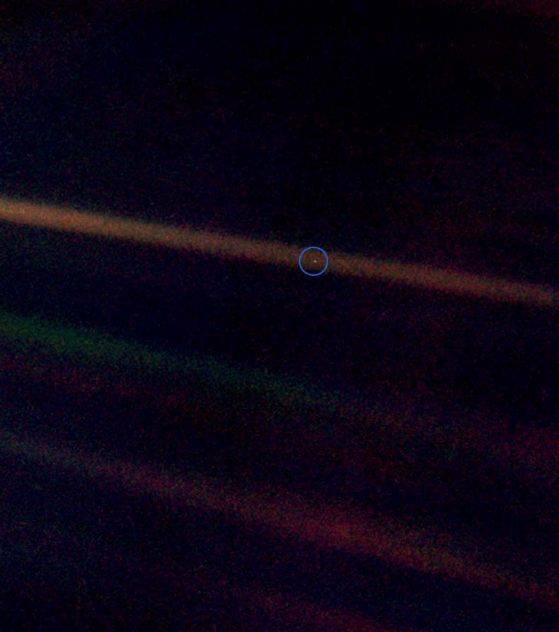
The small spots in the blue circle are our earth, and the brown stripes are the result of sunlight. Image from nasa navigator one
Away from the earth, far from the solar system, flying to the cosmos, vast, unbridled, unbounded, unbridled, unbridled, with many unknowns in astronomical sciences waiting for us to explore