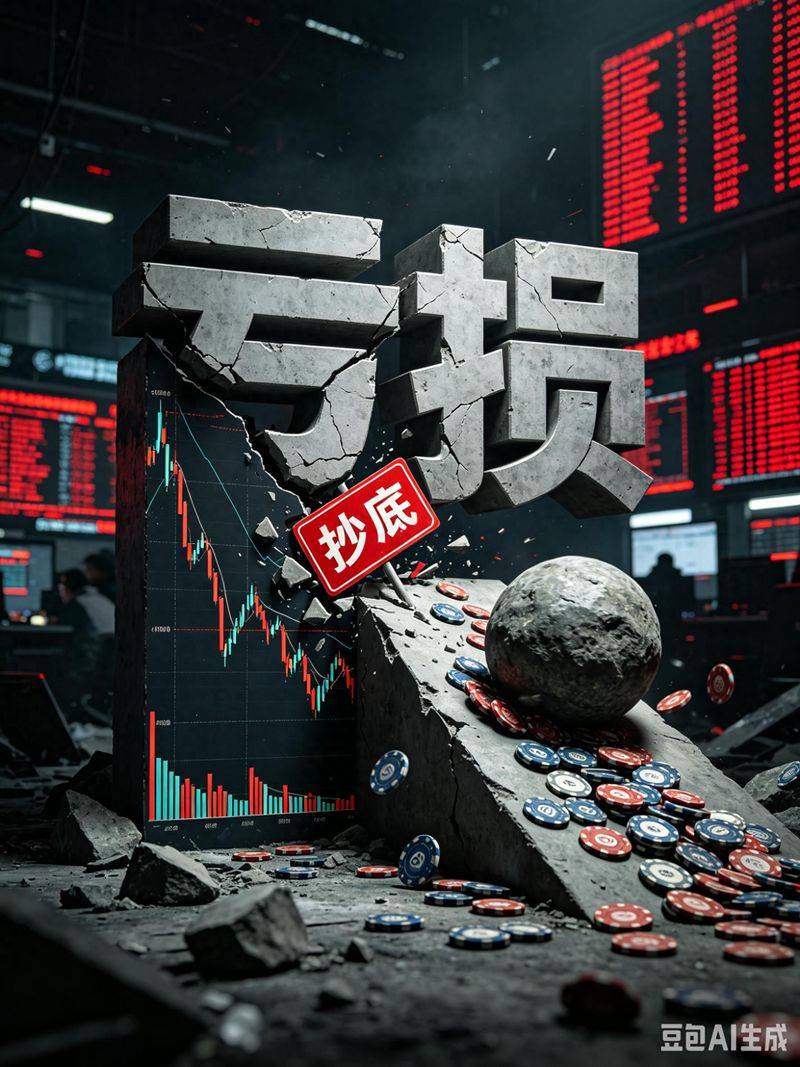
Looking at the a stock market data over the years, the vast majority of ordinary investors have long been unprofitable and persistent account losses have long been widespread. There are two kinds of triggers for a significant reduction in the flow of funds: a small fall in stock prices, with the result that downfalls are taken blindly as the bottom; and a reluctance to stop damage following the retreat of the hold-up band, leaving it open for losses to increase and ultimately for depth. Many shareholders continue to blame their losses for poor financial performances and harvests by market owners, while ignoring their own wrong trading habits。
In combination with the current market environment of stock shock a, the pattern of plate rotation, operational skills, new-hand pit avoidance points, mental retrofitting, long-line configuration logic of six dimensions, and objective analysis of the two main loss traps of blind bottom-checking and passive overlaying, the full product is a rewinding of market patterns and an investment knowledge library, without recommending a share, no promise of revenue, no insider information, and helping investors to change the bad trading habits and reduce unnecessary losses from source。
I. Current stock a large-scale rewinding: stock concussion normalization, with a steady increase in bottoming and fallback traps
At this stage, unit a as a whole maintains its box-shock pattern, the entire market is in a reserve capital playing environment, and the pace of entry of incremental funds is flat. In-house funds are cut back and forth over the years between the three pillars of high-profile, low-value, and growth technology, making it difficult to achieve a full-scale surge or a sustained one-sided collapse. The market environment in which the index moves back and forth between critical support and pressure levels, and the boom and fall into a normal state of affairs, is the hotbed in which two major problems of loss, such as blind bottom-checking and hold-up, have erupted。
In terms of trade-off changes, short-term capital flows are concentrated during the block-up phase, which, when the trade falls at the top, rapidly shrinks, and falls + occasionally drops. Many have seen a stock decline for days and a cheaper stock price rush into the bottom, and the contractions are often not really bottomed, and the bottoms fall, which are followed by a back-to-back, with a sharper fall。
In terms of index structure, the large disk index is normalized, with a small gain in the index, but more than half of the equity shocks are weak; when the index is small, the small votes fall far more than the large disk. A large number of shareholders are looking at the base of a large disk index to determine a stock, taking stock of a blindly distributed stock, ignoring the location and fundamentals of the stock, and also being an important factor in the loss。
Overall, there is no general dividend in the structural scenario, and the fragmentation of individual shares continues to increase, and shocks for a long time to come remain the dominant tone of the market, with the primary objective of avoiding losses being to reverse the trade problem of random copying。
Ii. Depth of plate hot spots decomposed: different tracks have different logic of retreat, depending on the bottom threshold
There are different fundamentals and financial structures for each of the large blocks in a, different triggers and bottom patterns, blindly applying the same set of bottom lines, which can easily fall into different loss traps, with market blocks broadly divided into three categories, each with clear risk elements:
(i) high-level, pure-lined panels: the fall is mostly due to foam, and the vast majority of retreats cannot be randomly copied bottom
Such panels are based on news of hot spots, short-term conceptual booms, stock price increases that are entirely dependent on short-term funding and are not underpinned by performance fundamentals, with large short-term increases in the preceding period and valuations that are highly detached from the industry's reasonable margins. After the main funds had been released at a high level, the plate had been turned back in succession, falling into the return value of the foam, with a long evacuation cycle, and short-term small rebounds were tempting。
A large number of the dispersed families saw the stock drop by 20 or 30 points and were rushing to the bottom, resulting in only a midway point, followed by a continued fall and fallback, making up for the more losses, which were the most lost tracks in the area。
(ii) high-rise growth course: short-term re-adaptation valuation, not falling at the bottom
High-end medium- and long-term scenarios such as high-end manufacturing, semiconductor, military engineering, etc., have been subject to a gradual retreat, influenced by large-scale moods, short-term financing, and the long-term industrial logic of the industry has not changed. The decline has been the erosion of valuation resulting from the realization of the profit drive. However, the staged bottom of the retreat and the drop-interrupted fraction of the object, the rapid and sharp drop of the short line does not mean the end of the adjustment, and the premature bottom-cutting is prone to secondary detachment and set for months. Partning conditions are only available after a full indentation of the grinding disc and the return of the valuation to historical reasonable ranges。
(iii) low and high dividends and miskilled value segments: fundamentals are solid and irrational retreats have bottom value
High-equity blocks such as utilities, infrastructure and resources, as well as high-quality targets that have been drawn into passive error by large disks, have been at a low valuation level for many years, the industry's profits have been stable, and the retreat, driven mostly by a general panic in the market, has been an irrational decline. These plates are subject to a series of low-suction conditions only after a continuous sharp fall and a substantial contraction in the turnover, and are also a relatively high distribution across the market。
The board concludes that only by drawing a distinction between decline in the nature of the problem, digestion of valuation or emotional error can the pit be avoided。
Iii. The experience of business in fields: those risk to risk the business, the trules of practice
In response to the two main points of loss and loss, four practical guidelines were compiled in the light of years of experience in combat, which were suitable for market-wide shocks:
Empirical i: set a hard-copy standard and never get in without meeting the conditions
The bottoming of high-quality markers requires reference to three main signals at the same time: the continuous contraction of the plate, the absence of substantive margins in the industry, and the steadyness of the chips. Without any one of these conditions, no one can come forward. Putting an end to the “higher = bottom” misconception, the decline cannot be used as a basis for a bottom-up. Short-line flashbacks are often followed by inertia, rather than pre-empting the bottom。
Empirical ii: pre-positioning of loss lines to eliminate bottom-line death move
Whether long- and short-line hold, pre-planned loss of position prior to entry, the average mark has a loss of 8 per cent to 10 per cent for each item; and if the basic surface has deteriorated, the loss is no matter how timely. Many dispersed households have a sense of resilience, ranging from small retreats to depths covered, essentially without a sense of wind control, and stoppage is the most effective means of cutting losses。
Lesson three: stick to batching, and no one can get a single round. Bottom
Even if the bottoming conditions are met, there are two to three batches of silos, the first one being tested with small funds only, and the follow-up will be steady. Once the one-time silo has been exhausted, the second retreat takes place, with no reserve funds at a low cost and is passively trapped in a depth. Scattered purchases in the shock market can effectively cover the costs of the warehouse and reduce the impact of the withdrawal。
Experience iv: distinguishing short-term speculation from long-term investments, with two sets of standards implemented separately
Speculation of short-line subject matter is highly volatile in itself, with irresistible risks to minimize participation; long-line values are the backbone of the silo-condensed industry, which can withstand a reasonable wave-band retreat, and the basic surface becomes worse, regardless of whether it rises or falls, leaving the field immediately, without mixing short-line long-line operating logic。
General rules for warehousing
The total warehouse position of the concussion environment is up to 50%, with no more than 20% of the total warehouse space of the high-platform plate, and cash is set aside to respond to sudden rollbacks and high-quality plates。
Iv. Guide for new hands to pits: six common areas of error, where new shareholders are the most vulnerable to theft and retreat let's go
The new stockholders lack full experience, no objective knowledge of bottom and fallback, and the six high-frequency error zones cause large losses over the years:
One: the cheaper the price, the safer it is, the bigger the fall. Bottom
The newcomers naturally prefer low prices to a large drop in the value of the investment, simply judging by high and low equity prices, neglecting the deterioration of the basics of the scale, often followed by a long fall in the value of the low stock and continued to be tricked down。
Avoidance: priority is given to determining value in the light of industry trends and financial data, and stock prices cannot be used as a basis for buying。
Erection 2: falling back and down, trying to spread costs quickly. Ben
High-level entrances have been reversed, increasing the number of silos and increasing the size of the silos, and the losses have been multiplied if the target trend has gone bad, which is the most important reason for the depth of the shelter。
Refusal: high-platform prohibition, low-grade, high-quality target stable, small-scale stowage。
Miss three: scratch the meat when you see it jumping on the plate
After a short retreat from the holding tank, he was blinded by the panic. The body was cut, the mark rebounded quickly after the cut, and sustained losses were dropped repeatedly and down。
Circus: distinguishing between short-term emotional retreats and basic face-to-faces, the irrational fall of quality markers does not blindly stop。
Mistake iv: listen to all kinds of quotes: "big view, bottom copy"
Various types of bottom-up slogans emerged during the market crash, with freshmen and wind entering the field and being lured by news into the fall。
Avoidance: all operations are based on public financial disclosure, industry data autonomy, distance from all types of input stock, and internal recommendations。
Miss 5: short-term buy-in of passive long-duration line for years
Short-line and wind subject matter is covered, with no desire to stop the loss and hold it for a long time, with no long-line growth logic in the subject unit and with a constant decline。
Refusal: short-lined drop-out lines are decisive, and only those that meet the long-line screening criteria can be held long。
Zone six: leverage and bottom-up, zoom in. Loss
The low-profile use of borrowed funds, the leveraging of finance, and the short-term small withdrawals face passive flat cutting。
Circumvention: investment with idle funds only, and any action away from leverage。
V. Investment performance: lights of problems received from humanity value, revised by those territories
Blind copying, carrying back, by nature, is the image of greed and fear, among others, in the stock market, so that attitudinal correction can correct the error from its root causes:
First, to overcome greed: not always to buy at the lowest. No one can precisely copy the lowest point in history and pursue extremely low prices, often rushing into the field and accepting the reality of buy-in and buy-in on a small scale。
Secondly, overcoming luck: abandoning the idea of a fall-off. After the fall of a large number of a units, there was no bottom for the basic weak species, and the retreat would only go deeper。
Thirdly, overcoming fear: not panic with short-term evacuation. It is normal for high-quality targets to be subject to a short retreat, panic being cut low, the chips being lost in vain, and rationally distinguishing the causes of decline before making decisions。
Fourth, abdication of impatience: there is no adequate bottom signal for patience. Every day, every day, every day, every day, every day, every day, every day, every day, every day, every day, every day, every day。
Vi. Long-line investment logic: values-based circumvention of pitfalls and rationalization of normal retreats
Long-line investment is the best way for ordinary bulkers to avoid blind copying and to reverse their losses. The core logic of long-line investment is not brainless, but rather to choose the course, choose the location, and control the right wind。
At the macro level, the long-term trend towards domestic industrial upgrading, national production substitution, upgrading of domestic demand consumption and policies to sustain the real economy, as well as the long-term growth chassis of quality tracks, remain unchanged. Long-line layouts give priority to the screening of three main directions: high-equity defense plates, alternative hard technologies for national production, and just-to-exceed headwinds. These industries are generally robust, and retreats are mostly a gradual emotional disturbance。
Long-lined grounding:
1. Timing: set up in batches when the overall valuation of the plate is low and market moods are low, avoiding widespread fire from the plate, re-entering during the valuation foam phase and eliminating heights from the source。
2. Hold hold: take advantage of the normal wave band of the industry as long as there is no turning point in the company's fundamentals and industry landscape, and not blindly cut off for short periods of time; once the fundamentals have deteriorated irreversibly, the profits and losses will leave in time。
3. Configuration: using a value plus growth balance configuration, account fluctuations resulting from the large retreat of the high-share marker hedge growth track, spreading the risk of a single plate black swan。
In the long-line perspective, short-term retreats are only small fluctuations in the behaviour of a high-quality asset, which, after retreating, leads to a price-for-money distribution opportunity, while blind retweeting is a high-risk operation against long-line logic。
Vii. Comprehensive summary
The vast majority of the bulk losses are concentrated on the two main issues of blind copying and carrying back, blindly treating the drop as the bottom of the back-to-back re-entry process, and re-entry as the basis for the refusal to stop the loss, which is the core cause of the decline. The current structural shock of unit a continues, the fragmentation of the plate is further intensified, the risks of high-level retreats remain high, and irrational retreats of low-quality assets have a layout value。
At the physical level, it follows the conditions for entry, pre-emption planning, dispersing the risks; newers move away from low-cost garbage units, news units and change the practice of frequent retorts and silos; and the investment mentality is improved to overcome greed and to set up high-quality tracks along long lines of value lines。
The identification of the causes of losses and the modification of trading habits are key to a viable long-term presence in unit a。