Three decades of climbing around the a-stock market, from fresh entry into the market, full of blood, short-line wealth, to a few rounds of loss and loss, half of the life of stockmaking, a trap, and a huge amount of school fees, are now truly the essence of investment finance. In earlier years, following the hot spots of the wind, frequent vote exchanges, increased greed and panic attacks, countless middle-aged stockholders and my youth were operating in exactly the same way as i was doing, working all day on the disk, often at the end, making it difficult for account assets to rise steadily。
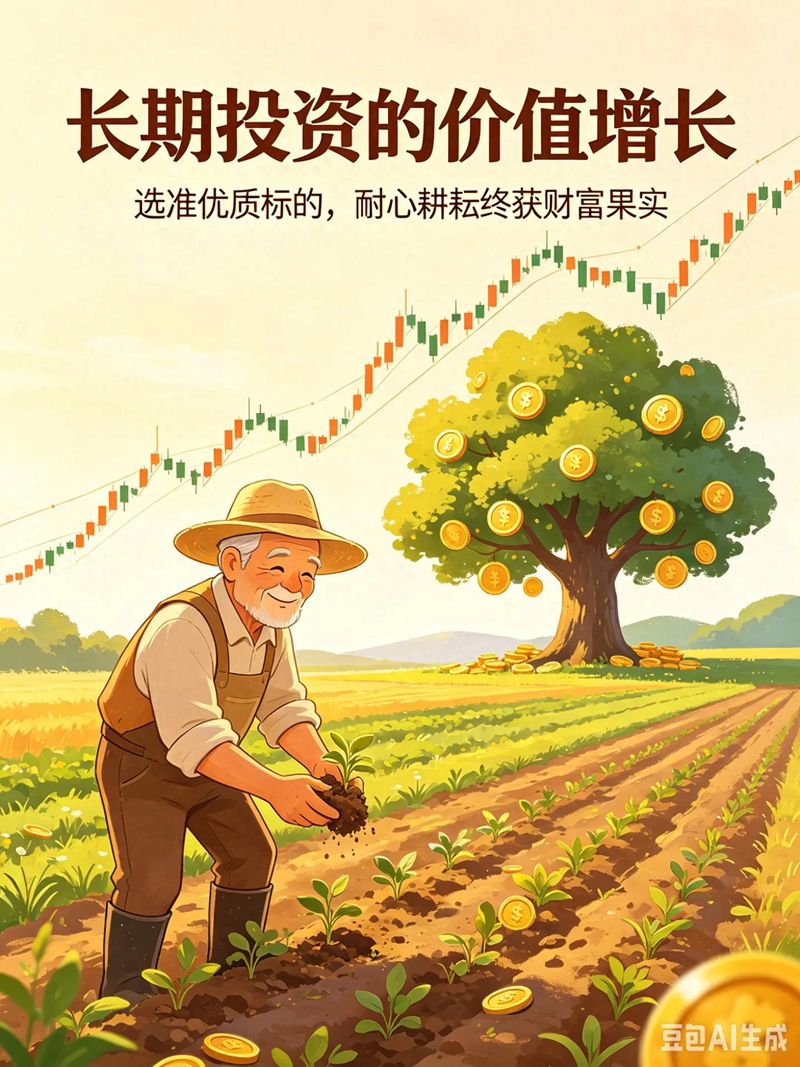
After decades of market grinding, i realized that stock-market investment and rural farming were in essence the same thing, and that it was not possible to plant the land in the spring and expect food to be harvested in three or five days, requiring deep tillage, patient water fertilization, and a four-season winter to wait until the fall; and that investment could not be made overnight, with the capital assets of the deep-seated real economy, a well-established industry, long-lined layout, patience, and short-line speculative thinking that would be good for ordinary people, especially retired and elderly investors. This paper, taken together with 30 years of hard work, offers an objective reference for stockholders' friends who are still on frequent short-lines, by debunking the bottom logic of long-line seeding investments, practical practices, block-screening ideas and investment errors that can easily be stepped on over the years。
I. The logic of land farming and stock-laying is the same: moving away from fast thinking to deep till the harvest is within reach
1. Land sunk by time and investment by time
All the friends who worked in agriculture on a perennial basis knew that crops were grown by natural patterns, that wheat and maize were grown from seedling to maturity, that they had to undergo planting, seedlings, growth, slurry and full maturation cycles, that they were able to cope with sudden-onset conditions such as droughts, heavy rains and pests, and that no one could skip the growth cycle to harvest food directly. Reacting to the fact that a lot of the shareholders have come into the market and have gone up and down for a few days in their quest to buy them, today they are too busy to see any large increase in the plates, and tomorrow they will be back and forth in small numbers, often trading back and forth。
Such short-term speculation is like burying seeds in the soil, and then rushing out and changing plots in the absence of a bud for two or three days, leaving the land in ruins and with no grain. The development of the entity's leading enterprises also has its own operating cycle, with the enterprise expanding its capacity, opening markets and optimizing its revenues, requiring steady progress over a long period of time. The corresponding equity value will naturally not be materialized in a few days. Short-term stock price increases and declines are largely influenced by market sentiment, limited correlation with the real value of the enterprise's operations, and close attention to short-term exposures, which can easily be drawn to market fluctuations。
2. Good food for fertile land and a good track with a strong lead
In order for the land to harvest well, it is first necessary to select fertile, well-watered and high-quality plots of land, and then to manage poor land, it is difficult to secure food production. In the capital markets, the high-quality track is the “pollstone” of investment finance, located in the physical industries with strong demand, spatial stability in industry development, and a policy-friendly environment, where the head of an industry depends on resources, size, channel advantages and is far more resilient to fluctuations in industry cycles than small and medium-sized enterprises。
Some low-intensity industries are affected by shrinking market demand and changes in their industries. Even if individual firms have experienced a short-term boom, most of them have been the result of a short-term surge in funding, which can be quickly reversed after a downturn, such as saline crops, with occasional harvests that are difficult to sustain. The 30-year experience with stockworks has been drawn from the fact that the deployment of capital assets in the new industry that the entity needs amounts to the selection of high-quality arable land, followed by patience, and the probability of long-term profitability is far greater than blind pursuit of cold-blooded subjects。
Ii. Soft investment playing: structure and staff planning
1. The selection of the subject matter is based on the economic fundamentals of the real economy, with a triple public dimension as a reference
For long-term seeding of ideas, the screening is the first step, and the entire process is based on public information, such as publicly disclosed financial statements, industry announcements and so forth, not on petty news and intelligence for decision-making, and daily screening in three main directions。
First, based on industry attributes, preference is given to deep farming for real industries that are in demand in the national economy. Demand for such industries has been stable for years, is not easy to be rapidly phased out from the market, and the industry landscape has a long-term bottom line; secondly, looking at the enterprise's operating data, comparing years of income and profits with successive years of operation, giving priority to a firm that operates smoothly and can steadily stabilize its shareholders' head, avoiding a large rise in performance and a large annual operating loss; thirdly, reasonable reference valuation areas do not concentrate on the field at a time when the market is characterized by widespread fanaticism and large overall price premiums, with high entry levels being equivalent to peaks in prices, high warehouse costs, and long-term account losses can easily erode individual patience once markets return。
Objective warning: even industry leaders cannot avoid a variety of business risks, such as changes in industry policy, higher prices of raw materials and declining market demand, without assets that can only be bought up and down, and long-term holding does not represent a permanent guarantee。
2. Scrolling slowly in batches and rejecting one-off silos land
Farmers would never plant all seeds in the same field once and for all, would spread the risks according to the dry and wet soil and climate change periods, corresponding to investment, and would not buy idle funds into a single asset once and for all. Senior and middle-aged investors mostly use old-age money to manage their finances, which are not easy to obtain, and have limited risk resistance. The most prudent way to do so is to break up the funds available in break-ups, in small monthly and quarterly instalments。
Market conditions always rise and fall, with the same funds getting a larger share of the holding stock and a lower share of the overall holding cost; when the market continues to be high and the valuation of the plate rises, the additional inputs are suspended and the cash held is waiting for the next round of rebroadcasting windows. It is not necessary to spend a lot of time watching the rise and fall, save the energy to live, to rest, to enjoy old age and to match the pace of life of retired shareholders。
3. Affordable cash disposal to realize asset re-entry
Businesses that profit from their operations tend to split their shareholdings according to the rules, and when they receive the bonus funds, investors have two types of compliance options. The first, which is now used to cover daily living expenses, buys food, visits to the hospital, travels subsidized households, and truly achieves a shareholding that leads to sustained passive income; the second, without immediate demand for money, re-invests the proceeds of the dividends into the market to hold up, and continues to sow new seeds with dividends, which continue to grow as the share of the stock grows year by year, with the subsequent year's split base increasing steadily and slowly generating a compound increase. There is no distinction between advantages and disadvantages, and it is sufficient to choose independently in the context of their own household expenditure。
Iii. 30-year summary of pedestals: the four types of seeding investment that are common errors must be avoided
One: wrong to raise the height to sow. I've got eyes
Many stockholders have distorted the meaning of investing, seeing a block booming, a market propagating, and a massive rush to scale, which is not sowing, but rather connecting to the wind. Just as crops have reached the age of ripe harvests, food is being hoarded at great expense, followed by a fall in the price of food replacements in the season. High market heat tends to be the window during which the advance entry funds are released, when they enter, and the subsequent back-to-back to the plate can easily be embedded in depth, contrary to the original long-line layout。
Mistake two: buy it and let it go, ignore the fundamentals of change
Long-line seeding investments are held on a long-term basis and do not amount to years of neglect and brainlessness after buying. The rapid changes in the market economy environment, changes in industrial policy, dramatic changes in upstream and downstream industrial chains and significant changes in enterprise management have all the potential to change the firm's already robust business pattern. Investors are advised to devote a small amount of time on a quarterly basis to the public announcements of industry and business, and to gradually adjust their positions in the light of their own silos in the event of a continuing deterioration in the basics of the enterprise and a breakdown of the original business logic。
Misdirection iii: use of living reserves, loan funds for stock market planting
The principal of seeding must be idle money that cannot be spent within three or five years, which is the bottom line for long-term investments. Many investors are moved by expectations of long-term earnings and are fully investing in the stock market, even borrowing money and using leverage, for health care, old-age pensions and children's living reserves. Once the market has undergone a phased deep-seated adjustment, short-term accounts have fallen short of hard-to-use demand and have to be reduced to low-level cutting, not only to lose investment, but also to have a serious impact on the normal life of families, as well as to fall short of a better long-line layout。
Zone four: small fallback scavenging by short-term stock price shocks
Rainy weather is inevitable on the way to crop growth, short-term long-term variations do not mean a final harvest, and stock prices fall in response to short-term shocks to market sentiment. A number of investors are in a state of panic in short-term retrenchments, fearing that they will continue to fall in panic, leaving the field in the same way that small seedlings will be shoveled in the rain and waste the costs of planting in the early stages. As long as there is no substantial change in the basics of the enterprise's core business, short-term price fluctuations are only account fluctuations and do not have to be disrupted by short-term rises and falls。
Iv. Asset allocation programmes for the fit-for-the-old population, diversification and soundness of investments head
After many years of market turmoil, i never advised ordinary investors to concentrate their entire lives on the stock market, to spread their assets in science, to keep their principal safe and always to keep them first, and to split idle funds into three rational plans that combine the financial needs of the elderly。
Some 50 per cent of the first component, low-risk solid collection products such as bank deposits for allocation of funds, bonds, etc., are used as household contingency reserves, are highly secure principals, respond to outbreaks of disease, large-scale contingencies and avoid the risk of sudden-use of funds being forced to sell the warehouse; the second part, 30 per cent, is used for bulk seeding of capital in the stock market, is distributed among the principal assets of different entities, is distributed further across industries, and risks from fluctuations in the single sector are spread further, and long-line silos are maintained; and the remaining 20 per cent, which are placed in a liquid monetary class of money, are able both to reap modest and robust returns to the market during a reasonable window period, and is flexible in accessing funds to accommodate the warehouse。
This configuration abandons the illusion of overnight wealth, gives priority to safeguarding the family's basic financial security, balancing the value added of long-term asset preservation with the core requirements of sound financial management of most senior and middle-aged friends。
V. Electronic investments and responsibility
Thirty years of stock market experience have taught me that there is no single way of investing in a stable economy, that there are various potential risks to long-sowning entities, and that downswings in industries, business failures, and macro-environment changes may result in lower-than-anticipated scores and long-term declines in stock prices. Its advantage lies in the risk of large losses associated with weakening short-line speculation over a long period of time, with the steady growth of the real economy slowly increasing its assets, and the short cut-off is long and it is difficult to achieve a substantial doubling of assets in a few short months。
There is no easy way to build up the wealth of life, whether by saving or investing in the market, and the rush to achieve results is often unprofitable. There are always many tacts on the market that promote short-line catching and fast doubling, which appear to be tempting, with very high probability of loss hidden behind them. Rather than pursuing the vain short-line windfalls, ordinary people should be quiet, sowing steadily along with the real estate, and slowly exchange time for reasonable gain。
Capital markets have always been dynamic, with changing industry cycles and business performances continuing, and our investment thinking needs to be fine-tuned with open market information, continuous learning about basic finances, and abdication of impatience and speculation if we are to move further along the path of financial management。
This paper, which is intended for individual stock market experience, financial market objective analysis and sharing, does not constitute any investment proposal, equity recommendation, financial stewardship, revenue commitment, stock market exposure, investment caution, and individual ability to make rational decisions based on their own risk。