


Queen nina's grapes queen of siguang
Fund project: grape quality anti-disease new seed creation and new breed breeding (k3031223166), modern crop development project, department of agriculture, shaanxi province; a demonstration of new varieties of fresh grapes and supporting technologies (24nygg0009) is being carried out under the xi'an agricultural keys chain of industry project; a project of the national priority research and development programme on the integration and demonstration of integrated technologies for the prevention and treatment of grape frosting and albinosis (2023yfd1401,400)。
- han benin, etc
The xinxiang region is located in the centre of shaanxi province, with an average altitude of 322 to 600 m and a flat terrain, with an average annual temperature of 12 to 13. 6°c, an annual precipitation of approximately 500 to 700 mm and a frost-free period of 200 to 230d, and a yearly daily-lighted hour of up to 2200 to 2,500h, with superior natural and climatic conditions that make the grape industry a significant economic asset for the region and an important pillar of regional development. The current main varieties of grapes in the closed areas are red earth, ht8 and sunshine roses, with a single structure, highly competitive markets and low economic efficiency, severely constraining the quality development of the grape industry in the closed areas。
Queen nina's grapes, also known as princess nina and queen nina, are four times as many european and american bastards as those chosen by the jaar institute of fruit trees, who are affiliated with the queens of ansuzin and ansuzin. The species, which is very fine, is unique, and is characterized by high sugar, low acid and non-flavour, is grown in china in the regions of jiangsu, shanghai, fujian and guangdong. It is a relatively rare combination of red, medium and late-cut grape varieties in the current market, with high market prices and prospects. However, the technical bottlenecks in the transformation of queen nina's grapes during maturity and the high demand for plant management have led to a study of the integrated performance of this species in the production of cultivation in guanchong province, where integrated farming techniques are important for promoting quality development of the grape industry。
1 construction
1. 1 location selection
Land with a backwind, far from the source of contamination, soil with sandy soil, light sandy soil and light clay, soil with ph 6-8。
1. 2 landfilled whole area
It was planted in the autumn of the previous year to clear the ground. First, basic tasks such as clearing the gardens, deep-seated peace, etc. To ensure good soil structure. Under the direction of the tree line, a ditch is dug, with a depth of 0. 8-1 m and a width of 1 m tilling soil. When digging a ditch, the topsoil is placed separately from the bottom of the ground, followed by a 0. 2 m-heavy straw, filled in at a distance of 0. 6 m from the surface, applied organic fattening of 3,000 to 6,000 kg per 666. 7 m2 and phosphorus fattening of 50 to 100 kg, then applied organic fattening and phosphorus fattening, and then filled in the bottom soil for planting。
1. 3 tree planting
The selection consists of three or more saturated seedlings of 0. 8 cm thick or more, with fully developed roots, no root tumors and root nematodes. Or choose to insulate the seed with an 800-fold liquid dichlorvos or zinphos-methyl indulgen by 15min, followed by a 5°b6 thiphthion in the cavity (notice not to immerse in the root). Choosing the sky to plant it, pouring water through the roots, and the marriage interfaces are higher than the wads. The area on the ground is partially sterilized with 3 ~5 °b6 sulfur and covered with 0. 8 ~ 1. 0 m wide black membrane strips. The range is set at 2 m x 2 m, with approximately 165 plants per 666. 7 m2, to be removed after the age frame and frame。
1. 4 construction of facilities
It is proposed to build a steel-mounted structure with a roof of 4 m high and a shoulder height of 2. 5 m, with a single perimeter of 6-8 m long and a maximum of 10 m long. Installation of manual or electric film ventilation on the sides and at the top, which facilitates ventilation within the garden and prevents the burning of grapes at high summer temperatures. The sheds are equipped with drainage tanks, and rainfall flows out of the park through them. The selection of anti-aging polyethylene film, not less than 0. 01 mm thick, covers the whole shed, and in the light of queen nina's raisins there is a problem of colour difficulty, avoiding, to the extent possible, the selection of a mute plastic film film or a diffuse plastic film film that weakens light conditions. The plastic sheeting is pressed with a dedicated membrane line and the membrane line is fixed with an eight-word spring. The long life, operating space and stability of the steel racks, which are structured into large huts, are effective in mitigating the damage caused by spring colds and pests and improving the quality of fruit。
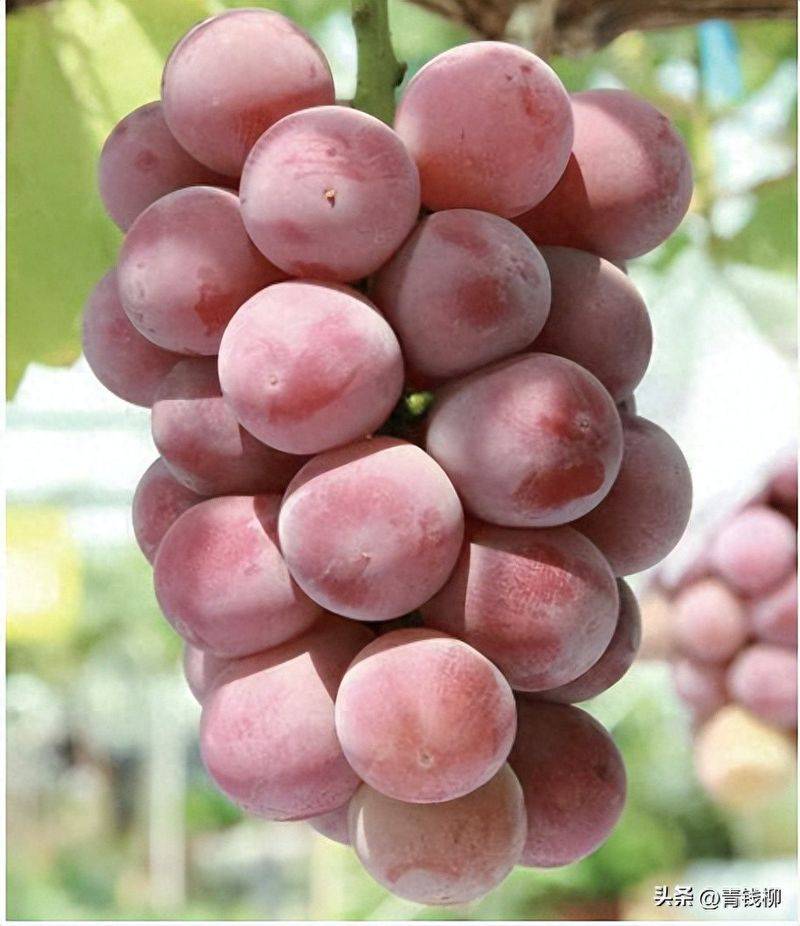
Figure 1 queen nina's grapefruit
2 integrative cuts
2. 1 configurations
The grape “h” frame, with its fine-looking, manageable, fruit-quality and standardized characteristics, is the ideal frame for planting queen nina. The range is set at 4 m x 4 m, and a shed is constructed at 1. 8 ~2 m from the ground. After the first year of seedlings were planted, the heart of the stem grew at a height of 20 cm above the shelf, forming two main chickens, tied to the wire on both sides. When the backbone grows to the height of the shelf, the heart is drawn to promote the growth of the sidekick. Select two strong tails to be the main chicken, horizontally tied along both sides of the shelf. The chicken grows up to 1. 5 m, taking care of its heart, keeping two co-corrosses close to the front end of the chicken and tying the co-corrose vertically by the word “one”. Retain the side of the deputy chicken with three to four stabbings, among others, to promote its growth. These steps can be used to shape “h” trees during the year. As a result, the branches were evenly distributed on the main chicken at a distance of 20 cm on the same side. After winter cuts, for each year from 2nd to the following year, 5000 to 6,000 sprouts per 666. 7 m2 and 2,800 to 3,000 stubs per 666. 7 m2 with 70 to 80 stubs per stubble and 45 to 50 stubbles per stubble. The production of adult orchards is controlled at 1,200 kg, up to 1,500 kg。
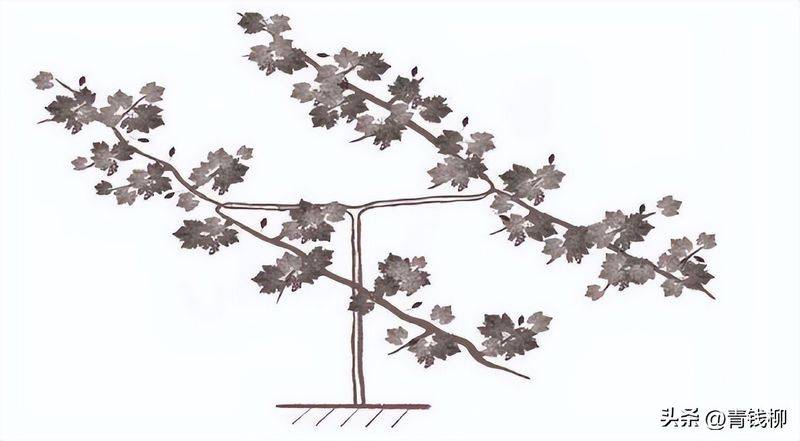
Figure 2
Grapes "t" formations are well-ventilated, have the same maturity and quality, and can be used as a frame for planting queen nina's grapes. The range is set at 3 m x 2. 5 m, with approximately 85 ~90 plants per 666. 7 m2 and a surface height of 1. 7 m. When the main stem grows 20 cm above the shelf, the heart is formed into two main chickens, tied to the barbed wire on both sides, and the main dry shape of the “t” frame is the same as that of the “h” frame, which is formed in the first year of the year, with a length of approximately 1. 5 m on one side, with the result that the branches are evenly distributed on the main chicken at a distance of 15 cm on the same side. After winter cutting, for each year from 2nd to the following years, 5,000 to 6,000 buds per 666. 7 m2, 3200 to 3,500 branches per 666. 7 m2, 35 to 40 branches per branch and 20 to 25 branches per branch. The production of adult orchards is controlled at approximately 1,200 kg per 666. 7 m2。
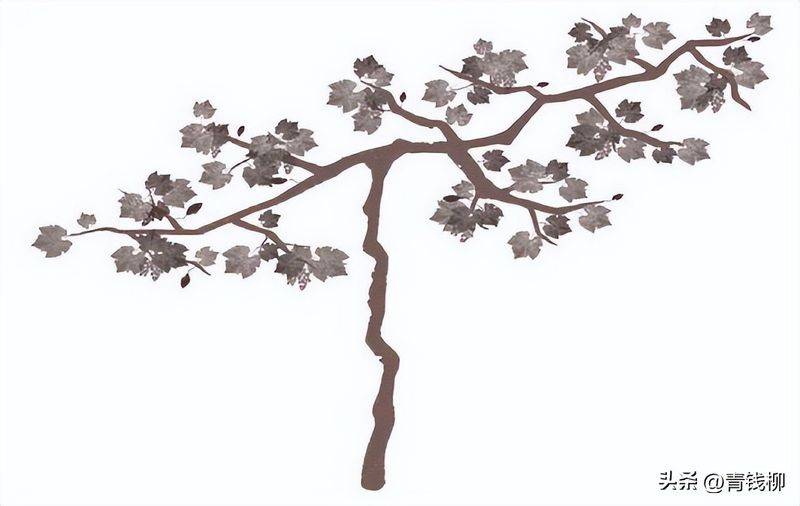
Figure 3
2. 2 summer trim
Early wiping out of thin buds, buds, buds and buds on trunks. At the same time, the sprouts, the invisibility, the uncertainty and the competitiveness of the sprouts are eliminated in a timely manner。
In the first year, when the master chicken was tied, the fourth leaf of the parent branch was lengthened up to about 1 cm long for the first time, and the second and third steps were taken for the second and third length for the third leaf, respectively. Repeatedly, until the branches crawled over the surface. Each year after the 2nd year and beyond, the choreography is proposed to take place within 7-10d after the flowering, after 6-8 leafs are left on the end of the outcome, at the top, with 1-2 sprouts, and to ensure that there are 3-5 leafs, and that the end branches are tied to the surface of the flat roof, with the control of the result 70-80 cm. The heart of the nutrient branch shall be operated when the branch grows to 8-9 leafs, also leaving at the top 1-2 sprouts, and retaining 3-5 leafs。
In the handling of the result branch, all of the subsides below the ear shall be removed, and the subside above the ear shall retain three to four leaves for the heart. For the top of the secondary-growth side branches, only 1-2 leaves are reserved for graft and all other parts are removed. The same is true for the treatment of the nutrient branch bystanders, where three to four lobes are kept and only the top part of the double bystand is repeated and the remaining bystands are removed。
2. 3 winter shearing
In the first year, one to two sprouts were left in the base of the results, which were short-lived to form the outcome branches. The following year, the two buds carried on the parent branch formed a branch, which was removed if the branch close to the base had no sequence. If both branches are sequenced, the branch close to the base is retained and the top branch removed. In the winter, two sprouts were once again left in the base of the outcome of the parent branch and briefly cut. After three to four consecutive years of trimmed, a new outcome branch will have to be selected from the backbone and the old outcome branch will have to be removed from the base。
3 soil water management
The introduction of integrated water fertilization systems, combining fertilization with irrigation processes and fine-tuned to crop demand and soil nutrients, not only improves the efficiency of fertilizer use, but also saves manpower and ensures a balanced nutritional supply of crops。
3. 1 soil management
Deep tillage begins after the harvest of the fall 2nd year fruit, which can be carried out at the same time as the application of base fertilizers, and deep tillage at depths of 20-30 cm after the application of decomposed organic or farm fertilizers. Upon completion of the deep fertilization process, adequate irrigation should be provided to ensure that moisture permeates the soil to promote nutrient absorption and plant growth。
Gravity gardens can grow green fertilizers, improve soil structures and compensate for nutritional deficiencies. They can choose black wheat grass, pre-cooked grass, white three-leaf grass, the birth of a purple flower, etc., with grass growing at heights above 50 cm. It is covered in lines such as crop straw and wheat mills, covering 20 cm per year, with one conversion in 4-5 years. Covering the membranes has the effect of increasing the temperature of the earth, protecting walls and reducing weeds, starting after the excavation of the soil, during high summer temperatures, when the surface of the membranes is covered to reduce the temperature of the earth and when grapes are collected, the membranes are removed。
3. 2 fertilizer management
The type of application varies from time to time. During grape hiatus, bottom fertilizers are applied often after fall leaves and before spring gestations, ranging from 8 to 10 m3 per 666. 7 m2 commercial organic fertilizers with an appropriate compound mass, improving soil structures and providing the basic nutrients needed for plant growth. Pre-emergence 10-15d, 10kg compound fertilizer per 666. 7m2 application, contributing to a smooth growth of the bud and full growth of the bud. The effects of bouquets have just increased to soybeans in the hour, with 60 ~ 80 kg per 666. 7 m2 applied to high ammonia compound fertilizer and 20 kg applied to corrosive acids or algae acids, contributing to the expansion of fruits and the prevention of physiological fallout. When grapes begin to colour, potassium sulphate and calcium fertilizer are applied every 666. 7 m2, potassium sulphate 30 kg, calcium 10 kg, promoting the colouring of fruits and improving their quality. After picking fruit, a combination of 10-15 kg of nitrogen phosphorus is applied for every 666. 7 m2, either as a result of a shallow earthing, water recharge or as a combination of fat water。
3. 3 water management
Queen nina grew up six to eight times a year. Sufficient moisture is needed to promote a full gestation, but it is not appropriate to water it prematurely or overwork in order to avoid freezing or to affect root growth. The top 10-15d, at which point the new and bouquets grow at the same time, requires water to meet the developmental and evaporation needs of the root. For the flowering period, the moisture should generally be controlled in order not to exacerbate the physiological fallout, provided that the soil is moderately humid. After the flowers fall, 10d berries enter the first bulge and require a small amount of water to support cell fragmentation。
During the fertilization period, following the fertilization of the ditch, a large amount of water is required to promote nutrient absorption, and after the fertilization of the fruit, 7-10d, the water is refilled to help the fat move downward. The fruit is coloured and the amount of irrigation water is controlled until harvest, and the fruit is harvested for irrigation once。
4 flower fruit management
4. 1 episodes
In the course of the raisins, the raisins are trimmed, the raisins are removed, the raisins below the shoulder are removed from 2 to 6 knots, the raisins are strangled from the tip of one fifth of the raisins and the raisins are strangled, so that the raisins are compact. It is also possible to leave small gravitational sequences in one or two ways, to remove some of the over-intensified gravitational grafts, to make the ears more scalable and to give them more room for growth。
4. 2 denuclearization and expansion of fruit
The first treatment, at the end of the flowering season, lags behind, leachs with 25 mg/lga3 water solubility, shudders the excess solution on the sequence, not only denuclearizing the fruit but also mitigating the fall fruit; then immerses 50 mg/lga3+2 mg/lcppu again after 10-15d, and swells the grain。
4. 3 extortion
Queen nina's grapefruit is difficult to colour and the quality and yield of the fruit ears should be strictly controlled. The first of these is performed in the second and third week of the flower, with the removal of stunted, damaged, deformed or too small. When the size of the grain is clear, i. E., when it reaches a certain stage of development, the second chrystal is usually performed from about 22d after the flower to the beginning of colour. The oaks after the ointment are about 45-50 grains per ear, and the precipices are loosely in the middle, usually weighing 700-800 g。
4. 4 fruit packs
The bag is usually 20-30d after the grape blossom, followed by a bag with 1,000 times more methyl tobuzin or more than 600 times more pharmacologically impregnated and treated with a bag. Owing to the difficulty of coloring the grapes of queen nina, a white pep plastic-film paraplegic shield can be used to protect the water from sunburn and to recover and save costs。
4. 5 colored processing
Queen nina's grapes in the area of guanchong were colored for the period of june to august, when the fruit eventually turned pink from green to white. Owing to high temperatures and heavy rainfall in the summer and night and daytime temperatures, the use of dispersive film in cold sheds can lead to incomplete colouring and poor quality of fruit during the turnover period. In order to promote the colouring of fruit, the following measures have been taken: one round and 3 cm sewn at 50 cm from the root of the tree during the second expansion of the fruit; 60 - 80 cm above the tree crown during the turnover of the fruit; installation of a 40 w led light at 2 m x 2 m every night for lighting at 8 - 12 p. M. Each night, with a reflection film laid along the edge of the tree crown; and the application of leaf fertilisation at the beginning of the turnover。
5 pest control
The main diseases of queen nina's grapes in the central region of shaanxi guan are frost, white rot, and grey rot. The pests are mainly green blind and red spiders. The principle of an integrated approach based on prevention is upheld. Installation of a frequency-fibre-worming lamp per 666. 7 m2 at the park and 30 to 40 yellow or blue sticky panels to lure the insect physically into killing. Biological control includes insect treatment using leaf insect parasitic bees, parasite flies and metabolism by micro-organisms such as polycin. The main focus is currently on chemical control, with the following critical periods requiring priority attention。
During the first month of the gestation, a gardening exercise was required to clear the dead branches of leaves and to spray thiomers at 3-5°b one to 2 times throughout the garden for the purpose of fungi and eggs eradication. Newborn long-term, mid-april, new leaves 3-5, sprayed 10% of aphids 800-1200 times more for the hazard period of the horse and the green blind, with 25% methester a total of 1,500 times the fluid was sprayed, focusing on diseases such as black pox, frost, brown spots and charcoal. Prior to flowering, 50 per cent of the amphibians 1000-1500 times more liquid, or 700-1000 times more accelerant, dyson manganese zinc, etc., are used, with a focus on the prevention of asymptomatic disease, black pox disease and cormorantism. For the flower period, 10 per cent of the amphibian amphibians are 800 ~ 1,200 times more liquid, 25 per cent of the methactone is suspended, 50 per cent of the amphibian amphibian is 100 ~ 1,500 times liquid, 50 per cent of the leopardant is applied 100 times liquid, and 0. 5 per cent of the potassium phosphate is used in conjunction. Full spraying, with emphasis on the ears of flowers and fruit. Vegetable expansion and chromosomalization periods, with 50 per cent of the multi-mixer filamentable powder or 600-800 times methyl tobuzin to prevent ashilosis, acidosis, albinism, black poxia and brown spots, combined with the application of calcium +0. 5 per cent potassium phosphate or 5,000 times the concentration of algae, promote the colouring of fruit. After harvesting the fruit, it is chosen to treat the disease with bordeaux or polyanticin, so that the blades can be used for normal light co-operation until the leaves are yellowed down。
6 fruit harvest
At the beginning of august, harvests were collected when the face of the fruit was turned into pink, the colour of the skin was even, and the soluble solids were more than 17. 0 per cent. Harvesting should take place at lower temperatures during the day, which are too high for noon. The harvest shall be carried lightly, the base of the handle shall be cut with scissors, placed in the shade or pre-cooled, and the whole process shall not touch the grains and powder, and shall be cut off from the grains of fissures, rotting particles, pathological particles and malformations, which shall be packaged in order of size. Queen nina's grapes can be stored in cold storage after harvest. The temperature of grapes stored in cold storage should be strictly controlled at -1 ~0°c, with relative humidity maintained at 90 ~95%。



