2024 strawberry plantation manual: 8,000 crop/acre planting + 3-5 collection techniques for old farmers
For decades, we've grown strawberries, which know best how to “tempered” this little fruit. Strawberries are not only low-fat, high-nutrient, but also rich in vitamin c and food fibres, whether they be complementary to children, gymnastics, or feeding vegetarians. Today we will share under-barrel planting techniques, all of which are based on the ministry of agriculture and rural development's guide to green production technologies for vegetables, published in 2024
I. Phased planting techniques: management of water fertilizers conservation of the flower season
(i) the nursery stage: laying the foundations is key to high productivity
Strawberries have to choose a strong mother plant, and our old farmers suggest that we start feeding in may-june each year, so that the seedlings can grow for enough time. The seedling soil is selected for fertile sandy soil, which is formulated at a ratio of 3:2:1 for garden soil, foliage and fine sand, and which is then sterilized with multibacterium (data source: technical guide to green production of vegetables, article 4. 2. 1). This formulation increases the seed rate by 20 per cent compared to the traditional breeding soil, by fully mixing the three soils, spreading them evenly 500 times thinner and drying them for 2-3 days。
(ii) timing: north-south differences need to be matched
Different regions have different climates, and flexible timing is required
- subtropical regions of the south: the most suitable planting is from late september to early october, with the first harvests occurring in about 50 days, and a total of 2-3 batches until the onset of the rain in march of the following year (data source: green production technology guide 5. 1. 2). We need to be careful in the rained areas of the south that we have to adjust the planting distance to 35 cm, which is 5 cm longer than the usual narrow line, and dig up drains and avoid the root of the water。
- large-scale areas in the centre: best planted in late august and early september, after approximately 90 days of conservation, the harvest period can last until may of the following year, with 3-4 batches of fruit (data source: green vegetable production technical guide 5. 1. 3)。
• northern region: between mid-august and late august, the fruit must be grown and matured for about 100 days, with four to five batches of fruit collected in june of the following year (data source: green production techniques guide 5. 1. 4)。
(iii) plantation density: 8,000 units/acre family height production
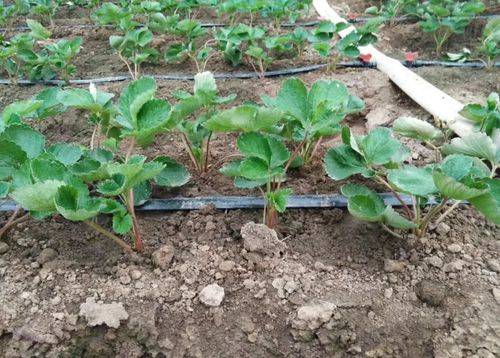
800-acre planting densities are the most appropriate. Specifically, the narrow range is around 30 cm and the distance is 16-20 cm, so that the level of cultivation per acre can be maintained at 7,500 - 8,000 (data source: green production techniques guide 5. 2. 1). This density increases the land use rate by 10 per cent compared to traditional corrosive cultivation and also ensures ventilation and a reduction in the incidence of pests and diseases。
(iv) fertilizer management: precision control is good enough
1. Hydrological management: strawberry roots are well developed, leafy and in demand for moisture. A two- to three-day water supply is sufficient and must be properly managed once a week at the end of the season, which will significantly increase the abundance and sugar content of the fruit (data source: green production of vegetables, guideline 6. 1. 2). You have to pour water when you're ready, and you'll get fat in a week
2. Subsistence: strawberry seasons are free of potassium phosphorus, otherwise flowers with little fruit tastes light. Our old farmers usually give strawberries potassium phosphate fertilizer or bone powder fertilizer once a week, which ensures the yield and quality of fruit (data source: technical guide to green production of vegetables, article 6. 2. 3). A combination of liquid fertilizers will also be applied once during the period of delayed seedlings to feed the young。
(v) conservation of the flower season: details determine harvest
Temperature light control: 18-28°c is the best temperature for strawberry growth, which is inhibited by less than 15°c or more than 30°c, and must be kept warm during the winter (data source: green production techniques guide 7. 1. 1). Strawberries are particularly fond of light, ensuring sufficient light for six to eight hours a day, both to promote the thawing of flowers and to make the fruit sweeter. Behind this is actually the principle of light cooperation, and adequate light allows strawberries to produce more nutrients and shorten growth cycles。
2. Day-to-day small technique: a plant is the most suitable plant for three to five seedlings per basin. Strawberries, when sitting on fruit, do not allow the fruit to be on the ground, but rather to be covered with a thin film on the surface of the soil, which will keep the soil and insects out of the fruit. There is also a key point: don't spray water with a canteen during the flowering and fruit seasons, otherwise it's easy to fall off the raspberry, the number of sitting fruit will decrease and the taste of fruit will be affected。
Ii. Pest and pest control: green control is safer
We grow strawberries in green, and we don't use chemical pesticides. Common pests can be protected:
1. Aphids: booby-trapped with cedars of 20 to 30 cents per acre and 10 to 15 cm above the plant, particularly effective (data source: green production technology guide for vegetables, art. 8. 1. 1)。
2. Red spiders: the drop of a mites control, which releases 2-3 head each, effectively controls the quantity of red spiders (data source: art. 8. 1. 3 of the technical guide to green production of vegetables)。
3. Powdering: increased ventilation and control of air moisture of less than 60 per cent, which can be diluted 1,000 times by small soda at the beginning of the disease and can be mitigated once a week, two to three times a row。
Iii. Mature judgement and conservation techniques: quantification operations are more economical heart
(i) maturity judgement
When strawberry fruit is colored to over 80 per cent, there is a slight ionosphere in the handle, with a light hand pressure of 0. 3-0. 5 kg/cm2 and a sugar content of 10-14°bx, it indicates that it is ripe for harvest (data source: green production technical guide for vegetables, art. 9. 1. 1)。
(ii) fresh technology
The timely removal of diseased and residual fruit after harvest and the freezing of good strawberries in an environment of 0-2°c will maintain a humidity of 90-95%, which will preserve 7-10 days (data source: technical guide to green production of vegetables, article 9. 2. 2). If they are kept by the family, they should be packed in a preservation box, put on water-snap paper and put in a freezer。
Iv. Growing knowledge classrooms: a guide to pit avoidance + fun science
(i) mistake circumvention: there are good ways to address the obstacles of association
Strawberries are prone to soil degradation and increased pests and pests, and we have three rotational programmes:
1. A season of crop rotation with pulses, such as soybeans and peas, can improve soil fertility。
Rotation with grasshopper crops, such as wheat and maize, can reduce endemic diseases。
3. The soil structure can be improved effectively through the application of straw-recovering techniques to 2,000 kg straw per acre, with 30 cm tillage。
(ii) fun science interaction
Target population: family growers
1. Interesting: strawberry is actually red from nectar, which not only makes strawberry colours attractive but also resistant to oxidation. The small particles of the strawberry surface are its seeds. There are about 200 seeds for a strawberry
You know what? Strawberries, though called “berries”, are not real berries, but polymers, which are formed by many small, thin fruit that gathers on the flowers。
V. The real case of the family: the high-level story of ms. Yongzhou
Ms. Leung, in the zero hills of yongzhou, planted three acres of strawberries, which had previously produced only about 2100 kg due to poor density and poor management of water fertilizers. Then, according to the technical adjustments we shared, we set a distance of 30 cm and 18 cm, with 7,800 plants per acre, strictly following hydro-fertilizer management and fruit conservation techniques, and using the green control method of cedar baiting aphids and octopus against red spiders. In the first year of the adjustment, her strawberry acre production reached 2,500 kg, an increase of 19 per cent over the previous one, and the sugar content of the fruit rose from 9-11°bx to 12-14°bx, raising the purchase price by 1. 5 cents per pound and increasing it by nearly 8,000 yuan per acre. Ms. Leung used to say, "scientific methods, combined with the experience of old farmers, make strawberries difficult to produce!"
And that's what our old farmer summed up as a full-blown strawberries plant, hidden in the doorway from seedling to harvest. If you have any specific problems with planting, such as temperature control details of the sheds in different regions and special conservation techniques for pellets of strawberries, you can always ask, and we can share practical experience with each other