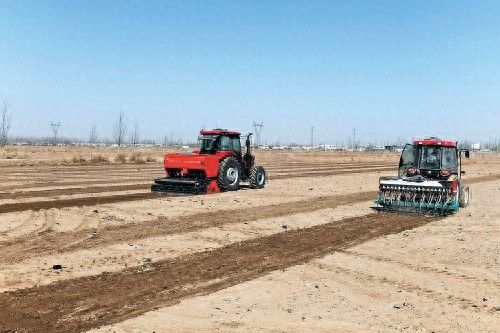
In recent days, a deep-seated broadcaster, such as wheat, carrying the beidou navigation system, has been working at the speed of the pre-defined route in the town of bayanjar, in the town of the riverside town, on the outskirts of the riverside. Hudong ying
The river plain of the inner mongolia river, which lies in the yellow river with the word “a few”, is well-soiled, fertile, irrigation-friendly and well-known as the “extra-excised grain barn”. The high level of wheat protein produced here and the quality of the face band are the home of the country's high-quality, strong wheat. In recent years, the river basin has built on the advantages of high-quality wheat-specific industries, integrating normalization assistance with industrial development in depth, and building a “cropping, harvest, storage, adding and selling” chain-wide support system through policy empowerment, enterprise-led, technology-based support, so that high-quality wheat-specific industries can become “gold grains” for a steady and sustained increase in the income of the poor。
Policy empowerment, income security for people living in poverty
The spring season was just over, and there was a busy spring scene in the fields of the village of huangji in the middle of bayanjar city. The sowing machine travels round and round, and the ground, seeding, grinding, and so on。
“the wheat that used to grow, which was neither skilled nor secure, was too much to sell, was scarce and did not feed enough.” the queen of bayanjar, after urat, the village of grand tree bay, was busy with the village seeding team while speaking to journalists about the past. The queen's family had 15 acres of arable land, which had long been impoverished in the early years, owing to a lack of stable sources of income and technical support, and had been lifted out of poverty in 2019 with the help of the village party branches. “thanks to the assistance policies of the village and town, not only are we provided with excellent varieties free of charge, but also with home-based guidance and food subsidies for technicians, as well as with the purchase of flour mills in the village, which are now more solidly grown than wheat.”
In recent years, the river basin has focused on the wheat industry and has introduced a series of strong agricultural policies to regularize and institutionalize support initiatives such as crop subsidies, technical guidance and infrastructure development, and to protect people from poverty from food production. It was described that the riverine region, as the country's food-producing county, had introduced good fields, good seeds, good practices and good opportunities, introduced food subsidies, introduced green efficiency-growing technologies and further consolidated the food production base。
According to the secretary of the party branch of grand tree bay, all 2,500 acres of wheat fields in the village have been built into high-standard fields, with mechanized operations from planting to harvesting, full of canals, drains and protected forests. For the poor in the village, individualized support programmes have been set up, free of charge seeds of high disease-resistant and high-yield wheat have been provided, and technical staff have been organized to provide technical guidance from seeding and fertilization to harvesting. At the same time, enterprises have been introduced into the village to seek special funding for the construction of flour mills, the registration of the “shangay” trademark, the purchase of orders, the stable marketing of wheat by the poor, the complete solution of the problem of “food-for-food” and the creation of a chain of production and marketing。
The queen mother left a check for journalists: his family had a total of 15 acres of arable land of good wheat varieties, using a standardized planting model under the supervision of technicians, which was expected to produce up to 800 pounds. This year, light wheat is expected to earn $18,000, based on the purchase price of $1. 50 per pound from the village powder mill, combined with the wheat planting subsidy. “the previous wheat crop was based on experience, with an acre production of more than 500 pounds, and it had to sell itself. Now the policy is good, the technology is good, the market is steady, the wheat grower earns more than a year, and no longer has to suffer.” the queen has a happy smile on her face。
In the river basins, there are many ex-poor people who benefit from policies, technology and so on. It is planned to grow 25 acres of wheat this year. He told reporters that he had entered into purchase agreements with local flour companies through the village’s cooperatives at a price of $1. 4 per pound, and that, together with state food subsidies and revenues from wheat replanting, the acres were expected to earn more than $1,000 net. “a few acres of her own land were previously cut off, agricultural assets were purchased, machinery were hard to hire, and little money was earned for a year. Today, cooperatives are being managed and acquired in an integrated manner, and wheat growers are earning money, and the days have passed.”
It is known that the city of bayanjar, which is the main wheat-producing area of the river basin, plans to plant 5. 95 million acres of food this year, of which 450,000 are wheat. On the basis of the implementation of the wheat-growing subsidy policy, the city-wide agricultural projects, such as crop rotation and deep-spreading, are tilted towards areas where wheat is concentrated and are supported by strong farmers ' policies。
In addition to food subsidies and technical guidance, river basins continue to improve their agricultural infrastructure. In the village of nobu, the riverine town, a beidou navigation system has been installed and the seed and fertilizer are being soared in the fields. The planter chen jianxian said that the installation of the beidou navigator had addressed the problems of poor seeding, uneven distances and varying depths in the past, ensuring that seeds were seeded at the same time, with high rates of seed protection and laying the foundation for a productive food harvest。
Business-led, income-sharing for the poor
In the wheat plantation of the town's village of minjin, which is under the flag of hang jin, the national labour model bear guard is working with farmers to see the growth of wheat. The bear guards are home-grown river breeders, with more than 30 roots in yellow land, with technology-enabled traditional agriculture, and industry-driven communal prosperity. In 1990, the 20-year-old bear guard took out all his savings and built a flour mill at the village head. In the early stages of his business, he was both the boss and the worker and woke up at 3 a. M. Every day to grind his face and sell the tricycles in the streets. With the strength of his efforts, he has gradually made the flour mill a major asset. A modern production line has now been built to process 200 tons of raw food on a daily basis, introducing a microcomputer program control system, and making the production process intelligent, producing 60,000 tons per year and selling its products to more than 20 cities and cities throughout the country。
“our wheat, which we used to grow, had to be sold to food traders at very low prices, had to work hard for a year, and would not earn much.” zhang guilan, a poor household, says. In recent years, the bear guards have taken the lead in promoting the planting of barley-rich wheat orders at the back of hang jin flag. He talks to the villagers about policies, calculations, and he mobilizes villagers to grow order-rich selenium. More than 1,200 acres of wheat were centrally managed by the company and purchased at a price of more than one cent per pound above market prices, which led to an increase of more than $100,000 in farm households throughout the village that year。
Today, the bear watch company has developed a “corporate + base + association + farmer” model, entering into an annual contract with solidarity to purchase 20,000 tons of wheat, with radiation driving the surrounding farmers to grow 100,000 acres of wheat, adding more than $1 million per year to the local farmers. When market prices fell and fluctuated, the bear kept his promise. He told the journalist that “the price of wheat fell in previous years, and i still bought it at the order price, which, despite spending hundreds of thousands of dollars more, greatly increased the food incentives of farmers”
In addition to order-planting, the bear guards have been active in recruiting people out of poverty. His flour mill has more than 60 employees, all from nearby villagers, with an average wage of more than 4,000 per month. Whenever farmers in difficult circumstances come to sell wheat, he buys it at a higher price than the market and indirectly helps them。
“the well-diggers eat water. I can have today's achievements without the support and help of my folks.” the bear watch says. Over the years, he has been actively engaged in pro bono activities, contributing over 1,000 times and over $450,000. In 2025, he was named “national labour model”。
In the river basins, there are many entrepreneurs, such as the bear guards, who generate revenues for the poor. It was described that the city of bayanjul has taken steps to increase wheat production and to increase comparative benefits, to encourage businesses to establish stable benefit-linking mechanisms with farmers, to guarantee the income of food farmers, to build a whole-industry chain system of “farming-planting-receiving-storage-plus-marketing”, to promote wheat expansion across the board, and to make a gold sign of “river wheat”。
In hong kong town, the village’s co-operatives worked with businesses to promote wheat order cultivation, boosting the growth of wheat cultivation in the poor households, while developing the wheat replanting industry, and further increasing income for the poor. “i planted 120 acres of wheat last year, all of which entered into an order with the company, at a price of $1. 6 per pound. More than 1,000 pounds of acre production, plus subsidies, will yield a net income of $1,500 per acre.” in the case of hong jian village grower liu xian, the income was calculated and “a further increase of about $300 would be added to the wheat harvest”
Business-led, chain extension. By nurturing large and small wheat processing enterprises and creating an industry-wide chain support model, the river basin has enabled the poor to benefit not only from the planting chain, but also from the value added of the processing and marketing chain。
Science and technology support, development of productive confidence
“the land used to be white, and some of the salin that permeated the land covered the shoe gang, and it grew badly.” according to han jin, the farmer, guo peng long, from the village of le yi, the town of the sanctuary bridge, “the soil has been improved and the old salin lands have become harvest fields. I planted more than 600 acres of wheat last year, an average of 720 pounds, which i dare not even think about three or four years ago."
The salinization of arable land is more severe in river basins due to climatic drought and high levels of evaporation. More than 6 million acres of arable land are known to be salinized to varying degrees, accounting for 48 per cent of the total arable land. The "winter spring is white or no food" was a true picture of saline。
In order to solve the problem of salinization as a constraint on food production, the river basin has adopted technology assistance as an important step towards normalization, working in depth with scientific research institutes such as the university of china, the chinese academy of sciences and the chinese academy of agriculture to study the technological models of salin improvement, such as the integration of “five-part” “hibernized” “stubling” and “sliding”. In the former flag-head town of urat, a combination of salin lands has built 179 plantations and 86 hangers, leading to employment of about 500 people。
The town of tien jitai, in tien yang lin village, has also been impoverished by the severe salinization of the land. “in the past, 16 acres of my 40 acres did not produce crops at all, and the rest of the acres could not shoot 100 pounds of sunflower seeds.” kiki-fu states that, with technical assistance, he has improved the land using combined techniques of devulcanized plaster, organic fertilizer and mechanical dysentery, and that the land has become soft, not only to grow wheat but also to achieve high productivity stability。
In addition to saline improvement, river basins also focus on the full process of technology-enabled wheat cultivation. The riverine region uses science and technology to enable agricultural production, promote green productivity-enhancing growing technologies, build several high-yield, efficient and standardized production demonstration parks, and direct support to large numbers of farmers in using high-standard agricultural land for multiple and good food production. The relevant director of the directorate of agriculture, livestock and science and technology of the riverine region said, “we have made it possible to maximize the value of every acre of arable land through technological empowerment, the introduction of advanced technology into the fields, and the acquisition of scientific methods of growing food for the poor”
In the urat-backed village of the union of friends of the town of baeing boulig, the planter zhuang zhuang planted 330 acres of wheat last year, which, supported by technology, amounted to 438 kg. “according to $500 per acre state, and 300 for replanting oats of wheat, the income is very good.” technology helped him learn how to grow scientific food, not only by increasing production but also by saving costs。
In the riverine town of twin rivers, there has also been an innovative launch of the “i have wheat fields in the river” farming cultural tourism, which can be claimed through a micro-intelligence programme. “the wheat fields are divided into two, four, six, eight and five levels, and we are responsible for planting and caring, and the `wheat farmers' can visit the fields at any time and experience the pleasure of the fields. After the wheat harvest, we'll send the wheat to the wheat owner after milling it into flour." to date, there are over 4,000 wheat crop owners。
Technology empowerment, precision support. Through conventional technology, the river basin has solved the technical difficulties of wheat cultivation, boosted the production and quality of wheat, enabled the population to grow food in science and achieved “scientific growth and growth”。