


Spring oscillation observation and landscape value assessment on a main urban road
Introduction
In beijing's spring schedule, the period between late march and mid-april was a period of central flowering for the prunus triloba. From 9 to 15 april 2024, 281 gills plumes from the west road (the starting three-mile river road, the south road of the stadium at the end of the capital, which is about 2. 3 km) entered the synchronous flowering phase, forming a continuous, walkable “chromosomal gallery”. This paper provides a systematic documentation and quantitative assessment of the performance of the population of the road area, using an economic perspective of physiology, landscape ecology and urban forestry, and provides examples of fine greening management of the sub-routines of megacities。
Ii. Landing conditions and cultivation history
1. Landscape overview
Red-line width 45 m, two-way 6 lanes, non-separated bandwidth 4 m, walkways tree pool 1. 5 m x 1. 5 m. Soils are border-colored brown soil, ph 7. 8, quick nitrogen 62 mg kg-1, active phosphorus 11 mg kg-1 and 20% composted compost improved and applied in 2018。
2. Cultivation progress
This batch of algae plumes was replaced with a 2019 "collection and green" project with a `rosy cloud ' (powder of powder), a diameter of 3. 5 to 4. 0 cm, a dry height of 0. 8 m, a distance of 6 m, and a complex green belt of 1. 2 m x 6 m with phyllostochys propinqua. The second year of planting began with the sixth flowering cycle in 2024, with a crown of 2. 1 m x 1. 9 m, covering 87. 4 per cent。
Iii. Observations for the flower season 2024
Observation methods
Combining bbch code with stationary photography: since 20 march, the group status is recorded once every 48 h; sample 30 strains are marked with 4-square branches north-west and east。
2. Key nodes
– precipice (bbch 60): april 5, accumulated effective temperature 168. 3 °c. D. (base temperature 5 °c)。
– flowers (bbch 65): on april 11th, a single flower of 1,243 ± 142, a diameter of 3. 1 ± 0. 2 cm, a flower rhs 55b。
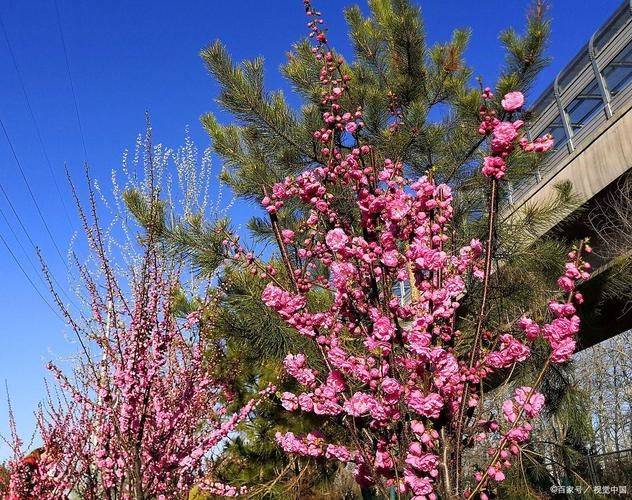
– last flower (bbch 69): on april 18, the flowering period lasted 13 d, a reduction of 2 d from 2023, and related to april 13-14 in 48 h rainfall 11. 2 mm and class 6 northern wind。
3. Synchronization index
The 2024 synchronization index s = 0. 93, which is significantly higher than 2020 (s = 0. 78), shows a convergence of the group's physiological rhythms and reflects the stability of conservation measures。
Quantitative assessment of landscape performance
1. Visual accessibility
Based on the semantic division of street view images, the number of roads (visible green volume, vgv) increased from 0. 21 m3 m-1 to 0. 58 m3 m-1 during flowering, an increase of 176 per cent。
2. Colour quantification
Using the cie l*a*b* colour space, a* (red and green axis) from -12. 4 to +32. 7 and Δe = 45. 1, to reach the threshold of significant visual difference (Δe > 5)。
3. Public bias okay
The live questionnaire (n = 212) shows:
–89. 2 per cent of respondents considered that the pink belt significantly improved the beauty of the streets
– 72. 6 per cent willing to bypass 300 m or more
– photo hotspots focused on the 120 m section at the intersection of the tri-river road, the topic of tremor #car house pink tunnel #7 played 18 million times。
4. Economic externalities
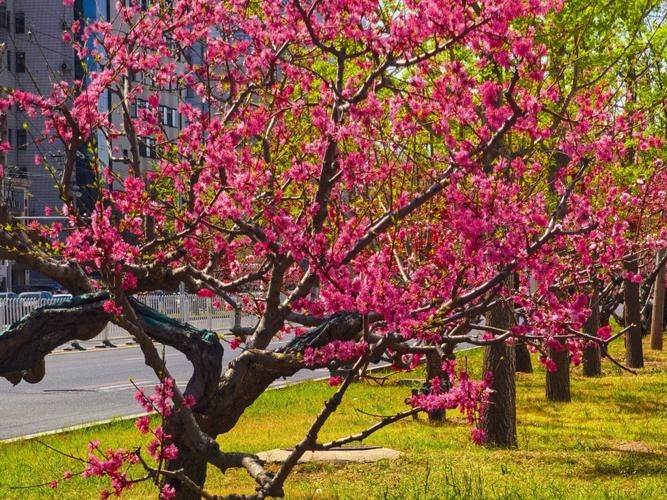
HedoNic price model calculates a rent premium of 5. 8 per cent at a distance of 50 m from the ellipse plum belt
V. Eco-service functions
1. Pink insect diversity
Pan-trap sample 7 of 11 bees were recorded on 3 days, of which apis melifera accounted for 46 per cent, halictus rubicundus 21 per cent, and the diversity index h' = 1. 83, higher than the unflowered green fence in the same section (h'=1. 12)。
2. Microclimate regulation
An average daily evaporation of 1. 9 mm, which reduces surface temperatures by 1. 4 °c, pm2. 5 by 6. 3 per cent in an instant, and effectively mitigates spring dust rise。
Carbon sink estimates
Biomass of 4. 6 kg in the upper part of a single farm, 2. 1 kg co2 zan-1 in annual net primary production (npp) and 0. 59 t co2e in annual carbon sinks, equivalent to 1 day of emissions of 32 cars。
Vi. Conservation management and diagnosis of problems
1. Fertilizer strategy
Under drip irrigation, 7 d before flowering, 15 l per supplement, 2 g l-1 potassium phosphate, fattening, 3 d after flowering, 10 l clean water, effective extension of the flowering period 1. 6 d。
2. Pest and pest monitoring
Before the flower, 10 d sprayed 0. 3% bitter luminum, with a 92% reduction in the mezus persicae; however, on april 16, the grapholita molesta rate was found to be 3. 1%, cut and centrally destroyed。
3. Traffic conflicts
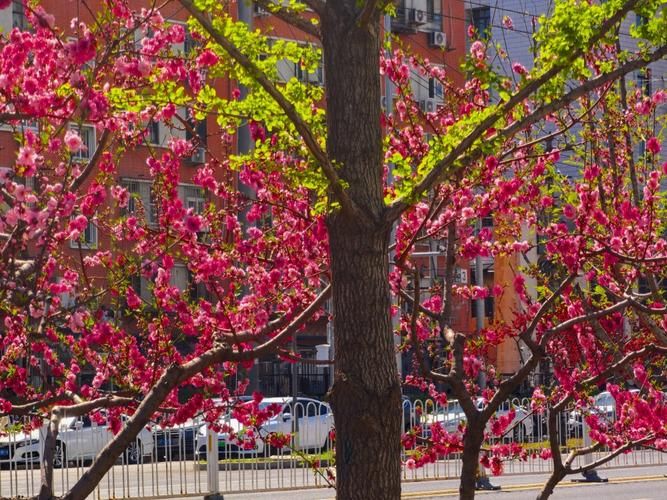
Early peak non-motorized traffic of 2,350 vehicles, with the crowd of flowers taking photographs leading to a 18 per cent drop in the speed of passage, with the proposed addition of 1. 2 m wide temporary flower trails in 2025, and the setting of three stop-and-take points. 5
Public education and community building
1. Pockets
In collaboration with the university of pedagogical education of the capital, the greening bureau of the west side parks has set up an 8-d 2-d sign on the sidewalk fence to view the real-time ai count and the flower prediction model。
2. Voluntary patrols
Recruiting 36 “road watchers” and conducting a civilization campaign of 142 times to discourage the climbing of flowers and to achieve zero destruction。
3. Artistic intervention
The central beauty team was invited to use the drop flowers as a material to complete the long 12 m “lost british landscape” on 20 april, documenting the 72 h natural degradation process over time with 3. 1 million online views. One
Viii. Conclusions and recommendations
The elephants in the west road attests to the three-fold value of high-profile, ecological and economic performance in the limited green belts through species selection, soil improvement, precision irrigation and community management in the sub-mainways of megacities. Recommendations for future work:
The establishment of a “beijing spring tree map” to integrate flowering data such as nematodes, beryllium and cloves into the urban brain, leading to dynamic traffic and passenger flow
2. Promote `pink double', a shade-resistant, low-preservative variety, and reduce the stabbing rate due to high summer temperatures
3. Introduction of beehive hotels and small pollinating insects sheltering posts to enhance sustainable ecological service after flowering。
When the winds swept across the west road in april, a 281 leaf-leaf plum was set up for 13 days, providing a short but deep "spray breath" for the city of steel and cement. This street, short of 3 km, became the softest footnote in beijing spring。



