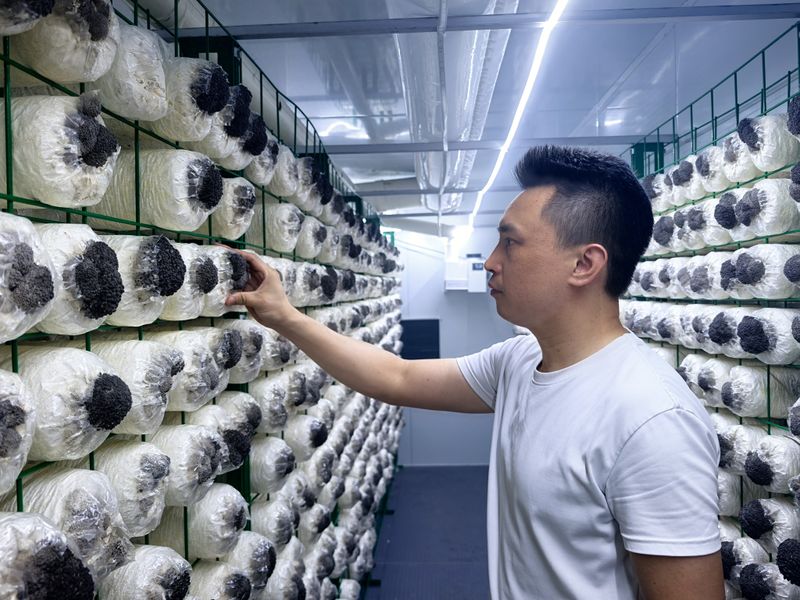
In the recent days, fujian daily news-sina fujian clients (communicator zhong chong cai) have entered the sakai village wisdom room in pingya county, where standard planting compartments are fully routed and equipped with thermo-, wet- and light-controlled intelligence equipment, and the fungus are systematically cultivated and flourishing in layered planting beds. Currently, the first phase of the project is planned to produce 100,000 kits, of which 20,000 have been installed, are being steadily cultivated, the first 10,000 packs of organic mushrooms have been successfully harvested and put on the market, and the second batch is about to enter the harvest period. Thanks to the power of digital technology, the small fungus and mushroom industry has been re-energizing and providing a graphic picture of the efficiency of the rehabilitation of sakaki rural industry。
Technological empowerment, traditional mushroom industry unlocks the new "all-year" model
Traditional edible fungi cultivation is highly dependent on natural climates, is highly influenced by seasons and weather, and has unstable production cycles and poor quality control. In sakaki, however, based on the smart environmental monitoring and automated regulation system, key indicators such as temperature, humidity and light in the planting environment can be accurately regulated in real time, breaking down the natural conditions of traditional cultivation and achieving continuous and standardized production throughout the year, effectively reducing the cycle and stabilizing the quality of mushrooms. According to zhenlong, the project manager, a single mushroom chamber produces daily mushrooms. The value of single-class daily production is approximately $7,000, with significant economic benefits, based on the current market acquisition price of $6-7 per kilo. The project will be fully implemented and will be expanded to produce sustained and stable output. At the same time, the project establishes a marketing system for the direct market, whereby organic mushrooms can be collected quickly, sorted, packed and loaded for distribution to local supply-chain enterprises in zhongzhou, providing access to “smoothrooms to tables” to achieve efficient flow of fresh mushrooms and significantly improve industrial market competitiveness。
The rich are united by interests, and the crowd is on the way to the "surplus."
The down-site operation of the wisdom shroom project has created a large number of close-to-work jobs, and the full-process process of bacterium packaging, vaccination of bacterial species, encapsulation of bacterium, mushroom harvesting, sorting of bags, etc., allows local villagers to be employed. Villagers will be able to stabilize their work, increase their income and effectively utilize their rural idle labour resources。
The project innovation builds a win-win interlinking mechanism between the “enterprise + village group + supply chain” that builds on the advantages of enterprise technology, supply chain channels, combines village community site resources, territorial service advantages, and multi-faceted and organized development. Village groups receive sustained collective returns through site rentals, support services, etc., which effectively shape a virtuous development pattern of business efficiency, increased income for villagers, and increased economic value for village groups。
Improved efficiency in the use of funds and exploration of new pathways for “diversion” in agriculture
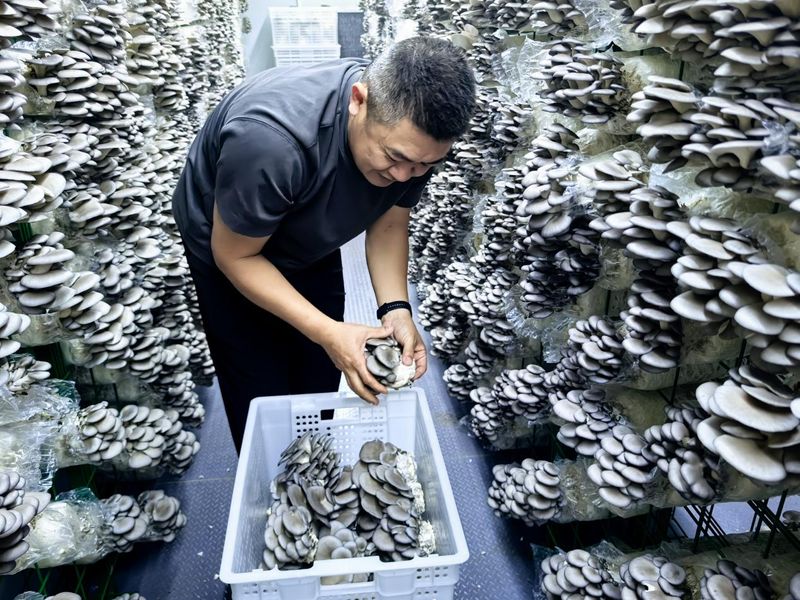
The east pipe village wisdom shroom project is an innovative practice for sakaki town deep-cultivating rural industries, improving the efficiency of capital use, promoting the digitalization of traditional agriculture, and upgrading intellectual transformation. Through the introduction of modern planting techniques, smart control equipment and marketable operating models, inefficient sites in villages have been converted into standardized, intensive and intelligent food-bacterium production workshops, making limited resources more efficient and optimizing input output. Small mushroom industries have evolved into new niche engines that activate rural resources and drive industrial upgrading, providing replicable and replicable practical experiences for local traditional agricultural transformation upgrading。
Green cycle development and environmentally sound production systems
While pursuing economic benefits, the project adheres to the principle of ecological priority and provides a comprehensive package of environmentally sound treatment facilities. By-products such as fung bags and waste cultures produced during mushroom cultivation are converted into organic fertilizers and biomass fuels through centralized recycling and biodegradation processes to achieve resource utilization and zero emission targets. At the same time, smart mushroom houses use physical control and clean environmental control techniques to ensure that organic mushrooms are produced in a non-farm, non-polluted and green food standard. This green production model not only reduces the environmental load but also increases the value added of products, providing a model for sustainable agricultural development。
The fungus carries the big industry, the great wisdom that empowers new villages. In the next step, sakai town will continue to use science and technological innovation as the driving force at the heart of the revitalization of rural industries, sustain deep-cultivated agricultural development, strengthen the rich industry, constantly strengthen the village's collective “blood-making” capacity, truly “live” its resources, “strength” its industries, and “drums” its people's backs, and continue to write about the new “srooms” of a thriving industry and a rich village。