With regard to toyota production system, a short version of the tps and toyota business culture, prepared by the toyota institute on 24 august 2004, it was used mainly for internal training and learning. The core content, which revolves around toyota's concept of lean management, business culture, improved methods of work, methods of work and a talent development system, is designed to help the participants to better understand toyota's success stories through systematic presentation and case analysis。
Origin and development of toyota production methods (tps)
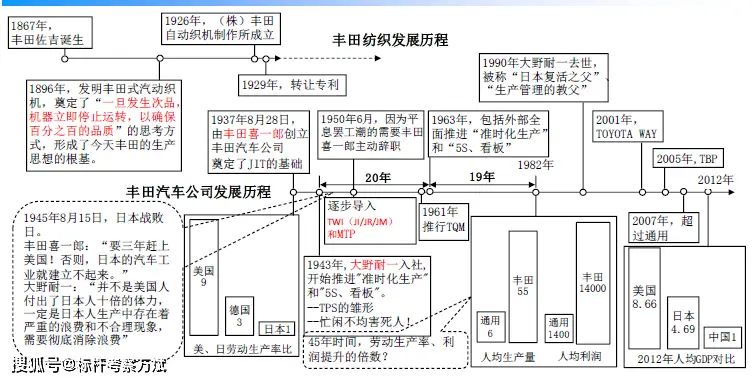
- origin: the prototype of tps began in 1943, when onoichi introduced the concepts of “time-on-time production” and “5s, board” to eliminate waste and increase efficiency。
- development: tps evolved from the creation of toyota motors in 1937 to the introduction of comprehensive quality management (tqm) in 1961 to the passing away of ono in the 1990s。
- status: toyota launched “toyota way” in 2001, developed into tbp (toyota business practices) in 2005 and surpassed general motors in 2007 to become the global car industry pole。
The core concept of tps
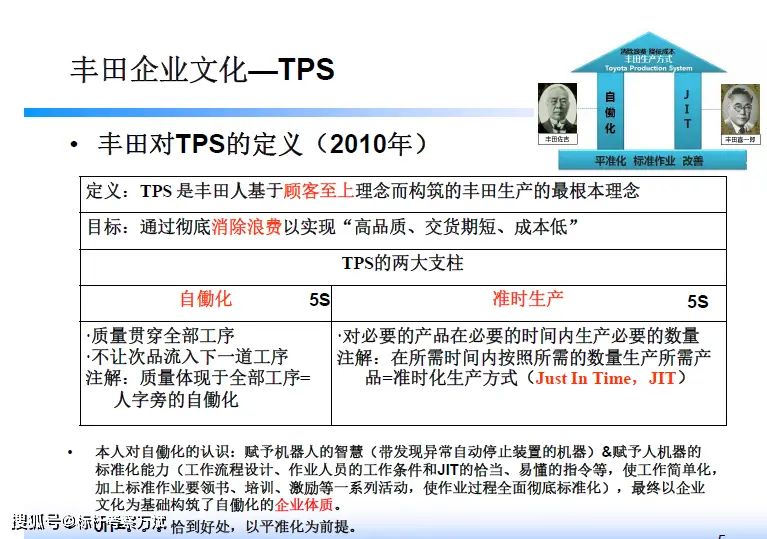
- definition: high quality, short delivery periods and low cost through the total elimination of waste, based on the concept of customer supremacy。
- two pillars:
- self-absorption: give machines the wisdom to ensure that quality issues are resolved in this process and do not flow into the next one。
- timeliness (jit): to produce the necessary quantities of products within the necessary time frame, on the basis of parity, and to eliminate imbalances in the amount of time spent。
Toyota corporate culture and values
- keywords: customer supremacy, total elimination of waste, full participation, continuous improvement。
- waste types: including seven types of excess production, bad products, stocks, movements, handling, waiting and waste processing。
- improvement tools: tps, qc, tbp, creative improvement, 5s, vsm, standard operations, etc。
Toyota improvement system
- improvement of levels:
- copper class: basic improvements, such as 5s activities。
- silver scale: standard operations and process optimization。
- gold: systemic improvements involving cross-sectoral collaboration。
- platinum level: improvements at the strategic level, such as restructuring of production systems。
- diamond level: the depth of corporate culture has improved to create an atmosphere of continuous improvement。
- methods of improvement:
- management of the approach: clear direction to achieve the goals through the pdca cycle。
- day-to-day management: maintenance of results, standardized management through the sdca cycle。
- tpm activities: maintenance and management of equipment with full participation, with the goal of zero accidents, zero failures, zero failures, zero waste。
Toyota methods of work (tbp)
- 8 step solutions:
1. Identification of issues。
2. Disaggregation。
3. Setting objectives。
4. Reasons for taking care of themselves。
5. Policy responses。
6. Follow-up on the implementation of the response。
7. Evaluation findings and processes。
8. Consolidating gains。
- core concepts: standardization, visualization, field and factual judgement, full participation。
Toyota's talent development system
- on the job training: on-site training for work content。
- on the job development: development at work and development of a comprehensive staff capacity。
- talent development model: upgrading of staff skills through hierarchical training (e. G. Tl, gl, cl) and field practice。
- managerial role: managers at all levels need to support and guide the ministry in creating a working environment that values talent development。
5s activities in toyota
- 5s content:
1. Collation (seiri)。
2. Rehabilitation (seiton)。
3. Cleaning (seiso)。
Cleaning (seiketsu)。
5. Nutrition (shitsuke)。
- aims: to create a working atmosphere for compliance with standards through 5s activities and to improve staff literacy and efficiency。
Toyota case of production management and improvement
- normalization of production: a balanced production of different models and parts through the rational organization of production rhythms。
- cost reduction: by eliminating waste, optimizing processes and improving efficiency, cost reduction and profit increase。
- full participation: from top management to front-line staff, full participation in activities to improve the business culture of continuous improvement。
Toyota's success stems from its unique production methods (tps) and deep-rooted corporate culture. Through continuous improvement, standardized operations, full staff participation and talent development, toyota has achieved efficient production, high-quality products and high client satisfaction. Tps is not only a method of production management, but also an enterprise culture that emphasizes waste elimination, respect for employees, continuous improvement and customer primacy。
An appointment is made for toyota to study the essence of toyota's culture of excellence. On-the-job experts from toyota could be invited to share the common problems of managing the operation in a thorough manner, avoiding error costs。