The clinical treatment of tumours, from surgery, decomposition, chemotherapy and target-oriented treatment to immunization treatment in the last two years, is constantly evolving, ranging from the removal of tumors, the survival of tumours and the elimination of tumours, to the “cure” of cancer。
The car-t-cell therapy for the successful “cure” of leukaemia girl emily in 2012 became another hot star therapy for the medical community following the pd-1。
On 1 june 2022, academics such as dr. Samik upadhaya of the american cancer institute conducted an in-depth analysis of the current cancer cell treatment prospects, the development of pipelines and clinical trials, in which the car-t therapy has been raised
As of 15 april 2022, there were 2,756 active cytotherapy on the global immune oncology line, an increase of 36 per cent over the same period in 2021. Of these, car-t-cell therapy is the largest in number, up 24 per cent from last year. Growth based on natural killing cells (nk) has also slowed, increasing by 55 per cent compared to last year。
It is worth mentioning that the increase in the clinical trials of real tumours is greater than that of blood tumours. According to clinicaltrials. Gov, as of april 2022, nearly 1,800 cellular clinical trials were ongoing, an increase of 33 per cent over the previous year; 43 per cent of these clinical trials were for real tumors, an increase of 44 per cent compared to the previous year, which is more than the increase in blood tumours (an increase of 25 per cent compared to the previous year), which is related to the rapid rise of car-t therapy and car-nk therapy
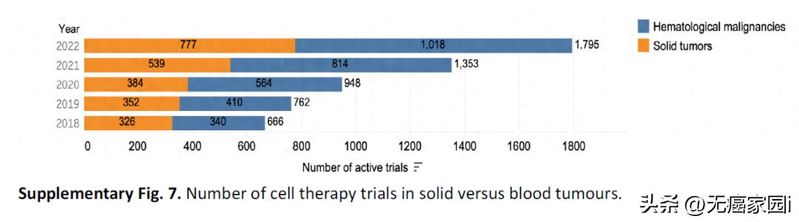
Clinical trial data for blood tumours and real tumour cytotherapy (blue tumours, orange tumours)
Car-t therapy
More than 50% of the cancer patients are completely relieved
On 1 march 2023, cargo therapics, a well-known biotechnology company dedicated to cell cancer therapy, announced the completion of a $200 million round of a financing. More than 50 per cent of the patients in the first clinical trial of the car-t therapy crg-022 targeted at cd22 have been reported to have fully abated from the relapse/difficult (r/r) large b cell lymphoma (lbcl) of the cd19 target. The results of this experiment are encouraging
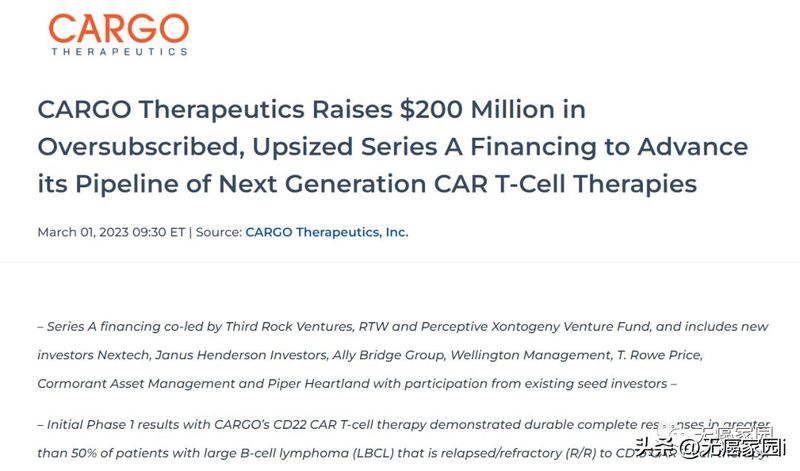
Image from globenewswire
About 60% of the big b-cell lymphoma treated by cd19 car cannot be permanently mitigated due to drug resistance. In addition, many patients do not have access to these potential treatments due to manufacturing and reimbursement-related challenges。
The crg-022 target of the car-t therapy represents cd22 antigens expressed on the surface of most b cell lymphoma and has the potential to treat patients with re-emerging diseases following the car-t treatment of cd19。
In one ongoing clinical trial, 41 patients were registered, 40 were separators of white cells and 38 (95 per cent) patients nurtured successful cells. 38 participants received two different levels of medication, with a median follow-up time of 18. 4 months and a median age of 65 for people who lost their bets, having previously received 4-line treatment (range 3-8 lines) and 37 (97 per cent) having progressed after the previous car19 treatment. The majority of the patients suffer from a widespread, large b cell lymphoma。
The objective mitigation rate (orr) and the total relief rate (cr) for 38 patients were 68 per cent and 53 per cent, respectively. To date, only one of the 20 patients who received complete relief has had a relapse. In this mid-term analysis, the median total survival period is 22. 5 months. In general, the toxicity characteristics of cd22 car-t are manageable。
It is worth mentioning that, based on these data, crg-022 has been certified as a breakthrough therapy by fda. We'll see about two clinical trials of crg-022。
There is a surge of b-cell lymphoma, t-cell lymphoma, t-al, acute lymphoma, non-hodgkin lymphoma, liver cancer, lung cancer, colon cancer, mesothelioma, ovarian cancer, etc
If you want to assess whether or not you can get a car-t treatment, you can submit a pathological report, treatment experience and a summary of the discharge to the department of non-cancer home medicine for a preliminary assessment
For further information:
There is a long way to go. Car-t therapy will bring new hope to more people with real cancer
To date, the number of car-t clinical trials conducted in the country has exceeded 500, the first in the world, and this is the first time that china has been at the international forefront in the development of a new drug. Among them, the legendary sidaki orence, the stansai, gcc19cart, and the kozi pharmaceutical industry, claudin 18. 2 car-t, are among the world leaders. In addition, there are a number of companies that are setting up a new generation of car-t and inhuman car-t technologies, with initial data and promising global markets。
The year 2021 marked the beginning of the year of cytological immunisation treatment, the pioneering car-t therapy, which is one of the future directions. The car-t therapy, which essentially involves the modification of t-cells to identify specific target points for tumour cells, theoretically has numerous types of car-t therapy for different target points, which means that there are infinite possibilities。
It is hoped that in the near future, with the efforts of national and international medical scientists, cytotherapy will be reduced, prices reduced, bottlenecks to real cancers will be broken, benefiting an increasing number of late cancer patients
Car-nk therapy
Over the past two years, in addition to the high visibility of the car-t therapy, immunotherapy based on natural killing (nk) cells has become a promising treatment for real and blood system malignant tumours. Researchers say that nk cells are more likely to be safer, cheaper and faster as a cell anti-cancer therapy。
Over half of the patients are completely relieved
The current nk-cell strategy for tumour immunisation is: in vitro active self-activated or alien nk-cell therapy; combined nk-cell and mono-resistant drugs (e. G. Immunosuppressants) to induce resistance-specific cytotoxicity; and the construction of car-nk-cell immune therapy。
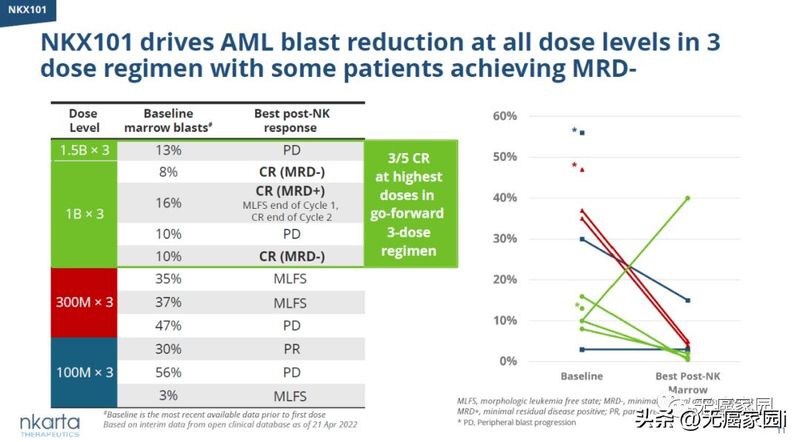
Most companies use the development of car-nk cells for treatment. On april 25, 2022, nkarta, a well-known biopharmaceutical company abroad, first published the results of two early clinical trials of its main hits, nkx101 and nkx019, both of which have had positive results in treating different blood tumours, not only reflecting good safety but also providing complete relief to more than half of the patients who have received multiple standard treatments
Nkx101 and nkx019 are the same type of nk-cell therapy. It is based on the acquisition of nk cells from a healthy provider and the use of bioengineering to add cars to make them known as nk cells. Nkx101 is a car-nk cytological therapy targeting nkg2d formulations. Nkg2d is the key activated receptor of nk cells, whose formulation is overexpressed in cancer cells。
A total of 21 cases were evaluated by nkx101, and of the two highest dose levels (300 million doses or 1. 5 billion doses), 3 out of 5 cases of relapse/difficult (r/r) acute mellocular leukaemia (aml) patients achieved a total reduction of 60 per cent with full haematological recovery, of which 2 cases of mrd (microre residual disease) were negative。
Mrd negatives are widely considered to be important quantitative indicators of the acute mellow leukaemia burden and are associated with increased non-prevalence and reduced risk of relapse. For all queues in the dose-discovered portion, out of 17 amls, there was a total relief of 3 cases, a partial relief of 5 cases and an objective mitigation of 47 per cent. There were four cases of bone marrow amplification abnormality syndrome treated, but no response was observed。