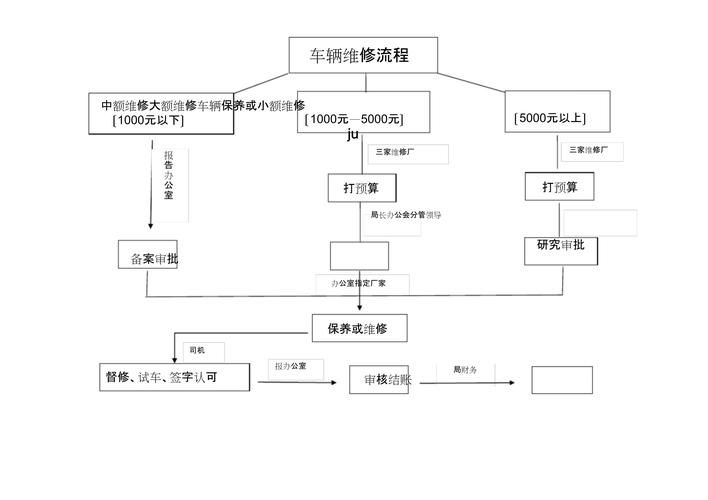
The professional and normative nature of vehicle maintenance process and standard vehicle maintenance services not only relates to the quality of vehicle maintenance, safety of use, but also directly affects client service experience and brand trust. A clear and rigorous service flow and standardized operating system is central to the maintenance plant's ability to safeguard service quality and improve industry's competitiveness. This paper will take into account the two dimensions of service flow and service standards, the professional business logic of dismantling a vehicle repair plant, the availability of practical guidance for practitioners, and the availability of information on maintenance services for owners. Service flow: full cycle management (i) reception chain from reception to delivery: when the first confidence-building step is driven to the store, the service consultant is required to meet the needs in a three-minute period of initiative and to ask the needs professionally, in a friendly manner (e. G. “is your vehicle broken down or needs maintenance? Can it be easy to describe the specific problems?”). Subsequently, the service consultant is required to work with the client to complete the initial vehicle inspection: to record the basic vehicle information (brand, model, mileage, car purchase time); to check the appearance of the vehicle, the state of the interior (e. G., scratches, damage) and to keep photographs to avoid subsequent disputes; to listen to the client's description of the failure or need, and to record the malfunction simultaneously (e. G., noise, alarm lights, motor anomalies, etc.). Upon completion of the information-gathering exercise, the service consultant is required to produce a receipt identifying the customer's needs, the status of the vehicle, the estimated duration/cost of maintenance, and to sign confirmation with the client that the vehicle will be accompanied by a protective condom (director, seat, foot mat) and that the key to the vehicle will be transferred to the workshop for dispatch. (ii) diagnosis chain: workshop movement of precise location problems assigns technicians according to the order of priority given to the receipt of the vehicle, who are required to conduct testing in conjunction with customer description and specialized diagnostic equipment (e. G., car failure diagnoser, oscillator, smoke detector, etc.): 1. Preliminary detection: reading vehicle failure code through diagnostic devices, analysing the cause of failure in conjunction with vehicle history maintenance records, driving conditions (e. G., long-term short-distance, high-speed accommodation); 2. In-depth screening: in cases where the failure code does not fully explain the problem (e. G. Occasional noise, hidden leakage), the service consultant is required to confirm the original failure scene through a road test, dismantling examination (e. G. Engine module, bottom disk) and, if necessary, to communicate with the technical support of the factory or peer technician; 3. Programme development: upon identification of the failure point, the technician is required to develop a maintenance programme (including maintenance projects, required accessories, working hours) to the client for a transparent offer (description of the original plant/bras and recommendations). (iii) maintenance chain: the standard operating quality assurance service is at the core of the service and is subject to strict adherence to the three main principles of “parts compliance plus process standards plus process controls”: spare parts management: spare parts required for maintenance are procured from the regular source, false identification, date of exit, suitability (e. G. Vin code matching) and the use of false or false or excess spare parts is strictly prohibited; if new faults are detected in maintenance (e. G. Damage to associated components following dismantling), immediate communication with the customer and re-identification of maintenance programmes and costs. Process execution: technicians are required to operate in accordance with a manual for plant maintenance or industry specifications, such as the use of a wrench wrench for the removal of bolts (the strict application of the force rectangular standards), insulation for circuit maintenance, welding operations to avoid damage to surrounding parts; and maintenance is required to keep the work space clean, tools, accessories sorted and vehicles cleaned (e. G., engine room dust removal, interior suction). Process records: the maintenance will be completed through the maintenance schedule, which will record replacement information for spare parts, maintenance steps, debugging data (e. G. Four-wheel positioning parameters, brake plate thickness) to provide a basis for subsequent quality inspection and sale. (iv) quality check: upon completion of multi-layer verification of maintenance against hazards, maintenance quality is ensured through a “level 3 quality check”: 1. Self-check by the technician: the maintenance technician checks the completion of the maintenance project against the manual list, the specification of the fittings, the restoration of the vehicle function (e. G., test driving tests, brake performance) and the submission of the correct signature; 2. Class review: the team leader or the mass examiner performs a second inspection of the vehicle, focusing on the quality of maintenance in key areas (e. G., engine, speedbox, brake system) and rereading the failure code through a computer diagnostic device to ensure that there are no residues; 3. Service consultant examines the vehicle from a client's point of view (e. G., checking the cleaning of the vehicle, functional integrity) and checking the consistency of the work list with the actual maintenance content, confirming that the customer has been notified of the vehicle. (v) traffic links: detailed services to improve the experience of traffic is the end of service and the key to reputation: settlement statement: clients are provided with a detailed statement of settlement (including spare parts, hours, discounts) explaining the composition of the cost item by item (e. G. “this is the original plant brake, 10. 000 km, and you can scrutinise it to verify authenticity”); vehicular lectures: demonstration of post-maintenance functional changes (e. G., method of using a replacement of a shaving) to clients, alert to follow-up matters (e. G., “recommended tires avoid an accelerator within 500 km) and give advice on the next maintenance; alternative care: small gifts (e. G. Glass water, car wash vouchers) are given to others, customers are invited to join the after-sale group (facilitating follow-up counselling) and emergency calls (e. G., “if anomalies are detected within three days, contact us at any time for free repairs”). Ii. Service standards: professional bottom line (i) standards for personnel from person to technology: dual professional and service requirements for mechanics: need to have a motor vehicle maintenance proficiency certificate, at least half-yearly participation in technical training at the factory or industry level (e. G. Maintenance of high-pressure systems for new energy vehicles, diagnosis of smart cars), skilled in at least two garage maintenance processes; service consultants: need to be trained in communication skills to understand customer needs accurately (e. G. To distinguish the type of “alphagus”: mechanical friction, electronic malfunctions) and to explain technical problems in a common language (to avoid “no term bombing”); staff protocol: uniform clothing, wear of work plates, and use of polite language in communication with clients (e. G., “your vehicle has been overhauled and we have added glass water for you free of charge”) and prohibition of imposition of liability (e. G. “this is not our problem”). (ii) technical implementation standards: core safeguards maintenance processes for quality and safety: strict compliance with the manual for plant maintenance or the automobile maintenance industry code, such as the use of specialized tools for engine maintenance (to avoid damage to the tank), the recovery of refrigerants for air conditioner repair (to prevent environmental pollution); and the quality of accessories: the original plant spare parts are subject to a certificate of quality at the plant, brands are certified through the state 3c and carbreaking is subject to a clear notification to the customer and an exemption agreement; and data records: all maintenance projects are subject to the maintenance archives (including work orders, accessories, inspection reports) for a period of not less than three years, which will facilitate tracing by the client or recall by the manufacturer. (iii) limitation management criteria: a balanced response to efficiency and experience: after making a telephone/line appointment, the client is required to confirm the service time, the project and to remind the client to carry a travel pass, maintenance manual within one hour; the maintenance time is long: minor repairs (e. G., replacement of brakes, oil) are to be completed within four hours, medium repairs (e. G., minor engine repairs, refuelling of transformers) do not exceed 24 hours, major repairs (e. G., engine overhauls) do not require consultation with the client for a clear cycle (e. G., “we are expected to synchronize the maintenance schedule every day for three days”); overtime processing: if there is a delay in the spare parts and technical difficulties leading to an excess, the client is to be informed two hours in advance of the replacement vehicle or transportation allowance (e. G., “i apologize very much, the spare parts arrive tomorrow and we have requested a traffic subsidy for you”. (iv) after-sale safeguards: trust in the mechanism of continuous return visits: within 24 hours of the customer taking the car, return by texting/telephone (e. G., “are you satisfied with this maintenance service? Are there any anomalies in the use of vehicles?) within seven days, customers are again reminded to check vehicles (e. G. “new tires are recommended for first-inspection foetal pressure”) quality assurance commitments: maintenance of project quality assurance for not less than 6 months per 10,000 km (core components such as motors, speedboxes can be extended to 1 year and 20,000 km) and non-anthropogenic failure for free maintenance during the quality assurance period; emergency relief: 24-hour road rescue services (e. G. “free trailers in urban areas, high-speed rescue at reasonable cost”) to ensure rapid response in case of failure of customer vehicles。iii. Closure recommendations: “living” processes and standards: visualization of management: posting of the service flow chart, “customs failure maintenance cycle” in reception areas and workshops to allow clients to visualize the progress of services; 2. Digital tools: improvement of process efficiency and data traceability using the maintenance management system (e. G., single-flowing, retroactivity of accessories, client returns); 3. In-house training: monthly “case review meetings”, analysis of maintenance errors (e. G., misloading of accessories, diagnostic errors) and optimization of process details; 4. Client participation: invitation to visit workshops (e. G., “customs”