The old stockholders have a visual feeling: two special times per month, large fluctuations are dramatically magnified — the date of delivery (third friday per month) for shares such as 300 deep and 50 above, and the day of delivery (second working day in the penultimate day of each month) for singapore rich time a50. Once the two windows are close or even overlapping, the probability of an index dive has increased significantly, and the market is commonly known as the “founding day curse”。
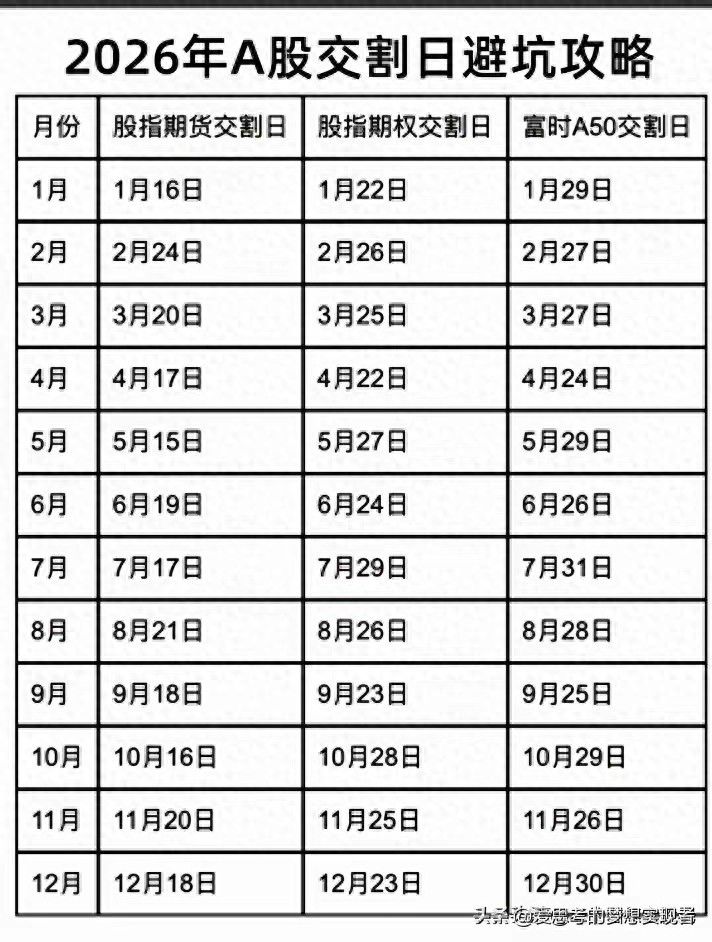
Many people have fallen to the fore, but it is a corollary of trading rules, institutional funds, foreign investment hedges, market sentiment and the resonance of power. This paper breaks down the bottom-down logic from two main lines of the domestic period, the rich times, and objectively distinguishes between “deepening fluctuations” and “necessarily collapses”, providing a clear approach to risk judgement for ordinary investors。
I. Date of delivery of future goods by domestic stock: 4 shares of funds expended
The four major shares in the country (if depth 300, ih 50, ic 500 and im 1000) are subject to cash delivery and the settlement price is fixed at the two-hour average arithmetical value of the spot index at 13:00-1500 on the date of delivery. Under this system, four types of institutional funds would be synchronized on the same day, creating a centralized market for sale。
1. Current holster consolidation, most direct short-term voltage
Quantification agencies have long used futures and spot price arbitrage: at a time when the price of futures is higher than the price of the spot (i. E., water) the standard operation of the institution is to make empty futures, buy a basket of weights/gang-based etfs, and lock in risk-free profits。
By the date of delivery, arbitrage slots must be synchronized in both directions: sell all stocks in hand and level the stock. Dozens of quantitative funds in the whole market were sold in bulk over the same period of time, such as siphons, banks and siphons, and short-term sales were concentrated and the index was under pressure. If the market is high, futures will be further expanded and arbitrage will be more forthcoming, making it easier to get out of the “high jump”。
2. Public condom transfer for a month and continuous flow of empty pressure
Long-line agencies, such as the public fund, the social security fund and the insurance fund, have a constant stock build-up to avoid the risk of large rolls falling and maintain stock-in-time bills. When the contract expires, the institution must complete the transfer by levelling off the near-month gap before the next month's bill is open。
Futures prices will continue to be suppressed by the silo process, while futures movements will reverse stock a cash in real time; while some robust institutions will simultaneously reduce stock positions and cash their exposures, and double-strangulations will sustain vulnerable shocks。
3. Multi-space game settlement, double the two-hour swing on the tailings
All futures contracts will eventually yield gains or losses, determined solely by the last two-hour index average. There is a natural game in a multi-spaced institution: many want to raise the average price, and empty wants to lower it。
In historical data, there is a greater willingness to engage in capital games in vulnerable situations, often after 13 o ' clocks, with the continued sale of weights and weights down the index; multi-carriage funds are dispersed and limited, and there is a high risk of a unilateral tailings jump, which triggers a single bulk loss and further exacerbates the decline。
4. Frightened self-fulfillment, increased voltage
After many years of market dissemination, there was a general consensus that “the day of delivery would fall”. A few trading days before the cut-off date, large numbers of dispersed households are expected to slow early, wait and see, and market liquidity shrinks; once there is a small fall in the disc, the panic disk is concentrated and flees, creating a negative cycle of “sliding and selling” that would have been able to shock the recovery, which would have turned into a direct fall。
Ii. Time a50 cut-off day: fdi hedge tools, disturbance of a weight core
Fulbright a50 was listed on the singapore exchange, tracking the top 50 core white horses in the market value of a shares, the only easy out-of-the-field hedge tool for north-to-north fdi, and the rules of cut-off were completely staggered with domestic reporting, for the second working day in the penultimate month. Its downscaling logic and domestic equity are complementary and compound market risk。
1. Foreign direct investment (fdi) is naturally required to hedge and destroy inventory in a two-way profit logic
Foreign investment holds a large a share of a horse, but foreign markets are unable to make an a share of cash directly, relying on the a50 stock hedge risk, and the market has a higher percentage of long-term empty stock, and foreign investment has the incentive to press the index, regardless of the increase or decline:
- if there has been a significant increase in a shares, foreign investment cashs a profit margin, holds an a50 bill simultaneously, the cargo recovers when stock prices fall, and locks in the proceeds
- if the a share continues to weaken, foreign investment will push down the index, relying on a50 for profit only and holding up against the stock。
White wine, finance, and new energy are at the forefront of the a50 core component, and foreign sales weights can drive the market-wide mood by driving 300 deep, 50 weak。
2. Early pricing of a50 fluctuations overnight, direct jump of a stock the next day
When a50 trading hours cover a stock closings, and one night before the date of delivery, foreign investment will bid early on for settlement, and a sharp rise and fall overnight will directly create the next a stock jump。
In the case of intra-country periods, with the expiration of the weekly fold plus a50, overnight fluctuations + double shocks from domestic institutions flattening the day, the openings are significantly low, the financial confidence in the field collapses, the inability to deliver more than one day, and the probability of a major drop increases significantly。
3. Synchronization of cross-border funds and doubling of risk at the end of the season
At the end of the quarter (3/6/9/december) is the dual high-risk window of a50, the domestic period: at the end of the season, foreign investment needs to go back, adjust the global asset allocation, synchronize the quarterly netting of public fund funds, double-directional decomposition with derivative delivery, and more than double the average monthly shock。
Iii. Double-cut window superimpose: two resonances, full drop risk
The most likely point of extreme decline is the domestic stock forward delivery week, which is close to the fha50 date and even matures in the same week, with a triple financial impact:
1. Quantified arbitrage, centralization of domestic institutions and suppression of the main plate weights
2. North-to-north fdi settles prices through a50 and sells core white horses
3. The double panic between the diaspora and short-term financing, with the depletion of liquidity, could lead to a rapid decline in the index in small sales。
In june 2026, for example, domestic stock shares were close to each other on the day of the cut-off and on the day of the a50 in the time of the rich, and the market was retraced throughout the day and the tailings were significantly weakened, a typical manifestation of the resonance of the two derivatives。
Objective clarification: the date of delivery is not a “might fall spell”, but a volatility amplifier
Many investors have cognitive error zones, believing that the date of delivery will fall, and two key facts need to be clarified:
1. Institutionally managed design
The domestic stock represents a two-hour average price for the settlement of futures, it is difficult to distort the average price significantly by relying solely on short-term fund crashes, and there is real-time monitoring of large-scale and concentrated transactions at the supervisory level, without the condition of a discretionary index of funds. The data from the day of exchange of history show that one third of the rises, shocks and declines are not unilateral。
2. Days of delivery only magnify pre-existing market trends
- the market itself is on an upward trend: on the day of delivery, even with short-term outages, multiple successions are sufficient, with an approximate rate of return and tailing repairs
- markets themselves are vulnerable and have a capital stock game: the concentration of pressure on the day of delivery will magnify the decline and emerge from the unilateral jump。
To put it simply: cutting-off days do not create rises or falls, but only magnify the original power of the market. At the core of the decline was the weakness of the field funds themselves, and the delivery rule had only accelerated adjustments。
V. General investor-acting coping strategies
1. The pre-marked monthly double-risk window: (b) third friday (domestic period) per month, penultimate working day (fift time a50) per month, with two dates approaching with the initiative to lower positions and circumvent extreme tailing fluctuations
2. Reduction of short-line recovery operations on the date of delivery: (b) the intensity of the damage during the hour, the ease with which the damage can be cleaned, the low rate of short-line error, and the priority given to watching
3. Races that circumvent the weight of power: white wine, finance, large new sources of energy are arbitrage, foreign investment is the preferred option, and high-interest defense plates can be replaced by delivery days to reduce volatility
4. Distinguishing trends before judging risks: there is no need for excessive panic if the market is in a strong dominant position; if the index is stagnating and the turnover shrinks, it is imperative that the delivery week is safe。
Viewing statement: the text and shares in the text are used only as personal duplicate records, not as investment advice, and the stock market is at risk and requires caution。