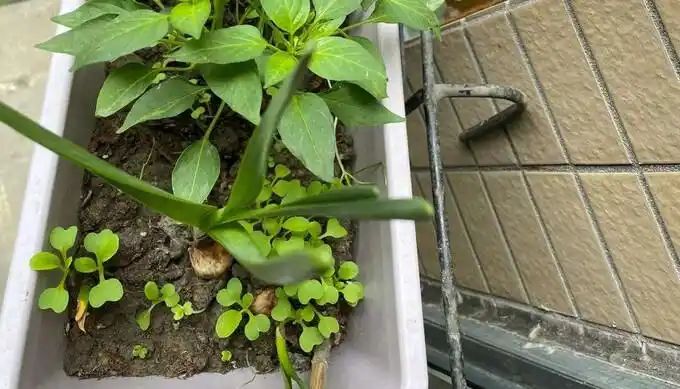
A lot of friends who like to grow food at home have been having problems. Not only does ordinary earth produce vegetables, but they also tend to breed small insects and muds. The balcony space is already small and the pottery is easy to smell and is time-consuming and laborious。
It's actually a new way of growing, and that's hydroponic. Without soil, without deep tillage, with simple preparation of containers and water, and with a little daily trimming, a vegetable can be harvested in about seven days. It can be operated either in the unoccupied corners of rural homes or in urban closed balconyes。
Today, we're going to clean up the six usual vegetables, grow fast and have a low threshold, get new hands on them, recycle them in a clean and hygienic manner, and make daily meals with fresh food。
I. Basic knowledge of hydroponic vegetables
Many people feel that hydroponic techniques are complex and require specialized equipment, and that home-grown farming is perfectly simple。
The plastic baskets, used lunch boxes, foam trays, bottles of glass, which are not used in everyday homes, can be used as water-containers. The core requires only two points, root access to moisture and upper leaves to allow for ventilation。
Day-to-day maintenance requires only the replacement of fresh water on time, avoiding the tan of midday light and placing it in the air-dispersed position. At a suitable temperature, spring and summer festivals produce seedlings at a particularly rapid rate, freeing them from fertilization, pine soil and a series of problems. The following is a case-by-case description of six hydroponic vegetables suitable for family planting。
Ii. Category i: water for green bean sprouts, 7-day fast-growing veggies
Green bean sprouts are the most common home food on your table, and they're good for cooking, cooking, and mixing. The bean sprouts bought outside are mixed, and there are also pharmacological conditions in part. It'll take seven days for you to grow up and enjoy yourself。
The green beans, which are full of particles, are selected, so that they are immersed in constant water for six hours, until the beans fully absorb the water skin. Prepare to empty the plastic basket and lay a veil on the bottom and flatten the green beans and not pile them too thick。
Every morning and evening, water is poured out, and the extra water naturally leaks, avoiding light placement. Temperatures remained moderate, three or four days were sprouts, seven days or so were sprout lengths met, and they were collected directly。
Bean sprouts are used only for water, without any fertilizer, clean and impurity, and now taste best。
Iii. Second: fragrances, which are collected many times as they are eaten
A lot of people can cook without the fragrance, but ground-planted licorice is slow and prone to yellow leaf roots. The fragrance not only takes its roots fast, but also cuts and harvests over and over again。
Select the root of the fragrance with its roots, clear the yellow leaves and keep the white roots on the bottom. Prepare for shallow vent containers, pouring into a small amount of clean water, so that the water level is just above the root and leaves are suspended above the water surface。
Place it at the balconies and replace it every two days. It'll be about five days before fresh stubbles come out of the top. At a later stage, no single root will be removed, only the upper leaf will be trimmed, the roots will continue to be preserved and sprouted。
Iv. Third category: hydroponic onions, kitchen ready and ready for cutting
Households cook with little onions and often go to the market to buy food. Use the rest of the onion roots at home for hydroponic training, recovery of strength for seven days and long cycle harvesting。
Retain two or three centimetres of the base of the white and clear the outer layer of dry skin. Free mineral water bottles are cut open and shallow disks can be used as containers, with a small amount of water immersed in root systems。
The first period was one of slow seedlings at the ventilated light, and then slowly received soft light after rooting. After the roots spread fast, the upper onions grow fast. Until the height is sufficient, the upper leaf is cut directly, the roots are kept and the new onions continue to grow。
Home-based water onions can flourish without fertilization and regular water exchange, and kitchens are easily accessible。
V. Fourth: aqueous garlic seedlings, fast growing insects
Garlic growth is highly adaptable and hydroponic is the simplest form of planting. In autumn and spring and summer, we can grow green garlic seedlings, dumplings and fried eggs in about a week。
The whole garlic graft, with no need to go to the skin, is laid in a shallow plate, with a small amount of water at the bottom, and it comes to the bottom. Pre-light avoidance takes root and then moves to light-dispersed positions for conservation。
Under clean water conservation conditions, garlic seedlings are growing and uniform, with very few pests and diseases. Once the garlic is grown up to about 15 centimeters, the garlic graft can be re-emerged。
Vi. Fifth type: watery cabbage, hotter and hotter
The hollow cabbage itself is watery and damp and well suited to the water-breeding environment, and the summer weather is still strong. Whether it's a stick or a root, it's quick to live。
Choosing swigs, cutting off 15 centimeters, removing spare leaves from the bottom and immersing them directly in clean water. Put a ventilated balcony, three or four days with white aquatic roots。
Once the roots have stabilized, normal dispersible maintenance takes place, with two to three days to replace the water. At the top of the branches, new sproutings continue to emerge, each harvest is strangling, the bottom branches continue to remain in place, and the summer is a continuous harvest。
Vii. Sixth: hydroponic celery root, time saving for replanting power
The celery tastes nice, and many people eat only the leaves and throw away the celery roots, which are particularly suitable for regenerative water。
Cut the celery roots flat, keep the whole root plate and put it in a shallow vent container with water maintenance. Prior periods have been characterized by low water availability and normal maintenance following new roots。
In about a week, leaves appear, and at a later stage a whole seedling of celery grows. A small amount of domestic plant is being planted, and the daily soup is just fine, with no use for soil and clean insects。
Viii. Home-based water and water training
Skill one: put the control level at the core
All hydroponics must not be soaked in all their leaves as to allow the roots only to touch the moisture, so that the leaves do not glitter。
Tactic ii: change water on time
High spring and summer temperatures make water quality susceptible to deterioration and stench, with two days of fresh water being replaced; low temperatures allow proper lengthening of water cycles, keep water quality clean and the roots are not easily decomposition。
Strategic iii: placed in good shape
It spreads light before its roots, grows new leaves and receives soft and light, avoids the hot sun, and prevents excessive water temperature from burning the roots。
Skills iv: reasonable trim and extended harvest period
Varieties that can be harvested over time, not even roots, are trimmed only for edible parts, retain roots and foundations, and continue to grow and grow for long periods。
Nine: common error zones for hydroponics, avoiding a few turns
Miss one: water level full of pickles
Water is not enough for the leaves to rot and the rate of survival is reduced。
Zone 2: long-term placement of dark corners
The lack of light-seeding vegetables has a weak yellowing effect, and the growth has been slow to change。
Mistake iii: long-term non-replacement of conservation water
Water quality breeds bacteria, roots have black hair and stink, and there are rotten roots。
Wrong four: blindly adding all kinds of fertilizer
The short-term harvesting of vegetables by households allows water to meet the demand for growth, and fertilizers tend to breed algae and trouble management。
X. Comprehensive summary
The six are hydroponic vegetables that are grown in a small home-friendly environment and free of the mud. Green bean sprouts produce a single harvest at seven days'speed, garlic celery is regenerated from roots, and hollow cabbage twigs are rounded。
Simple water-level control, timely water change, rational light operations, without deep tillage, without pesticide fertilizer and with fresh vegetables at all times in a clean state. Small gardens can be built easily, in both rural and urban areas。