Natural disasters are natural phenomena that endanger or damage human survival, including droughts, high temperatures, low temperatures, cold tides, floods, flash floods, flash floods, typhoons, tornados, fire tornados, hails, hails, frosts, storms, snowstorms, freezing rain, acid rain, fog, wind, ice-freezing, haze, fog, haze, earthquakes, tsunamis, landslides, landslides, dust, sand, sandstorms, thunderstorms, thunderstorms, spherical flashes, volcanic eruptions, etc。
The direct economic losses caused by disasters are enormous. Damages to buildings, infrastructure, agricultural and industrial production facilities, among others, require significant investment in rehabilitation and reconstruction. These costs not only consume social resources, but may also affect the country's fiscal stability and economic growth; and, secondly, the indirect economic losses caused by disasters. For example, disasters can lead to disruptions in market supply and higher commodity prices, which in turn affect consumer and business interests. In addition, disasters can have an impact on services such as tourism and insurance, further exacerbating economic losses; in addition, they can have a ripple effect on the global economy. A disaster in a country or region can trigger fluctuations in global supply chains, affecting international trade and investment. Such a ripple effect could increase global economic instability and uncertainty and threaten global economic recovery and development。
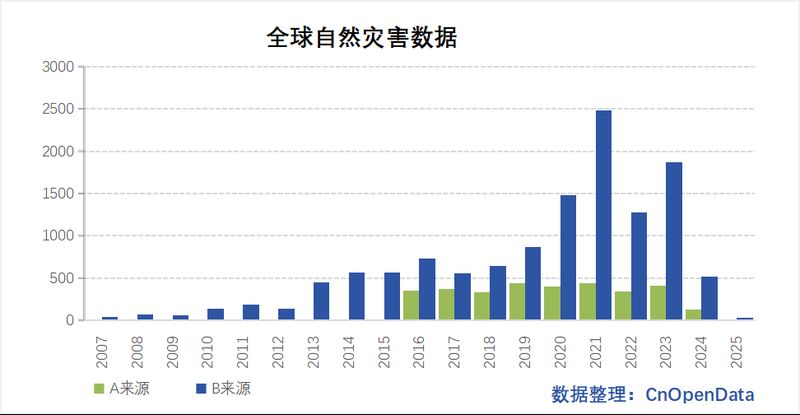
In conclusion, the economic losses to human society caused by disasters of all kinds worldwide are enormous and require concerted efforts by governments and the international community to strengthen disaster prevention and mitigation and to reduce disaster occurrence and loss. At the same time, there is a need to strengthen research and analysis of the economic impact of disasters and to provide strong support for the development of science-based disaster prevention and mitigation policies. Against this background, cnopendata collates global information on natural disasters from two sources, with a total of 3,200 data from a and 12,000 data from b. The table contains information on the type of disaster, level of disaster, region, latitude, number of people affected, direct economic loss, etc。
Size of data over time
Field display of global natural disaster data for sample data - global natural disaster data for a source - frequency of updating of literature data for b source
Annual update