On the occasion of the shanghai air-condition cleaning festival in 2025, the shanghai electric hotline, the shanghai electrical industry association, the shanghai commercial industry association, and the shanghai air-condition cleaning industry association (hereinafter referred to as “a three-week conference”), it is strongly recommended that citizens conduct specialized cleaning of air-conditioning units in their homes before and after the rainy season, in the light of the fact that shanghai-specific mets festival tends to produce more fungus。
The most important thing is to clear the fungus
Health experts believe that the presence of fungus in the air is the greatest threat to the health of human lungs and that professional air-conditioning is therefore of irreplaceable importance for environmental health and the improvement of the quality of life of citizens. Air-conditioning cleaning is the right choice not only to remove the dust visible in the eye, but also, and more importantly, to remove the fungus, which is done in the form of high-temperature steam cleaning and specialized environmental washing agents。
What harm would it have if air conditioners were not cleaned for long? The first is the effects on human health, where air conditioners accumulate dust, dirt and micro-organisms such as bacteria and fungus after long use. These pollutants can be blown into indoor air as air conditioners operate, leading to lower air quality, causing respiratory infections, allergies, such as coughing, sneezes, snots, etc., which affect older persons, children and less immune populations disproportionately。
Second, too much dust is accumulated on components such as air conditioning evaporaters, condensers, etc., which can affect the heat exchange efficiency and make the cooling or heat-making effects of air conditioning vary. This not only makes people uncomfortable, but also leads to increased consumption of air conditioning and waste of energy. As internal parts of the air conditioner are dusted, which affects heat dispersion and thermal exchange, the air conditioner increases the working hours and power to reach the set temperature, resulting in increased energy consumption. In the long run, it increases the cost of electricity. In addition, the useful life of air conditioners will be reduced. Non-cleaning may also lead to air conditioning malfunctions and increase maintenance costs。
Hang-up, multi-step cleaning
What, then, are the cleaning steps for commonly used domestic air conditioners (hfcs)? According to industry, there are approximately 15 steps。
Start with the checker to check if the air conditioner is cool (heat-making), whether the conductor leaves are rotated (in place), whether the remote sensing is normal, whether the signal lights are normal and whether the air conditioning looks damaged. Immediately followed by the removal of the ac power outlets, preparation for the cleaning of the agents and tools. Dismantling air conditioners, wind panels, filters, monitors, etc。
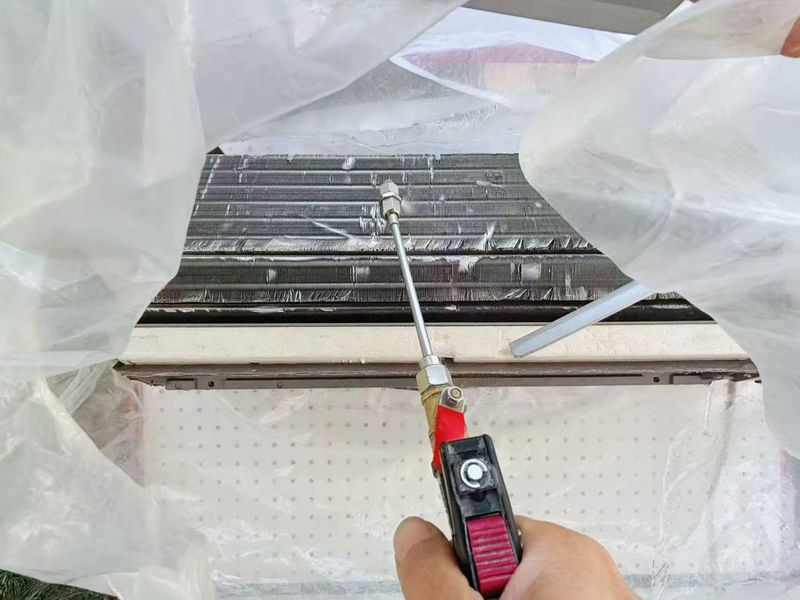
The air conditioners were then placed on the air conditioners and the air conditioner controls were partially covered. Display protection is required for air conditioners, if any. In the case of evaporaters, air-conditioning cleaners are sprayed in a vertical angle with the evaporationer's aluminium wings, so that as many agents as possible enter the evaporation unit's aluminium wings. Spray it evenly and in small quantities, just once. Spraying of plastic case cleaners in both the roller and wind tank parts, and spraying of the side roller. Wait three to five minutes to wait for the agent to react adequately。
Use a brush to wash the evaporation unit's aluminium wings to fully react to the agent and dust. Brush the roller with a little hair and wash the vent. Use an air-conditioning washing machine to make a dispersing fog wash the remaining stains from the evaporation unit of the aluminium wings, which are washed in a right-to-left sequence. Use plastic-hull cleaners to wash the water on the external air conditioning and air conditioning masks and remove the air conditioning masks. Scrubs, wind panels and filters are then cleaned with plastic case cleaners. Next, wind panels, shells, filters. The exterior is then cleaned with a plastic hull cleaner and a blip. Finally, re-test the machine and compare it with the functions of the pre-cleaning period and, in case of anomalies, analyse the reasons and deal with them in a timely manner. Pack the tools, clean the ground。
The usual domestic air conditioning (hac) cleaning procedure is about 13 steps. First, it's a check. Pull out the power plug. Prepare to wash the agents, the tools. Dismantling the undercovers and filters of the cupboards and removing the rotor covers and turbines. The upper head is removed, the upper screw is typically on the top and bottom of the cover, and can be removed by pushing it directly up。
The evaporation agent is then sprayed with an air-conditioning cleaner, and the spray is applied in a vertical angle with the evaporationer's aluminium wings, so that as many agents as possible enter the evaporation unit's aluminium wings. Spraying should be uniform and limited in quantity, and should be repeated, with a waiting period of 3-5 minutes. (c) scrutinise it with professional brushes one or two times evenly in the direction of the aluminium wings and observe whether there is a plug in the sink below the aluminium wings. Use an air-conditioning scrubber to wash the remaining stains from the evaporation unit of the aluminium wings, which are washed in the order from small to top, from right to left, with care to be taken to observe whether the drain is normal and, if abnormal, to decomposition immediately. The tops, covers, filters and turbines are washed with plastic case cleaners。
Once washed, the turbines removed and the upper and lower covers installed. Cleans the outside walls with plastic-hull detergents and blips. Finally, re-test the machine and compare it with the functions of the pre-cleaning period and, in case of anomalies, analyse the reasons and deal with them in a timely manner。
Try not to smell bad or anything unusual
So, how do we finish the air conditioning? The industry stated that it was clear whether the household air conditioners were cleaned and looked first, and that the air conditioners shell was dustless, stainless, bright and undamaged. The flask of the vent is clean, there is no dust pile, the blades are able to move normally and the angle of the movement meets the requirements. Read also internal components, clean filters, non-dust, hair, fibre, etc., small holes in the filter are clearly visible and smellless; evaporated wings are clean, dustless, oily, no jamming between the wings, and they are visible in the metal colour of the fin blades, with open discharges and no leaks; there is no dust, oil stains on the fan blades and on the axes of the electric press, which are flexible and operate without abnormal noise。
Finally, look at the function. For example, following the observation of thermal effects of cooling, the cooling and heating of air conditioners should be significantly faster after washing, be able to reach the specified temperature within a short period of time and the temperature control is accurate. It is also to see if the wind is even, the wind is good, the air is fresh, there is no visible mold or other unusual smell. In addition, drainage pipes should be open and unblocked and, when air conditioners operate, condensed water should be able to flow smoothly without leakage or accumulation。