“some comrades have never seen or studied the party platform before. There has been some ambiguity in the past, and it is now very sharp. Some of us don't know, and they're clear now. It's a remarkable feeling that it's closed to the light, and it's like, "the eyes are wide open."
“some comrades have been dissatisfied with the party in the past, arguing that it was unfair and that it was a loss to the honest. As a result of this study, it was mainly the result of individualism and the fairness of knowing the party. The main reason for not being promoted is that they are not well equipped, and not that they are mean, but that they are too objective to themselves. It's a small achievement compared to the party's career
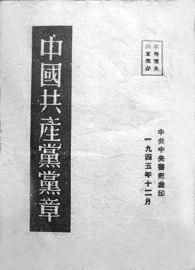
These pristine words and insights are the result of a historical collection of historical records from a rare collection in the central party school archives, which recorded the thought of the participants in the central bureau party school who studied their party chapters in 1947. Words are born in our hearts and minds, as if we were still able to read these living words, as if we were still able to travel through distant time and space, to feel their firm faith in the party and to share a serious education and spiritual baptism in the political life of the party. In the context of today's era, revisiting this literature is of great inspiration and relevance for furthering learning。
This document, entitled " the harvest after the study of the party's chapter " , contains more than 7,000 words, which summarize the stories of the students of the two, three, four, and five groups of the central bureau who studied the party's chapter and summarize them in terms of awareness and thought. This includes the nature of the party and its founding principles, its guiding principles, the characteristics of the chinese revolution, its popular route, the democratic concentration system within the party, the review of the six aspects of the cadre, the concept of learning, the concept of life, the ideology of the individual, and the organization and upbringing of the organization. During the group discussions, participants made serious criticisms and self-criticism against the articles of the party's statute, which truly played the role of red-heart, sweating and detoxification, healing and refuelling。
Old party members have been confronted with new problems: breaking down ideological confusion and ambiguity in further studies
For the first time, the mao zedong idea was established as the guiding philosophy of the party, the seven major chapters were added to the general section and, for the first time, the obligations and rights of party members were clearly defined in text. The seven major chapters have also included criticism and self-criticism in the general outline, with a particular emphasis on the party's popular route and the refinement of the party's principle of democratic concentration, which was the most fully developed of the party during the democratic revolution. In the face of many “first” and “new issues”, many old party members have experienced confusion and ambiguity。
Some question the strengthening of theoretical learning — “there is also some subjectively gay contempt of theory — which is the dogma, thus blocking their theoretical advancement and intellectual advancement”, and “some feel that chairman mao's ideology or the deeply rooted theory of marxism is a matter for senior cadres and highly educated comrades. `how can marxism be learned without culture' some are puzzled by the party's philosophy, such as knowing that mao is good, not knowing why, not knowing where he is good' and believing that the party's advocacy role is to promote the idea of mao's `what to do' is empty. Some have a vague understanding of the construction of the party, considering that it is the responsibility of the comrades working in the party, and that it has nothing to do with it, not knowing that it is the task of the party as a whole, and not knowing that the transformation of individuals is part of the building of the party. Participants also have different ideas about what to learn, how to learn and what to do。
In response to these problems, the party school of the central bureau, by organizing students to listen to the reports, study the party's chapters, then interact with each other, inspires each other, corrects misconceptions in the resolution of doubts and removes the buttons of thought. “becoming aware of what needs to be put on the back of the old, the more complete, the better”, “the past was only organized into the party, and it is now the thought that has entered into the party, and it is the future that continues its efforts to improve its foundations by constantly using marxism, mao zedong's ideology as a standard”, and “more profoundly reflecting on the results, which have led to considerable improvement and progress”. Through the mirror of the party charter, the participants turned their backs and actually pointed at the caves, poking into the sacks and showing their shortcomings。
The new march is accompanied by a new problem: strengthening the party's ideological and political construction is always on the way
From the seven to the eighteen largest, the situation facing the party has changed dramatically, but some of the old problems raised by the participants at that time still exist, but only today there are new manifestations. For example, with regard to the popular route, “the people are always great when they say they are great, and i am great when i'm in the crowd”, “not knowing that all of our party's policies are for the people, not knowing that they work for them. On the contrary, the work is done by the crowd and it is done by itself. It is emphasized that the decision of the superior is to be implemented by the masses without regard to whether the decision should be modified in the light of the opinion of the masses, and that the latter are left behind”. For example, in the context of the implementation of the party's democratic concentration system, some comrades simply ignore the collective leadership, do not have a party committee, often make individual decisions and develop plans, guidelines and instructions. Personally dealing with branch issues and party membership issues, “some comrades think that i am the party, and that i am the party, and then they don't consult with the party committee, so they don't talk about it, they don't do it, they don't do it, they don't do it, they don't do it, they don't do it, they don't do it, they don't do it, they don't do it, they don't do it, they don't do it, they don't do it, they do it, they don't do it, they don't do it, they don't do it, they don't do it, they don't do it. In terms of awareness of party school studies, some students come to the party school and wish to give them a big lesson, put theory in their minds, and when they return, they can speak to others to show themselves. Some believe that they have a low level of education and are simply learning about culture. Schools are used as rest and recuperation centres, and party schools are mainly used for rest and recuperation, and there are even those who wish to change jobs。
When the old problem becomes a new examination, the new process is accompanied by new problems, and the “test” continues. In this new period of history, secretary-general xi once again raised the issue of “catch-up”: “to continue to test the `tests' of our party, to test the `tests' of our party, which are and will be tested, and to try to hand over excellent responses.” faced with the `four tests', with the `four dangers', the party is more demanding than ever before。
The new question calls for a new theory: always arming the whole party with the latest results of marxist chineseization
In the general outline, the seven major chapters establish that “the idea of unity between the theory of marxist leninism and the practice of the chinese revolution — the mao zedong idea — is the guide for all the work of our party”. Mao zedong's idea, the first major theoretical achievement of the marxist chineseization, is also reflected in the students' learning experience - “a more comprehensive system of understanding of the chinese and concretized system of ideas of mao's marxist ideology, the idea of mao as the guide of the chinese revolution, the communism of china, the culmination of the practice of marxism and china's revolution, the correct understanding of the characteristics of china's revolution, the triumph of the wrongs at hand, and the triumph of the chinese revolution ...”
Max once said, “the problem is the voice of the times, which is open, undaunted, and which affects all individuals”. From mao's ideas to deng xiaoping's theory, from the “three representatives”' important ideas to the scientific development perspective, to xi's series of important speeches, the secretary-general's scientific answer to the issues raised by different times and the chinese voice of different times. Every theoretical innovation of the party has its roots in marxist theory, its life cycle, and it has evolved and enriched with the development of times, practice and science。
The new theory that guides new practices: “both learning to do” learning is a major innovation in deepening regular education within the party
“learning must be linked to reality. This has proved to be the only way. Knowledge of the past does not solve problems in thought, because it is not a practical combination. The combinations that had been called in the past were empty slogans, not actions, not ideas, but dogmatics. It is now understood that, in order to be relevant, it is first and foremost necessary to have a good understanding of one's own and to be determined in mind and to be guided by specific issues.”
This seemingly simple but deep-seated learning experience reflects one side of what our party has always argued is that the purpose of learning is to be applied, and that theoretical innovations must be applied and guided by practice. At every major historical point, the party has consistently applied theoretical innovations to explore ways and means of achieving education in thought. On the basis of the party's popular education practice activities and the “three-thirty” thematic education, and in order to further consolidate the gains achieved, the party's centre deployed a “two-school” learning programme throughout the party, leading to a major innovation in regular education within the party under new historical conditions。
Channel selection
40 episodes of the historical documentary, " the power of faith " , online
The people have faith, the nation has power, and there's a lot of people who say, "the power of faith."
Mao zedong's eyes
Who is the supreme commander of the red army who died in the central red army
How far did mao zedong's parents reach him? Fan
Which one of the reds who came out of the mountains became a great diplomat
How has mao faced life and death
What 10 senior generals of the red army left during the land revolution