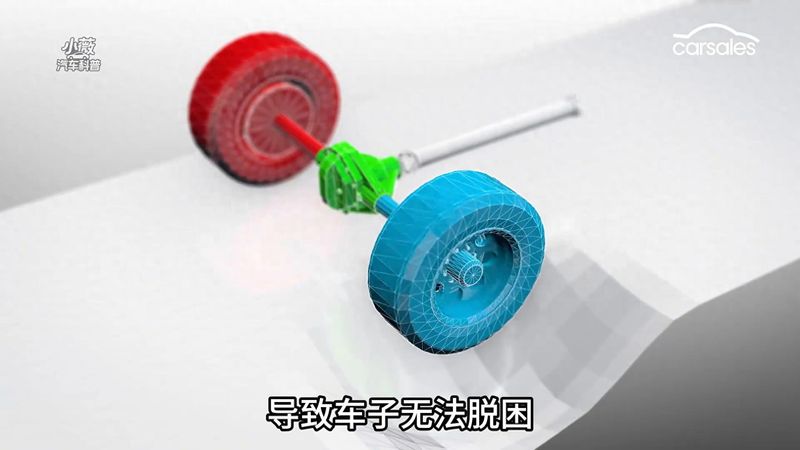
Today we share a wave of dry goods on axes, including definitions, materials, types and designs。
What's an axis
The axis is essentially a rotating component of any machine with a circular cross-section used to transfer power from one part to another or from the power generator to the power absorber. To transfer power, one end of the axis is connected to the power source and the other to the machine. The axes can be solid or hollow as required, and the hollow axis can help reduce weight and provide advantages。
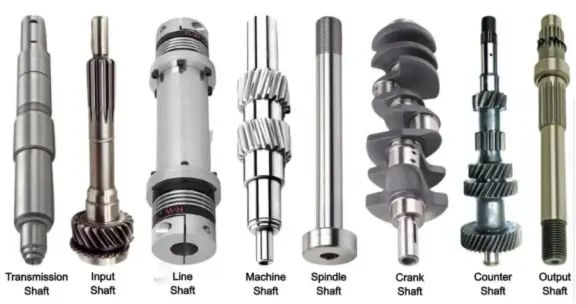
General description of axes
The axis is one of the very important components used in the machine. They are used to support rotational components, such as slides and gears, which are supported by bearings in rigid machine casings, and gears and belt wheels on axes that facilitate the transmission of motion。
Many other rotating elements are installed on the axis by key. Due to the counter-activation of the components supported by the axes and the twists generated by the power transfer, they bear the bends and twists。
The axis always has a circle cross-section, which can be hollow or solid. Axes can be divided into warp axes, straight axises, ripple axises or flexible axises, but they are usually used to transmit power。
The axes are usually designed to be steep cylinder poles, so they have different diameters over the entire length, although the axis with a constant diameter is easy to produce。
The stress size of the escalator changes with its length. Axes with a unified diameter are not suitable for disassembly, assembly, maintenance, and these axes create complexity, especially bearings, when the parts on them are secured。
Type of 2 axes
Axle 01
These axes are ladders for the transfer of power between sources to another absorbing machine. Installation on steps of axle gears, rims or belt wheels for the transport of motion。
Example: high shelf axes, line axes, subaxis and all plant axes。
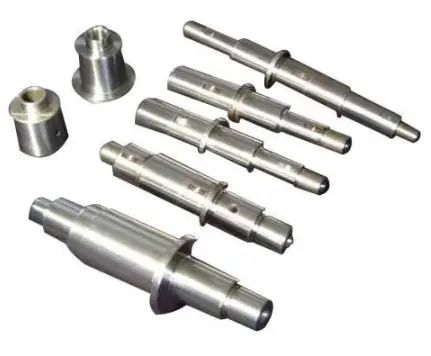
02 machine axis
These axes are inside the components and form part of the machine。
Example: the curved axis in the motor is the machine axis。
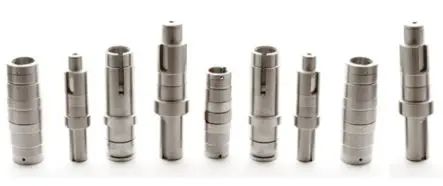
Zero-three
These axes support rotational elements, such as wheels, which can be installed in the shell with bearings, but the axis is a non-rotational element. These are mainly for vehicles。
Example: axes in cars。
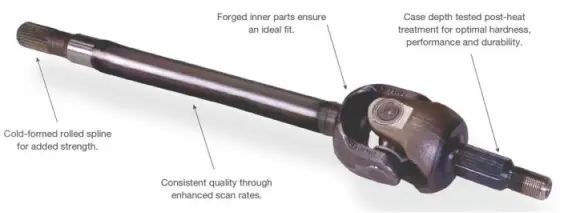
04 main axis
These are the rotational parts of the machine, which accommodate tools or workspaces. They are short axes for machines。
Example: main axis in car bed。
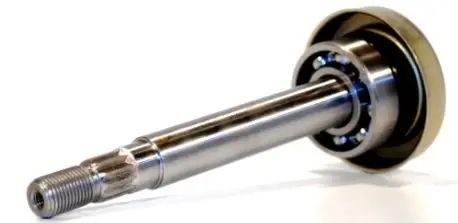
3 axis materials
Often, low-carbon steel is a material used for axes. Alloyed steel, such as nickel chromium, nickel, chromium steel, is used if high intensity is required. They are formed by thermal rollers and cold liftings and grinding, and the materials usually used for conventional axes are carbon steel of 50c12, 50c4, 45c8, 40c8。
Materials used for axes shall have the following characteristics:
4 axis standard size
Mechanical axes
It can be up to 25 mm with a foot of 0. 5 mm。
Drive axis
Standard size-step length of axes
25 mm to 60 mm to 5 mm long
60 mm to 100 mm-10 mm long
110 mm to 140 mm-15 mm foot long
140 mm to 500 mm - 20 mm long。
The standard size of the axle of the machine can be as long as 25 mm and 5 mm long. For axes, the standard lengths are 5m, 6m and 7m, but generally between 1m and 2m。
5-axis stress
The stress in the axis is:
C. Cut stress due to twisting (reverse caused by reversal of load)
(b) the bending force, which is of a condensed or stretching nature, caused by the force acting on mechanical components (e. G. Belt and gear) and the self-heaviness of the axis
Combination stress caused by bending and reversing loads。
The design response maximum allowed for cutting is:
1. Axis of 56000 kn/m2 with residual key slots。
2. Axis 42000 kn/m2 with no key slot balance。
Maximum permitted bending strength is:
1. Axis 112000 kn/m2, with residual slots。
2. Axis 84,000 kn/m2 with no key slot balance。
6 manufacture of axes
Axis are manufactured using thermal roller process. The cold-rolling axis is more intense than the heat roller, but cold-rolling results in high residual stress and deformation of the axis during processing. The exercise process is used to create greater diameter axes。
Upon completion of the roll-out, the axis is processed at the end, one end of the axis is mounted on the inspection and the other end is supported by a rotor tower of the bed. For the purpose of refining the axes, the blades are fixed and when the power is turned on, the wheel begins to rotate。
The kiosk is used to check the concentricity of the axis prior to processing and for various operations, such as carwing, end-side, scalding, cone cutting, etc., depending on the use. Massive, cnc applications are best suited for final processing. It can also be processed with a digitally controlled double-end machine bed between the blade and the clip。
In order to achieve a concentricity and circle, the revolving blade should be relative to the central line. This process is usually used for transmission axes and electric generators。
7 axis
We know the axis is used for power transmission, so the formula used to calculate power transmission is: p=2πnt/60. Of these, p is the power of the transfer (w); n is the turn-per-minute (rpm); t is the twist in n. M。
Speed of axes for various applications:
Mechanical: 100 ~ 200
2. Carpentry machinery: 250 ~ 700
Textiles: 300-800
4. Light machinery workshop: 150-300
5. Subaxis: 200-600。
8 axis design
The axis can be designed using two different processes, depending on the payload:
1. Axes based on strength are usually subject to bends, twists, axle pull and its combinations. Typically, the axis bears a combined load of reversal and bending stress。
Axes withstand pull:
Thrust = p/a
Of which, a = (π/4) x d2, d is the diameter of the axis in mm。
Axes to bend:
= (mbxy) / i
Of which mb = bending; y = d/2, where d is diameter; i = turnover = (πd4)/64
Axis withstands the twist:
Reversal stress = mtxr/j
Of which, mt=reversive force rectangles; r=d/2, of which d is diameter; j=extreme inertial rectangular=(πxd4)/32
Ii. Axis based on rigidity
If the axis does not distort too much, the transfer axis is called rigid on the basis of a reversal。
{mt/j} =(gx)/ l}
Of these, mt=n-based twist mm; j=extreme inertial rectangular=(πxd4)/32; d=axis diameter(mm); θ= turning angle; g=fresh modulusn/mm2。
9 strengths and disadvantages
Advantages of the axis
They are unlikely to be stuck
They require less maintenance than chain systems
They are highly resistant
They have very high inertial rectangular values
They are very strong and unlikely to fail
The inner shape of the hollow axis is hollow, so they require fewer materials
For the same rotor transfer values, the hollow axis is light in relation to the solid axis
They have a high rotation radius。
Shortcomings of the axis
They have power losses as a result of loose coupling
They vibrate during rotation
They generate constant noise
High manufacturing and maintenance costs
It is difficult to create
It is not easy to change the speed of the axis
Owing to mechanical problems, the stoppage time is longer
(a) oil droplets on high-axis
The use of elastic axes (e. G., clinker axes) causes loss of speed between axes
In the event of an axle failure, considerable time is required for maintenance。