In recent days, mr. Ma, a consumer of chongqing, reported air conditioners through official channels, officially priced only $40 for electric parts, and was charged a high price of $150 by the home repairer. On 3 july, the upstream news was charged $150 for spare parts at an official quote of $40? After the sale of gwig: after the presentation of the subject " trainer's misreading, refunded and suspended " , the post-sale service of gwig has generated widespread concern。
Following the publication, many consumers indicated that gwig's official after-sales was in fact “outsourcing” to third-party service providers. On 7 july, a journalist from the upstream news service (boliasy@163. Com in the newspaper box) made an inquiry about this claim by calling the 95082g hotline. At first, the client said, “this is usually his own, and then they also have the number of work, which must be officially certified”, but when the journalist asked the maintenance master whether he had a direct contract with gretchen, the customer said, “we are not in the maintenance centre, but they were all trained in this side”. In response to the journalist's query that the maintenance staff had a working code to represent outsourcing, the client's uniform did not respond positively, but stressed repeatedly that “if maintenance is not good, the work number can be recorded”. So does the gvs rely on “outsourcing” service providers? What's the reason behind the $40 fee for spare parts of $150
There's a lot of trouble with house maintenance
The market for the maintenance of household electricity has long been in disarray, and problems such as minor illness, high prices, false failures and suboptimal fittings have become areas of heavy consumer advocacy。
The analysis of complaints received by the national association of consumers of china in the first half of 2025 shows that after-sale services are more prominent in consumer complaints received, which account for 26. 47 per cent of the total number of complaints. On 8 july, journalists searched the black cat complaints consumer service platform with the key word “sale” of “home electricity” and found 7539 complaints。
In addition to previous reports from the upstream news, similar events were reported in the tide news in february this year. Ms. Zhejiang ning boshem's home suffered from a breakdown of the glac, and after reporting it to the official authorities, the repair manager came to the house and charged $800 for repairs. Ms. She later learned that the official newspaper platform indicated that the maintenance cost was only $350。
On the issue of the dependence of the after-sales system on “outsourced” service providers, in the morning of eight, upstream journalists made several calls to the switchboard number of pearl hercules electric co. Ltd., but were never heard。
On 23 august 2022, the official micro-message of gwig had written that gwig had a huge service network of “4000+net points covering the entire country, 80,000+ after-sale service workers”. It is not clear, however, whether these sites include third-party service providers。
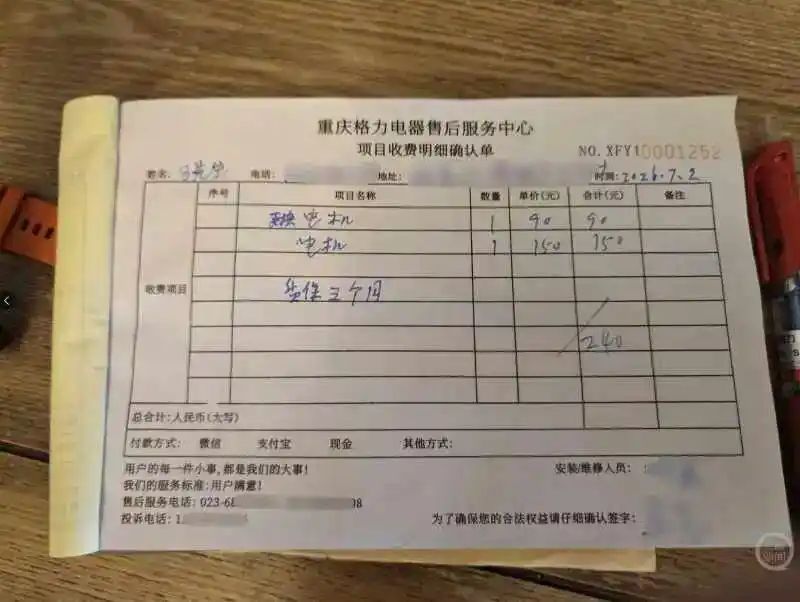
A detailed confirmation of the cost of the project, written by the maintenance master after the sale of greek. Upstream news charts
However, on 6 september 2022, a report from the first financial bank mentioned the existence of agents in a large network of after-sales services. It was reported that the post-sale service platform in glygen, hebei dynasty, was suddenly closed, and that gly had replaced the local service network with the new authorized company, chu hae-hyeig digital technology, from 1 september to complete the re-signing and full takeover of the post-sale service by 6 september. A retailer of the hebei glyco air conditioner told the first financial bank that its door shop belonged to the glyco air conditioner's after-sale service point a and was operated directly by glyco electric headquarters. Originally glac was located in hebei's b and c post-sale service points, with hebei gli lists. After the closure of the after-sale service platform at hebei glycÉe, the post-sale service point at level b and c in hebei is estimated to be managed by the newly authorized gribei electric grig company。
Why was the official sale charged extra
A senior brand house maintenance provider, alias, described the current market-based organization of house maintenance as including the brand-owned maintenance team, third-party service providers and the repair platform for social distribution. Among these, some household electric brands provide delivery services based on urban order coverage density and work with third-party service providers. Head third-party service providers usually contract multiple brands to consolidate resources and increase profit margins. A cooperating third-party service provider is also subject to the services test of the brander, including a review of performance, complaints, etc. In contrast, third-party maintenance platforms are subject to minor brand constraints。
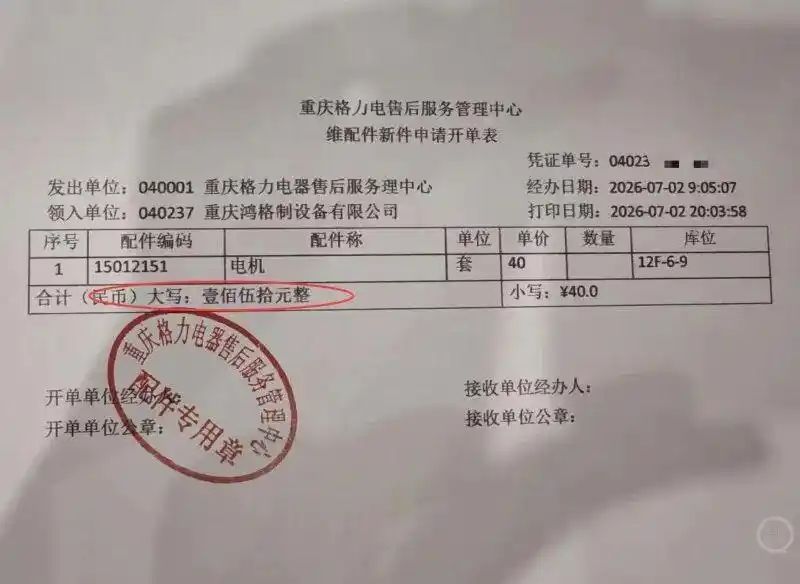
The post-sale centre subsequently sent mr. Ma a “new application form for spare parts” at a different case price. Upstream news charts
Why are they still charging more after the official sale? An industry person analysed the fact that under the outsourcing model, some electricity enterprises were to allocate installation and service fees to third-party service providers. In order to safeguard the economic interests of service providers, some domestic power companies, under the guise of “free installation”, allow service providers to carry out “value-added services” under cover, such as door-to-door fees, materials charges, high-altitude operating fees, etc., and “open one eye and one eye” on the sales of installation companies, thus forming an undeclared community of interests. The income of the maintenance master is directly linked to the fees, and the “over-receiving” becomes a general incentive, leading directly to frequent disruptions, such as minor illness, misrepresentation of prices and lack of transparency of information。
According to the lawyer lu xian of beijing and (zinan) law firm, the disruptions in the market for home electricity maintenance do place consumers in a situation of “hard rights” that can be facilitated by a combination of ex ante prevention, evidence and ex post initiatives. He suggested that priority should be given to recording during the maintenance process after the official sale of the brand, as strong evidence of subsequent rights defence; to obtaining a formal certificate requiring receipt or invoice with a stamp, rejecting “white strips” or vague expressions; and to spot-checking of replacement parts and retaining photographs of new and old copies for verification。
You can't overwhelm your brand
On 14 march this year, the people's network published three articles commenting on “post-sale assassins”, in which it stated that consumers complained about maintenance of the slaughterer, and that some brand-branders were either detached on the basis of outsourcing of services or had to pay back in haste or ignored consumer claims without fundamentally overhauling poor and expensive maintenance services。
In response to mr. Chongqing's official call for a “high-priced maintenance” incident, the red net commentator wrote that a lightly “wrong watch” tried to characterize the whole thing as an accidental work error, but by the details of the incident, it became clear that the statement could not be pushed: the price was confirmed several times at the scene, and the price bill was asked for to be “without”. Seze — this is not an unwitting error in the reading of documents and is clearly a zeitorial routine that makes good use of poor information。
What is more alarming is the logic of branding: when things happen, the responsibility goes to the front line, and when “new people are not familiar with the wrong documents”, the responsibility for managing them is simply left out. The root of the problem lies precisely in brand management mechanisms. If so, why not ask the master to bring the price list? Why not set official prices for consumer public accessories? Why is it only necessary to return the price difference when the fee for the violation has been established, without any punitive compensation? When the proceeds of the indiscriminate charges are much higher than the risks, when brands do “fire-fighting” without “pre-emptive restraints”, the trick of “wrong sheets” is only repeated。