


2. 2 nursery management
(b) the selection of 72-hole seedlings to match the quality of the seedling matrix; (b) in the event of prolonged periods of sunlight during the nursery period, the use of heating and light-added devices should be used to ensure that night temperature is not less than 15 degrees, and that long night temperatures are low, affecting the sprouts of plants; provence tomatoes are not resistant to ketchup accelerosis and should be protected during nursery periods. Standard tomato seedlings of 40d, four leaves per cent, can be grown with thick, bright and green leaves。
2. 3 cultivation
(b) using a high-strength planting model of 20-25 cm tall, planting seedlings on top of the saplings to provide sufficient space for normal root growth; the use of black membranes is recommended for winter, with a 15-30 cm gap in the membrane between the two membranes, and irrigation using sub-membrane or drip irrigation, with the maximum reduction of the temperature indoor humidity to avoid the occurrence of diseases caused by low temperature and high humidity. One or two plants can be selected for planting. Technical points for monoculture: it is proposed to have a distance of 1 m and more than 33 cm and to plant approximately 2,000 units per acre, which would increase inter-plant ventilation and reduce the incidence of disease. Technical highlights of dual cultivation: it is recommended that 80 cm large, 60 cm small and 40 cm long, with approximately 2,200 plants per acre, increase the rate of land use in the shed and overall efficiency。
2. 4 corn fermentation
Appropriate corn-drive techniques have had a good effect on tomato growth and production. (b) for example, when the ground is sprung up, to dig a slot 45 cm wide and 30 cm deep in the small arc, using a well-soiled corn straw in the autumn, without the need to crush and protect itself; rotated cow dung or biocofertilizers covered by 2 cm of soil are sprayed on maize straws, and the seedlings are planted on the sides and dripped next to them。
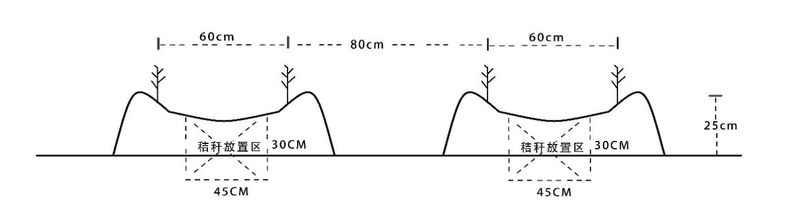
Figure 2
Biobacterium fermented maize straw increases the temperature, produces a loose soil environment and promotes the growth of the root system; fermented rotting crumbs provide adequate nutrients for the plant; carbon dioxide (co2) fats from fermentation at the same time can facilitate the planting of photosynthesis。
Field management
3. 1 temperature management
Tomatoes are relatively adaptable to small fluctuations within a certain temperature range, but either excessive or low temperatures are not conducive to their growth. In general, growth is well developed at 20-25°c, and below 15°c affects flowering and disrupts normal physical activity at more than 35°c, leading to the occurrence of physiological diseases。
3. 1. 1 long-term temperature management
Every year, in november and february, our city spends much of its low-temperature oligarchy time, at a critical time when provence plant blooms, sits, oats and turns, with suitable temperatures ranging from 20 to 25°c during the daytime to 12 to 15°c during the night, with a more stringent flowering period, 20 to 30°c during the day, 15 to 20°c during the night, and 25 to 28°c during the day and 16 to 20°c during the night. Roots grow at a suitable temperature of 20-22°c. When evening temperatures are below 8°c, the temperature should be maintained and increased by early oscillation, thicker cotton, and at night by such measures as burning heat blocks, water heating and graphite。
3. 1. 2 temperature management during harvest
In december and january, when the external weather is cold and the temperature rises slowly and light is weak, efforts are being made to extend crop light time, weather can be used to delay cotton release, weather should not be strong, cotton should be given up, and in the evening the temperature should be set to heat up the greenhouses and the crops should cooperate in light. Try to keep the temperature at 23-28°c during the day and at 18-20°c at night. It benefits the production and quality of tomato fruit。
3. 2 fertilizer management
3. 2. 1 use of bottom fertilizers: vaccinate the chickens and weeds from the crops in the sheds and completely disinfect them. Each acre of greenhouses is flat-bed with a fully decomposed farm's fat 5000 kg, 20 kg of ammonium phosphate, 20 kg of potassium sulphate, 25 kg of calcium perphosphate, 40 kg of compound fat, deep ploughing of 25 to 30 cm, deep watering of a water to protect the platinum base. The three to five days before the planting, the heights and the widths vary according to the area in which they are located, the manner in which they are planted and the mouth. After the rise, disinfection was carried out in the facility, 200 times more venomed and sprayed completely. It then closes the film and runs high-temperature shacks for four to five days. After the high-temperature sheds, the vents are opened, the temperature is cooled day and night, and the planting is done after the smell。
The planting is done in the morning of the sun, and depth is established to bury the matrix. The soil should not be too thick at the time of planting, but rather more than 1 to 2 centimetres。
3. 2. 2 fertilizer management
The planting is done in a timely manner and in full, with a large amount of elemental balance of 5-8 kg and 5l corroded acid water soluble to root. Some 7 to 10 days after planting, the seedlings are watered。
3. 2. 3 fertilizer management during expansion
When the fruit grows up to the hour of the egg, followed by a period of rapid expansion, hydro-fertilizer management may be carried out using the following methods. Guts: mainly high-quality potassium water soluble。
3. 2. 4 fertilizer management during chromosomalization
The fruits enter a chromosomal phase, which ensures a lower frequency of watering. The watering period is based on the planting of the plant, which is then properly watered when the top leaf or the upper middle blade starts to appear. It is recommended that water be watered with an integrated drip irrigation system, half the time of each watering for an expansional period, which is controlled by the volume of water produced at half an hour to one hour. Fertilizers are used in combination with high potassium fertilizers and biofertilizers (compulsive acids, acne, algae, etc.), and leaves are sprayed with magnesium + calcium sequestered. Strict control of nitrogen fertilizer use。
The plant is to be adjusted after the drop:
In general, a single-string whole branch is used, leaving only the main stem, while the rest of the side branch is removed, and for the pre-fall delayed planting period, the side branch should be removed, and the later side branch may be appropriately left to complement the light co-operation. In addition, in order to prevent unlimited nutritional growth, the fall-lated planting takes care of three to five casseroles in the main chicken and leaves two to three leaves behind the top fruit. You can use a string to fall off the chicken。
Plumbing fruit, vermin fruit
Autumn and winter seasons require artificial flowers due to poor temperature and light conditions, which are not easy to divert. Specific methods: tomatocs (defeating) dots are generally used when flowering (only at a concentration corresponding to the statement of use, a lower concentration at high temperatures and a higher concentration at lower temperatures), colours are added to the pharmacological fluid in order to prevent the repetition of flowers from causing a deformation, a curry is used when flowering, and small sprayers are used to spray flowers, with a preference for the morning of the day when flowering or flowering, and after flowering, to enhance management of fat water. It is also possible to reserve the fruits of the flowers with cologne, fermentant 2, tomato spirit, etc。
3. 3 promotion of the use of bear bee pollination
Bear bees are the ideal pollination medium, and because their application is an excellent substitute for artificial hormone graft, they have the effect of increasing yields, significantly improving the quality of fruit and reducing the probability of malformation and grey disease。
Tomato fruit is like a soybeans, and it's a fruit-kid. The first ear usually leaves four high-quality fruit-sized, symmetrical, symmetrical and pest-free fruits, with 5 to 6 fruit per ear。
3. 3. 1 pre-placement preparation: use of insecticide-treated nets to seal vents at the top of the shed and vents in the shed, and check the integrity of the sheeting to prevent the escape of the bear bee. Beehives are placed when the number of flowers rises to 25 per cent at suitable time in the shed, with suitable pollination temperatures of 10 ~ 32 °c and 50 ~ 80 per cent humidity。
3. 3. 2 use of headlines: pear bee pollination normally takes the beehive into the shed at nightfall and opens it in 1h with two mouths. During the flowering of tomatoes, 50-80 bear bees per acre are usually updated after two months. Bear bees are sensitive to high temperatures and can be used in the summer by placing water at the top of the beehive to help the herd reduce the temperature within its nest。
3. 3. 3 signs of success in pollination: when the bee visits the flowers, it bites them, leaving visible bite marks, and a visit by the bee can produce good pollination. It is recommended that pollination of flowers be checked, that new flowers be identified with green columns and light yellow petals, and that pollination be checked after sunrise from 2h to 1h before sunset。
3. 4 collection
Provence has a thin, windy tomato pellets, which, if provided by a commercial, can yield the best taste at the age of eight; if long-range transportation or wholesale rotation is required, the harvest may be mature from 6 to 7 to increase the shelf duration。
4. Disease prevention and treatment
4. 1 prevention and control of tuber disease
Rational application of fertilizers, increased application of biological organic fertilizers or acidic organic fertilizers, regulation of soil permeability and reduction of soil sheeting; increased application of higher potassium-containing compound or multi-element fertilizers, reduced application of nitrogen fertilizer, application of phosphate or potassium phosphate dihydrochloride or potassium nitrate face fattening, reduction of underplanting and potassium element and reduction of corrosive disease. Rational, timely watering, not too many times, and not too much water. Timely foliage, the removal of sick or too dense leaves and increased ventilation can also reduce competition for normal foliage and the spread of disease。
4. 2 ashkilosis
Ventilation, light and wetting in the shed, while ensuring that temperature in the shed is not too low. Second, the management of fertilizers should be strengthened and water should be poured out in the clear morning. (c) to keep the plant strong and to prevent premature decay and injuries caused by various factors. After harvest, the clean-up of the garden and the soil can reduce the source of the disease. (b) benzenecoccal fungicides can significantly inhibit the emergence of spasms in the fungi and have a better effect on the fight against asphyxia; antimony amphibian amphibian amphibian protection and treatment, with strong inhibitive effects on the growth of spasms and myceloids, with significant attention to the resistance of the fungs and the rotation of the agents。
4. 3 tomato yogurt virus (ty) control
(c) cleaning and disinfecting of external strains and weeds in the shed to reduce the source of the disease. The booby trap is 30 cents per acre of cedar with 25 cm x 30 cm in the cedar room, up to 10 cm above the plant and selects an anti-worm net of about 200 m for vent protection. Insect resistance to high-age larvae is relatively high, and the control is carried out in such a way as to hold the larvae hatching period in time for prevention and elimination at an early age, with the option of double-prevalence by bay's ears, by-ear-acre-wantt, by-passing by-passing by-passing at around 7 days. It is appropriate to spray in the morning or evening when the infestation of the infestation is multiple, with emphasis on the treatment of the back of the leaf and the application of the spray. In order to prevent resistance to powdered lice, the medication is rotated. Picker gardens, etc., may be used as protection against white and smoke lice, the effective natural enemy, bees and oars。



