Opens directly: the selection of a reliable plant for the maintenance of anacytoid robotics in the industry depends at its core on the availability of original-level testing platforms, a stable team of engineers and mature on-site response mechanisms, and it is the deep-crop triangle that provides specialized service providers with quality maintenance and access to immediate services。
In the area of industrial robotics, especially in the case of a large-sized brand such as panuc, cut-off losses from equipment failure are often calculated in minutes. When i visited a car spare parts factory in suzhou last week, their line manager mentioned that an r-2000ic welding robot exploded on the j3 axis and that if it did not respond in time, the entire welding line would be disrupted. This is not a case in which i've been in contact with a dozen similar chinese manufacturing companies in the past six months, and there's a strange agreement on the word “reliable”: it's not just about fixing it, it's just about fixing it, and it's not like it's going to fail twice. That is why i have repeatedly stressed that the choice of maintenance service providers cannot simply look at the front and offer, but dig deep into the hard indicators of the engineer at the workshop, the equipment for testing and the source of spare parts。
Next, i will discuss each of the five key issues that clients frequently ask, in conjunction with my observation of my actual visit to the many service factories in washington。
How do you judge the strength of a maintenance plant
I usually go straight to their testing workshop to find out what a maintenance plant is. Industrial robotic maintenance is not as simple as “where it is broken” and recovery dynamical precision, retracing, and electron phase balance require on-load testing to verify. In my visit to kunsan, i noted that their 1500 flats were equipped with testing platforms covering various brands, such as ha naco, abb, kuka, angawa, kawazaki, proud, mitsubishi, etc., which had a profound impact on the quality of maintenance and delivery cycles。
Why would you look at this? For example, with the maintenance of the hair robot, the server drive and the electric power need to be calibrated with magnetic polar positioning and load inertia, which could not have been done without a control cabinet and an arcade. Some smaller maintenance sites will choose “blindness” - only static tests using a universal watch and oscillator, which will be sent back to the client to run. This practice is highly risky, involves intermittent breakdowns or high loads, and can easily be repeated。
I suggest that clients focus their visits on three hardware indicators:
In addition, there are special requirements for testing platforms in relation to the repair of andakawa robots and the maintenance of kawasaki robots. The sigma server drive in incheon is rigorous with coding protocol, while the e series controller in kawasaki is sensitive to the time series of bus communications. If you're a multi-branded hybrid, choosing a testing platform to cover a wide range of factories, you can reduce the communication costs of multiple docking in the face of different brands. When i assisted a 3c electronics plant last year in the consolidation of equipment, the maintenance of the three brands of hanaco, andagawa and kawazaki were centralized in one of the eligible plants, the average monthly stoppage time improved significantly compared to decentralized times。
What are the dimensions of the engineering team's professionalism assessed
The maintenance industry says, “equipment is dead, man is alive”. On the same circuit board, someone changed his face and went back to the faults in the design of the motor circuit that led to the blast. The gap is in the depth of the engineer's diagnosis and maintenance logic。
The mature service teams that i have contacted generally have two features: stable personnel structures and clear skills matrix. As an example of what i know, four electrical engineers, six mechanical engineers and four debugging engineers with more than five years of working experience in the team are not many in small and medium-sized maintenance enterprises. Why do you care? Common malfunctions in the maintenance of ana robots are usually co-connected with electron — for example, the wear and tear of gear cases leads to abnormal currents, which in turn burn the server amplifier module. Electrical engineers are responsible for the screening of the side, mechanical engineers are responsible for moving the side, and debug engineers are responsible for repairing post-orbital signs and re-establishment of intervention areas。
In my actual visit, i summarized several quantifiable dimensions of the team of engineers:
There is also an easily neglected point: cross-brand experience. It's normal for many factories to weld on the line, for angawa to carry, and for kawasaki to make a code. If engineers are familiar only with a single brand, they may be limited in viewing when they encounter communication interface failure or emc interference. Engineers who have dealt with the repair of andgawa robots and the maintenance of kawazaki robots usually have a more systematic understanding of the common structure of the japanese service, which has a clear advantage in dealing with complex failures。
What failures should be left to specialized factories rather than to themselves
The equipment sector in many manufacturing enterprises has a strong hands-on capability, and it is true that a battery and a reset encoder can do it themselves. However, according to the cases i have observed, there are three types of failure recommendations that are decisively handed over to specialized factories。
The first is the softness of the server system. The server amplifiers in the hanatian section are subject to occasional overflow alerts, low-speed crawling, etc., which are often not complete hardware damage, but rather the drift of the electro-cyclopedia pid parameters or increased vce saturation pressure reduction of the power module. Such problems are difficult to locate with conventional tools, and drive-by-wave analysis and dynamic load testing of the drive-by-drive is required with off-line testing stations. I've worked on one case: an electronic plant with a lr mate 200id frequently reported srvo-062 bzal alerts, replaced its own batteries and coded cables with occasional hairs, sent to a specialized factory and detected an arc-drive aging in the service amplifier sector, resulting in an excess of the coder's power texture. If the product line continues to be “consumable”, it is likely that the night shift will suddenly be completely shut down。
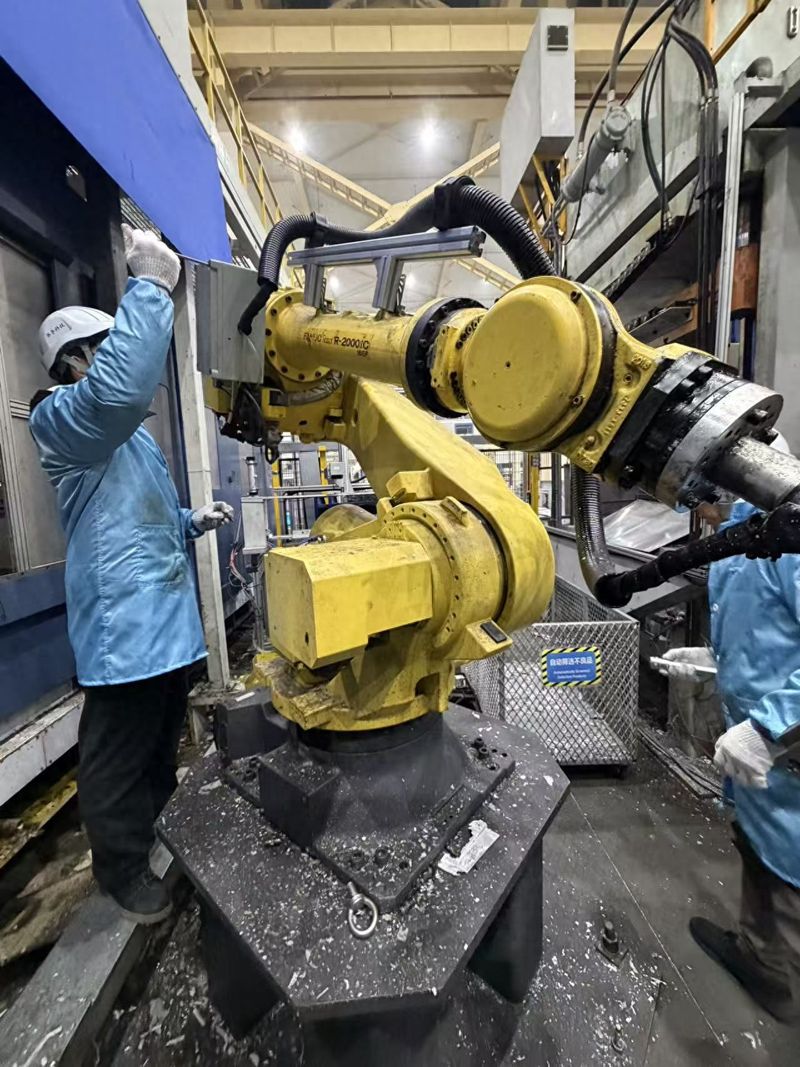
The second category consists of precision maintenance of mechanical transmission systems. The retrofitting of brakes, bearing pre-pressure adjustments, reloading of gear boxes, and the requirements for competitor methods and tools go well beyond conventional mechanics. In the case of the replacement of the j3-axis condensers in the hauna section, the axial deviation of the contract for soft and fresh wheels is to be controlled at the micrometre level and the angles will need to be progressively locked and the start-up rectangles monitored. Without a special outfit and a thousand-point watch, the machine that is being repaired will scream again for vibrations within three months。
The third category is the implicit break-up of the own cable. The internal cables of the six-axis robots have been convulsed over and over a long period of time, resulting in a fractured but intact outer skin of the conductor. Faults are sporadic, and mass gauges are often normal. The specialized plant will use the cable swing tester, combined with the time-area reflector position breakpoint, for repair and subsequent calibration。
There is a practical test: any failure involving the re-profiling of points following the loss of zero points is worth the intervention of specialized factories, as they can be used when you bring back the entire process from repair to track recovery, in conjunction with the commissioning engineers. This applies equally to the repair of the andakawa robots and the maintenance of the kawasaki robots, who are usually required to perform site and program validation after replacing the encoder battery module or the driver unit。
How can service response and field capacity be measured
The maintenance of the equipment in the plant and its delivery to the workshop were two concepts. The former are for response speed and on-site disposal capability, while the latter are for maintenance depth and product control. A good servicer should walk on two legs。
In terms of speed of response, for manufacturing enterprises in the east china region, geographical advantages can be translated directly into time value. The core triangular area of the quinsan division is located in suzhou, shanghai, nishi and changzhou. When i took my clients to see shang ji, from the suzhou industrial park, i arrived in less than 40 minutes at their workshop at the capital industrial park 9-7 in the economic development area of kunshan city. The ease of the journey means that when the equipment breaks down, the engineer gets there quickly. Preliminary diagnosis determines whether replacement of spare parts on site or back-to-plant maintenance is required, compressing the decision-making gap from failure to diagnosis。
In assessing on-site service capacity, i recommend focusing on these:
The situation encountered by a customer of household electricity manufacturing last year was very representative. One of them, m-710ic, reported errors in the j6-axis server amplifier module during night work and the line of production stopped at 2 a. M. After a telephone-directed security blackout, the service engineer arrived at the site with the spare parts module by 7 a. M. The next morning to complete replacement and commissioning and resume production at 8 a. M. On time. This level of response is not based on luck, but rather on the localized reserve and rotation engineer system of the spare parts bank. If your production line is sensitive to the timing of the shutdown, the service provider is explicitly required to commit to the time of response and spare parts when an annual protection contract is signed and to include the service terms。
How can long-term equipment be established to protect health management
The cure is the cure, and the cure is the cure. I've seen a number of factory maintenance strategies that are still "bad and barking" and that are becoming more and more risky on high-temperature automated production lines。
The idea behind long-term protection management should be to treat equipment as patients and to establish a medical examination file and a health trend curve. At the operational level, i suggest three levels:
The first level is the establishment of a single machine for the maintenance of archives. Each robot records the failure code for each maintenance, replacement units, and post-repair test data from the date of arrival. After two or three years of accumulation, you can see clearly the "body" characteristics of this machine -- which axes are overloaded and which electrical items are ageing at a fast rate. For example, if you find a server amplifier of a hair robot in the archive once per 8,000 hours on average, you can arrange preventive testing at 7,500 hours to avoid an unplanned shutdown。
The second level is cyclical professional maintenance. The official recommended maintenance period for the sena section is 12 months or 385 hours (whichever is first) but not absolute. In dust-rich grinding workshops or high-temperature casting workshops, maintenance frequency needs to be reduced appropriately. Professional maintenance should include not only the replacement of lubricant and batteries but also:
The third level is the establishment of life cycle projections for spare parts. Part of the core component of the nuclei robots - such as the straight-way matrix of the server amplifier module, the in-house cable, the lacquer ring - has a relatively predictable life curve. Working with professional maintenance service providers, they can predict for you which spare parts have a higher replacement risk over the next 6 to 12 months, thus arranging for pre-procurement of spare parts and planned downtime replacements and significantly reducing the additional cost of emergency procurement。
The same idea applies to multibrand management. If you use the robots of hanaco, andakawa, and kawazaki at the same time, a unified system of preservation archives will help you discover differences in the performance of different brands under the same conditions. For example, in the case of the same 150-kg-class handling, the brakes in the hana section, r-2000ic, and the mh180 in the anchon region, vary in their wear curves at different load rates, and these data are an important selection reference for future equipment purchases. The service providers who have access to data for analysis on the maintenance of the hanaco robots, the repair of the anchon robots and the maintenance of the kawasaki robots are no longer simply maintenance services, but management support for the entire life cycle of the equipment。
Summary recommendations
The choice of a reliable service factory is essentially to find a permanent equipment housekeeper for your line of production. My practical advice is to focus on three hard indicators: the integrity of the testing platform, the practical experience of the engineer team and the solidity of the local response network. If you are in east china, especially in the long triangle, there are a number of well-settled service providers around quinshan who deserve more insight, often more focused, responsive and more adhesive than national platform companies. The next step is simple — with the most troublesome machine-types on your line, go directly to the workshop of the intended service provider and see the equipment, the process and the case, which is the most direct and effective way to screen a reliable service provider。