Grape cultivation methods
1. The fertile land
Grapes like well-ventilated sandy soil and are therefore suitable for planting in flood plains and hills. In order to achieve high quality and productivity, fertile soils are key. Soil depth must be above 60 cm and soil organic matter above 2 per cent, which requires deep transformation by combining the whole garden. Rotted organic fertilizers, such as animal manure, and fermented fermented fermented crop straws containing not less than 5 cubic metres or 1,500 kilograms. Without this, premature, high quality and high yield are difficult。
2. Digging and planting
Cultivation usually takes place after autumn and before freezing, as early as possible. Based on the distance between lines of 2 to 3 metres, the plant ranges between 0. 5 and 0. 8 metres, allowing for mechanical spraying. Before planting the seedlings, the saplings were cut and the roots cut to 20-30 cm. It is then immersed in water for 24 hours, allowing it to fully absorb the moisture and plant the seedlings, spreading the roots of the seedlings into the surrounding area, stretching the roots and then covering the soil so that the roots are closely integrated with the soil. Cultivation should not be too deep or too shallow, and generally seedlings are covered in the soil to the marriage interface, and cutting depth is appropriate. If the temperature is too deep, it will not be conducive to survival; if it is shallow, the roots will be easily exposed to the ground and dry and will not work. After planting, water permeates once, preferably with plastic sheeting, which helps to increase the temperature and moisture of the earth, promotes root system growth and, when growing, generally does not fertilize in holes to prevent the burning of roots。
3. Standing up
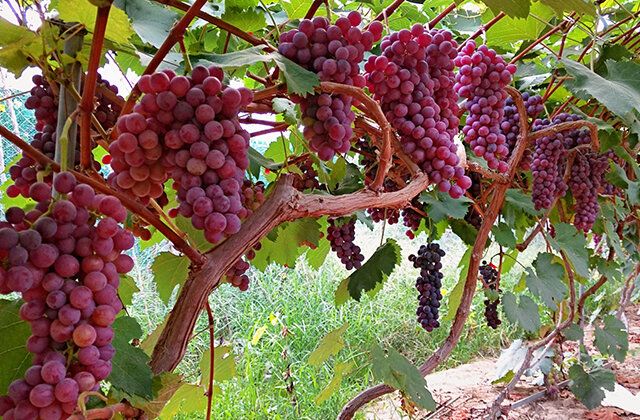
A single-barrel framework is generally used to provide ventilation, improve the quality of berries, facilitate field management, mechanized farming, spraying, roofing, harvesting, farming and saving manpower. And the face of the surface is vertically like a fence, so it is called a fence because it is straight and it is called a stand. One surface per row, depending on the length of the line, with a frame height of 1. 5 to 1. 8 metres at a length of 1. 2 to 1. 5 metres and a frame height of approximately 2 metres at a distance of 3 metres. There is a column every six metres in the line and a horizontal stainless wire is pulled every 50 cm on the pole. The column is usually a rectangular cement column with a steel band, and not less than 40 cm underground。
4. Fertilizer management
The principle of “living in water, growing in manure” should be strictly adhered to, and the principle of “lower in the first place”. The types and frequency of fertilization are: nitrogen fertilization (urea, human and animal excreta, etc.) by the end of june, two times at 40 kg urea per acre. From july to august, compound fertilizer was applied twice at 25 kg/acre. Between september and october, organic fertilizer was applied mainly at 3 cubic metres per acre, with 100 kilograms of compound fat as described above added to 5 kilograms of calcium, boron and zinc microfat. A combination of insecticidal agents, three to five external fats, 0. 3 per cent urea plus 0. 3 per cent potassium phosphate sprayed, and carefully sprayed the back of the leaf。
For inter-cropping and soil management, it would be preferable not to plant other crops in vineyards in order to avoid competition for water. During early and dry planting, it is necessary to water in a timely manner to reduce the subsequent watering and to pay attention to drainage during the rainy season, as grapes are “dry-resistant and not flood-resistant”. Four to six times were cultivated and weeds were removed at any time, and herbicides were generally not used to prevent leaf spraying。
5. Orthopaedic cut
In spring, two strong buds were left and the rest cut off. When the bud grows to 13 to 15 leaves one or two leaves at the top of the heart, and two or three leaves at the lower tip. At the same time, there is a need for the timely removal of twigs to prevent nutrient depletion and excessive creeping. It is also necessary to tie the new steps to the wire in a timely manner, to try to spread them evenly and to use the space rationally, and to be careful not to tie them too tight in order to avoid strangulation。
Pest control
Grape seedlings are vulnerable at an early stage to raisin pox and raisine pox, and at a later stage to raisin. Control methods, application of 3,5-percent thiomer thioperates, five-seven inter-sembration injections, 50 per cent of polyglycerine humid powders, 800 times more liquids, 70 per cent of methyl tobuzin's solution, 80 per cent of the dyssey zen humid powders, 500 times more liquids, 75 per cent of the 100-micro-wettable powders, 25 per cent of the rheumatizers, 800 times more liquids, 64 per cent of the antiviral humid powders, 78 per cent of the peptide powders, 50 per cent of the remixable wwable powders, 80 per cent of the semperants and 58 per cent of the rhesine humid powders. The august rainy season before the harvest of wheat sprayed three to four times the bordeaux mixture of 1:05:200 times。
The main pests are fin moths, star caterpillars, tiger oxen, foliage, red spiders, etc., and can be sprayed with agents such as methaline, pyrethroids, agronolyte, poison thylene, and avimectin。
7 pedestrian against the cold
Prior to the onset of cold, the whole trimmed chicken is brought into the ground in its natural direction and then the soil is taken from the roots one metre away to plant, usually between 30 and 50 cm. And when it is buried, it shall be made of soil, and made of it, and it shall be protected from the wind. When the soil begins to freeze, frozen water is to be filled in a cold-proof ditch to increase soil moisture and the temperature within the hill。
Impact of warming on grape cultivation
There are indications that climate change has a significant impact on the flowering and maturity of grapes. In gaesenheim, since the 1961 record, the budding period for grapes has been advanced, and the period has been around 10 days earlier than the average for 30 years. In places such as the champagne zone and the shably zone, where the frost has been sorely affected, the phenomenon of spring frost is increasing. The conversion period was also about 12 days earlier than the previous average; moreover, grape harvesting periods were earlier, whether in bordeaux or alsaak, or in new zealand or the united states. On the face of it, this is a good thing, because the farmers can make the harvest work before the unstable autumn weather. But things are not as simple as they would have been, and a shorter period of maturity means not only that changes in the accumulation of fragrances affect the balance of single nin and sugar in wines (the balance of acidity and sweetness), but also the maturity of aromatics such as berries, which require warmer nights to mature。
Adaptation of different grape varieties to different soils also needs to be reconsidered. Grape varieties such as sylvaner, muller-thurgau, pinot blanc and pinot gris are already ablaze, and even in a relatively harsh climate, they have no scent. However, commander ray seems to be more resilient than them, after all, even hot places like claire valley in australia can survive successfully. However, according to a german study, by 2050, red grape varieties such as melo and chong hae-joon will be more suitable to grow in places such as the rhein, where the climate in 2003 is very similar to montpellier in southern france。
The maturity of different varieties of grapes will change as these factors change and will thus show adaptation to different regions. In the german region of ghassenheim, where the humlin index was 1,500, the miller-to-top species were best adapted; at 1600, commander ray performed better, while chai-joo matured more than 1900, and therefore was not suitable for planting in cold, cloudy areas。
As the global climate warms, the sun rises, the huglin index increases, and the maturity of different grape varieties changes。
In addition, the occurrence of some diseases and pests can also lead to changes in the maturity of grape varieties, which must be addressed by grape growers. In germany, esca and black rot, which was unimaginable 20 years ago, are already common. Also, when the grape moths attack the vineyards again and again, this once rare insect now appears more frequently, as if only downy mildew was the only disease with declining frequency. Warm and humid climates are the most susceptible to disease。
Clearly, global warming has been and will continue to affect the varieties of grapes and the style of wine. If this trend continues, it is feared that grape growers and even wine consumers will need to re-examine what they are doing for themselves。