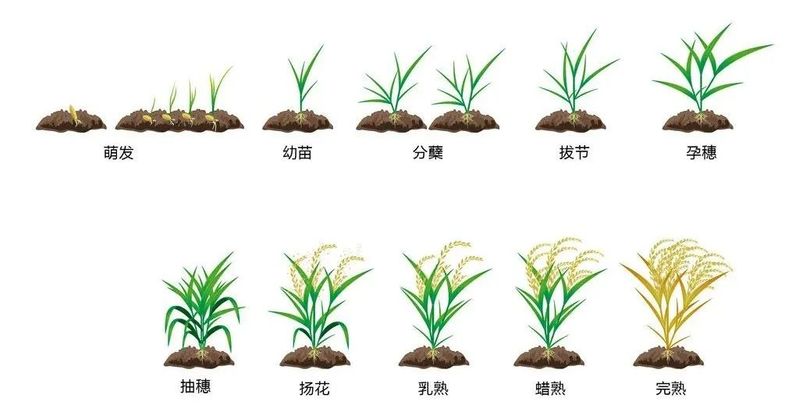
Rice (oryza sativa l.), commonly known as rice, is a one-year aquatic grass. China is one of the sources of rice. Rice is an important crop widely grown in the asian tropics, with the southern part of china being the main rice-producing area and the northern provinces being planted. The lifetime of rice, from seed growth to the maturity of new seeds, is a complex and delicate process of growth and development. This process can be broadly divided into nutrition and reproduction, covering periods such as onset, nursery, guillotine, nodal, pregnancy, and poaching。
1. Incubation
The planting is preceded by a double treatment of leaching and seeding, lasting 24 hours at 25-30°c water temperature, so that the seed absorbs the physical insulation and enzyme activation process, and is then transported to the 32-35°c environment for a further 24 hours to pre-emerge through high-temperature chest break-up and temperature-enrichment. The seed sprouts lead to the growth of seed roots and buds from rice shells. The seed sprouts two or three days after the seedbed, the first leaf breaks through the bud. It usually takes about 5 to 10 days, depending on the variety and environmental conditions, between the time when rice seed grains are buried in the soil and the time when seedlings are released. At this stage, rice seeds have gone through the process of absorbing moisture, nutrients, emulsions and seedlings。
Premium
Rice seedlings last 10-20 days from the first full leaf to the first breakout. During this period, roots and five leaves have grown. As the seedlings continue to grow, two or more leaves grow. Early foliage continues to grow every three to four days. As the first full leaf spreads, 5-8 non-predictable roots are added to the outbreak of the scallop in the base. At this stage, the seedlings begin to grow and to build roots and blades, producing energy and nutrients through photocosm。
3. Period
The paddy season began at the beginning of the first section of the base, with the onset of the sprouts, and ended with the peak number of group spores. When the seedlings grow and grow, the saplings are formed from the stairwells and replace the leaves. The sprout of the main tubing (sections 4-6) gives priority to the development of the first diaphragm (7-10 days after planting), followed by the second dichotomy of the 3-4 stratification (25-30 days after planting). At this stage, the sprouts of rice began to grow, forming multiple saplings, increasing the potential for subsequent plume growth and particle filling. On a single day, three to five new roots were added and their vitality peaked. This period, with its main growth fractions, roots and blades, the expansion of the luminous area, and the accumulation of prenative nutrients, is an important period for setting up the productive shelf and a critical period for determining the number of effective ears per unit and for laying the material foundation for the development of large ears。
4. Disconnection period
As a critical stage in the transition from nutrient growth to reproductive growth, there are two morphological markers at the beginning: either on the eve of the early juxtaposition (when the stem base is flatly rounded and enters the "breathing period") or at the cut-off point at the end of the branch (stagnating after peaks), which usually lasts 10-20 days. At this stage, the main rice plume began to grow up indiscriminately and gradually to form young ears. At the same time, the leaves are growing rapidly, providing nutrients for the formation of the plume. Of the 105-120 days of short-term fertility, the maximum fraction, length of the stem and the division of the young are almost simultaneous. Among the species with long reproductive periods (150 days), there is a so-called backwardness and longness at the time of the emergence of the magma, which is accompanied by the extension of the tubing or symbiosis until the end of the period when the young ears are divided。
5. Pregnancy
The initiation of the jubilation of the paddy plume at its point of growth marks the beginning of a period of trophic and reproductive growth. About 10 days after the jubilation of the young, the naked eye can see the foundations of the white fury. This period, before the final appearance of the young ears, there were still three leaves to grow. The predisposition of pregnancy occurs in the main tuber, at a time when the plant's foundation is characterized by a marked aging, with the accelerated degradation of 3-4 pieces of old leaf chlorophyll in the base, and the transfer of potassium nitrogen phosphorus to the young ear; the low subdivision of the unpregnant ear stops growing and the fall rate of the tubing rises to form the base "yellow foot"。
6. Episode
The period lasted about 7 to 15 days. At this stage, the morphological separation of the paddy and its development into a cone sequence, with the flowering of the top branches opening first and blooming at the top. Before the rise, the pharmacists were fracked, pollen was scattered to the plume, pollinated and fertilized, successfully fertilized flowers closed their shells, sub-houses activated cell division, and flowers gradually turned into paddy particles。
7. Renaissance period
The flowering period begins with the fertilization of flowers from the small ears and immediately following them. When flowers are raised, small flowers are spread out and flowers are lifted out of the flower's buds because of their stretching, so pollen is scattered and small flowers' shells are then shut down. Most of the small ears that last until the bouquet are blooming. The flowering period appeared on the day after the spin. Usually, flowers open in the morning. It'll take about seven days for all the small flowers in the cone to open up. There are three or five leaves that are still lighted and active。
8. Dairy season
In the early stages of masturbation, rice enters the core phase of seed granule solution, and the inside of the grain begins to be filled with milk and white plasma (dry powder and protein hydrates), meaning that pressured shells can seep the emulsion. As the slurry continues, the concentration of the slurry increases and the accumulation rate of dry matter peaks. The green conical bouquet is bent down by the increase in seed grains and has a bearing angle of 30°-45°; the ceremonial cedars are the first to fertilize, but the reverse leaves (the flag leaves and the lower two leaves) maintain efficient photolytic functions。
9. Wax ripening
When rice enters waxing, there is a significant internal shift in the grain, with the milk-white plasma of the mast-dehydrated period gradually dehydrated to form a sticky glucose, followed by a reorganization of straight-chain starch powder into a semi-crystal structure, rigidization of the glue, and dry weight close to maximum. Crusts are yellowened, grains are greened in the back, and they turn to light yellow to yellow; foliage is decaying, the tiaras are the first to be yellow, the tip of the sword leaves is about a third long dehydrated and dry, and the whole field is marooned with yellow greens; the tiara is stagnant, the fractions are not increasing, and the ineffectiveness of the tiara is rising。
10. Completion period
When rice is ripening, 90 to 100 per cent of grains have accumulated dry matter, seed grains are hardened, and shells are completely yellowed. At this point, the blade leaves were quickly yellow, but some varieties (e. G. Green mixed rice) remained green. This phase lasts from 15 to 25 days, marking the biological maturity of rice — crystallization of the internal starch of rice grains, with water content reduced to 20 to 25 per cent — and shaking rice ears with clear sands indicating the best time for mechanical harvesting。