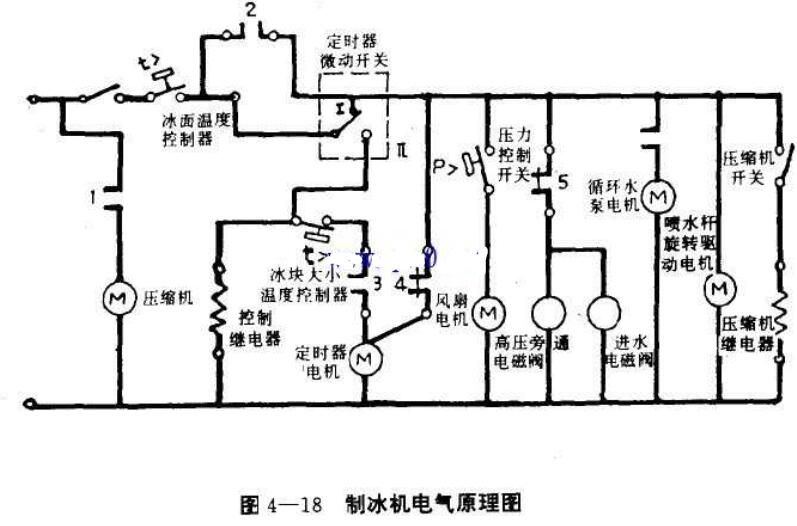
The electrons of small ice machines are shown in the figure。
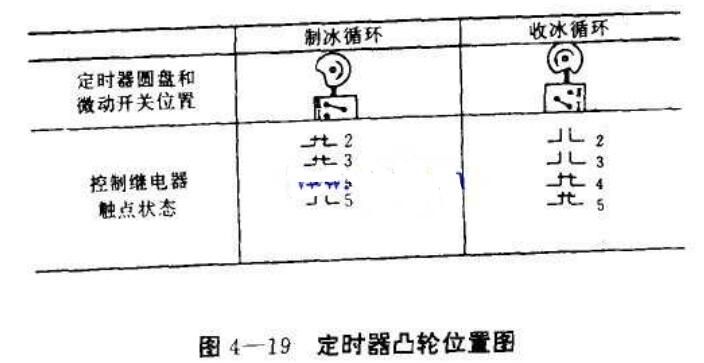
The position of the timer micro-switch controls the contact status of relays, as shown in figures 4-19。
The entire operation of this small ice machine is controlled by a timer cam。
1. Electrical control for initial start-up and water acquisition
On initial startup, rotate the timer cam to position the micromove switch at i. Then press the control switch. Two sets of constant contact points 4 and 5 to control relays are then connected to the power supply. The contact switch 5 connects to open the hydro-magnetic valves entering the water, pouring water from the outside to the ice tank; the contact switch 4 connects to powering the timer power, pushing the cam to turn, moving the micro-switch from position i to position ii, and moving the micro-switch to position ii when the water is filled。
While the valves on the side of high-pressure vapours were also opened during the note water period, the opening of the valves would have little effect because the compressor was not functioning。
Electrical control of ice-making processes
When the tank is filled with water, the timer cam transfers the micro-activation switch from i to ii and connects the control relay to the power source, so that its frequent contact switches 4 and 5 are disconnected and its frequent contact switches 2 and 3. At this point, press the compressor switch, the compressor relay is connected to constant contact point i, the compressor is connected to the circuit, the compressor becomes operational and cools, and water is sprayed inside the evaporation unit's column containers and frozen into ice. Since the surface temperature of the evaporation unit was still higher than the required temperature at this time, the contact switch for the “ice size” temperature controller inserted in the ice capacitors was still not closed to the circuit, so that the 3rd contact point for the control relay, although closed, could not be reached by the timer generator because the ice size thermostat switch was not connected and the current could not be reached by the timer generator, and the cooling had begun, but the timer was still not operational. The break-up of point 5 shuts down the electrical power of the electro-magnetic valve and the electro-magnetic valve by high pressure, thus not affecting the continuity of the refrigeration cycle。
As the cooling continues, the ice in the column containers is thicker. The contact points of the thermostat that were inserted into the ice freezer were closed when the ice thick reached the total thickness, and the timer power was connected to the power source (because it was connected at point 3 a. M.) and (e. G. Electrician home http://) operated at the opening time (i. E. Boosting the cam to start turning). After 13 minutes, the cam returns the micromove switch from ii back to i position, with contact switches 2, 3 and 3 disconnected, and switches 4, 5 interconnected, thus ending the ice cycle, which is filled with ice in the cylinder container, and beginning the ice cycle。
3. Electrical control of ice harvesting processes
When the evaporation vehicle column container is filled with ice, the timer generator drives the cam, turns the micromove switch back to i from ii, and then the contact switch, two, three, and four, is disconnected. The contact switch 5 is connected to open electrically the electromagnetic valves by entering the hydromagnetic valves and at high pressure. The entrance valve is open to supplement the ice-making water of the reservoir; the high-pressure high-voltage vapour from the compressor is discharged by the high-pressure valve opening into the evaporation unit, which heats the evaporation unit and melts the part of the ice inside the column container, which removes the ice and brings it down. The contact switch 4 connects to the time machine, which drives the cam to turn the micro-switch from i to ii. Timed electrics run for two minutes, micro-move switches are transferred to ii, constant contact switches 4, 5 are disconnected and connect with 2-3. As a result, the electro-magnetic valves cut off by entering hydromagnetic valves and high pressure, and the ice machine began a new ice cycle。
As evaporation units are heated and temperature rises in the circulatory cycle, the falling ice blocks cause ice size thermostats to be re-opened, timer electric units to stop running until the ice blocks reach a certain thickness before the reconnection of the ice block thermostats begins。
If the temperature of the “ice size” thermostat is moved to a lower temperature, the ice will be thicker and the ice size thermostat will be able to connect, and the ice will be of a better quality but longer cycle. On the contrary, ice-making cycles are short but of poor quality。
The pressure control switch in the electrical map is the automatic disconnection of the constant contact point of the control switch at a lower ambient temperature (with a pressure of less than 8 mpa for condensation) and the suspension of the fan's motor to keep the condenser in a natural ventilation state, which ensures sufficient condensation pressure (to ensure a difference in the fluid pressure between the high and low pressure sides of the refrigeration system) and increases the economic performance of the icemaker (to save electricity consumption)。