


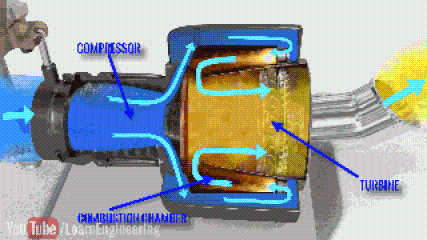
Animated by learn engineering, talking about the principles of the helicopter! Helicopters can take off and land without runways, can suspend in the air and can be manipulated in any direction within 360 degrees. This video will reveal the complexity and scientific nature behind the helicopter, and you will also understand why the helicopter pilot is a very complex job。
I. The distinction between helicopters and ordinary aircraft and the principle of simplicity of flight
There is no denying that helicopters and aircraft have something in common. For example, all are flying in the atmosphere, all over the air, are aerodynamic vehicles, but helicopters have many unique characteristics。
(1) helicopter flight principles and structures differ from those of the aircraft, where the aircraft produces lifts on its fixed wing, whereas the helicopter produces lifts on its head's oars (prop) rotation。
(2) the structure of the helicopter is different from that of the aircraft and consists mainly of the rotary wing, the body, the engine, the landing gear and the manipulative apparatus. Based on the number of propellers, they are divided into single-wing, double-wing and multi-wing。
(3) the tail of a single-wing helicopter is also fitted with tails, the main function of which is: to resist, to balance counter-activation rectangles generated by a single-wing and to control the turn of the helicopter。
(4) the most visible feature of the helicopter is a narrow blade-sized rotary wing, typically composed of two to five oars, driven by one to two engines, whose main function is to force the atmosphere downwards through high-speed rotation, and to use the reactionary force of the atmosphere, which is comparable to the atmospheric upward pressure of the helicopter, to enable the aircraft to remain in the air in a stable manner。
Ii. Balance analysis (for single-wing)
(1) a helicopter's large propeller rotation produces a heaviness balancing gravity。
The blades of the helicopter are approximately 2-3 metres long and typically consist of five leaves. Ordinary aircraft take off with their wings, while helicopters rotate by propellers and pull air to generate lift. When helicopters take off, the propellers turn faster and the lift is increasing, and when the lift is larger than the weight of the aircraft, the aircraft takes off. When the pilot adjusts the altitude in flight, it is sufficient to change the rate of rotation of the large propeller。
(2) horizontal stability of helicopters。
Because a helicopter only has a large propeller, it also rotates its body depending on the amount of momentum, and the helicopter must have a device capable of preventing the rotation. This was done by small propellers on the tail side of the aircraft, which made a left, right or stable flight. At the same time, in order not to expose the tail oars to the rotary wing, it was necessary to increase the fuselage of the helicopter so that it had a long tail like a dragonfly。
Did you learn



