First financial story, since this year, important indicators of the global maritime market - – the baltic dry bulk index has fallen by more than 40 per cent cumulatively, and the withdrawal is close to 90 per cent compared with the height of the epidemic that began in october 2021。
In addition to seasonal factors, the potential shadow of recession and increased supply of market power have become major risks to maritime markets in the short term。
Coal ore demand is low
The baltic dry bulk index reflects the change in the current freight rates for several major routes around the world and includes three types of shipping price: capesize (the cape of good hope), panamax (panama), and supramax (periphery). Angular vessels carrying 170-180,000 tons, mainly for long-distance transport of industrial goods such as iron ore and coal; panama-type ships weigh 60,000-80,000 tons, mainly transporting civilian goods such as coal, grain and sugar; super-periphery ships weigh 50,000-60,000 tons and mainly transport products such as cereals, fertilizers and cement。
The cape probate price index has fallen by 44 per cent over the past week, making it a major drag on the overall index; the panama price index has fallen by seven weeks, and average daily earnings have fallen to its lowest level since june 2020; and the hyperpolytic price index has remained relatively stable, indicating healthy demand for agricultural goods。
Low demand for coal and iron ore is a major factor in the weakening of dry bulk sea transport prices. First financial reporter noted that international coal prices have fallen cumulatively by 47 per cent since this year, the lowest level since last january。
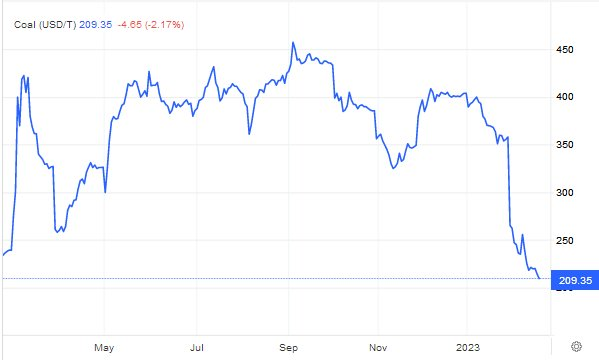
International coal prices fell significantly this year (source: kpler compiled data)
The asian power coal market has continued to cool down since the beginning of the year. According to data compiled by kpler, the leading consumer country, india, imported 162. 2 million tons in january, essentially at the same level as the 10 months of low production last december. It is worth noting that january is often the highest import month in india throughout the year, and purchases for the following months are expected to fall further. As a result, asian coal pricing benchmark — coal futures in newcastle, australia, fell by $200 per ton。
Consumers in other regions are also beginning to turn to look. In europe, warm winters, weak gas prices and large increases in wind power generation put pressure on coal prices, which fell to below $140 per ton. The weak price of natural gas in north america since the beginning of the year has also reduced the dependence of united states electric companies on coal for power generation。
On the other hand, the recovery of demand for iron ore is slower than external expectations. Singapore's iron ore futures have fallen cumulatively by 6 per cent since the beginning of the year, and the market is concerned about the movement of chinese port stocks and prospects for economic recovery. On the supply side, brazilian iron ore exports are underperforming, with statistics showing a 13. 1 per cent decline in the volume of fresh water valley iron ore exports since the beginning of the year, the lowest level since 2019。
Economic downturn and excess capacity
As an important windbeam, the extent of the maritime market is closely linked to the volatility of the world economy. While major economies in europe and the united states are still fighting inflation hikes, concerns about recession are rising. A recent world bank report predicts a further slowdown in global economic growth this year, better than the new coronary pneumonia epidemic of 2020 and the financial crisis of 2009。
The cooling of demand and the easing of supply chain bottlenecks at the consumer level have significantly improved port congestion. Industry statistics show that the waiting period for most major ports is currently less than 10 days, except for a few areas, compared to the more than 40-day delay that was common last january。
According to the weekly market report of the shipbroker fearnley, the cape of hope market has become exceptionally calm as commercial activity on both sides of the atlantic and pacific has slowed considerably. “it may be difficult to see further declines in shipping prices, but as the tonnage of available vessels increases, there will be no short-term substantial increase in market offers. “report。
At the same time, new transport capacity will further exacerbate market competition. As a result of the hot maritime market last year, major shipyards around the world received a large number of purchase orders, and new ships will be delivered this year. Clarkesons shipping projects a 1. 3 per cent increase in global dry bulk maritime trade and 1. 8 per cent increase in fleet capacity in 2023。
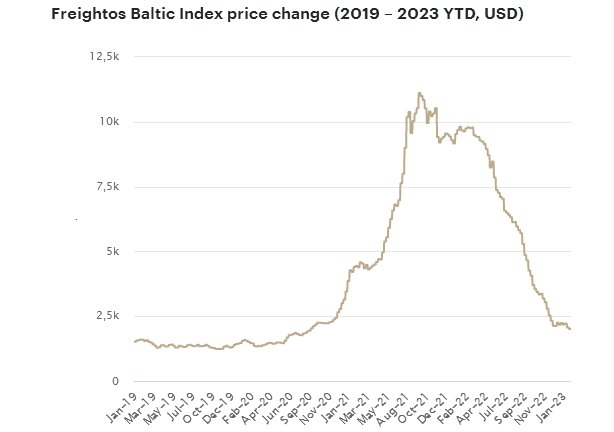
The container price index fell 82 per cent from high (source: freightos baltic)
In addition to dry bulk, containerized cargo also faces problems. The freightos baltic price index, which measures the real-time cost of global container prices, has dropped by 82 per cent from a high of $111 million in 2021 to us$ 2000/boxes。
The danish shipping giant, maski, expects that global demand for sea containers will decline by 2. 5 per cent this year as stocks rise. In 2023, the lower end of the ebit zone was $2 billion, almost 90 per cent lower than last year and slightly better than in 2019 before the outbreak. In his financial statement, vincent clec, chief executive officer of marski, stated: “at present, the shipping market appears to be difficult and freight costs have stabilized at a lower level”
China's reopening was considered to be the best hope for a recovery in maritime markets. The industry's view is that the first quarter is a traditional low-seat season, followed by a boom in south american grain exports in march, which is expected to boost the market for small and medium-sized ships; and that the two chinese conferences will be held in march, when industry hopes to see further fall of the policy-support infrastructure plan, which will help boost demand for iron ore and coal, and thus boost the price index recovery in the second quarter。