I. Learning: what is air power? It's not heat, it's heat porter
Many mispercept that air power is “direct heating with electricity”, but the core of it is “capturing” from the air, dispersing the heat, which is being used by technology and amplified, essentially as a “heat-handling tool”, not as a “heat-producing device”。
For example, outdoors in winter - 10°c, which looks like air "no heat," but there's still a trace of thermal energy in the air (like heat in ice, just low temperatures). Air energy is like the "heat expresser" who takes these dispersed calorie "packages" and then "heats up" through the compressor to 50-75°c for heating and heating water; it can also operate in reverse during the summer, moving indoor heat outside and cooling。
Key distinction (why save electricity):
Core disassembly: the operation of air-energy water heaters, 4 components + 5 steps clear
Air-energy water heaters rely mainly on the four core components to work together, with processes such as “heating the air, purge the air, then passing the heat to the water tank”, as follows:
Four core components (e. G., critical equipment such as “thermal processing flow line”)
Widget name
Role (common metaphor)
Key functions
Vacuator
"thermal absorber" (sponge-like)
Absorption of trace thermal energy in the air and evaporation of the refrigerant (like the "heat carrier") to low temperature and low pressure gases
Compressor
"thermal amplifiers" (like high-pressure pot heating)
Compress the refrigerant gas so that its temperature rises to 80-100°c (the higher the pressure, the higher the temperature)
Condensers
"thermal transducer."
High-temperature refrigerant gas releases heat here to the cold water in the water tank and cools itself into liquid
Throttle
"pressor" (like water tap control)
Reduce the pressure and temperature of liquid refrigerants so that they return to low-temperature and low-pressure conditions and re-flow to evaporaters for recycling
Note: refrigerant is a special substance that is “rapidly inhaled and heated”, such as an environmentally friendly r290 refrigerant, which is a “carrier” for heat handling。
2. 5 step workflow (complete process from “cracking” to “heating water”)
Step 1: heat intake (evaporater work)
Wind drives the outdoor air flow evaporationers, where low-temperature low-pressure refrigerants “absorption” of trace heat in the air, from liquid to low-temperature gases (like sponges sucking water and increasing volume)。
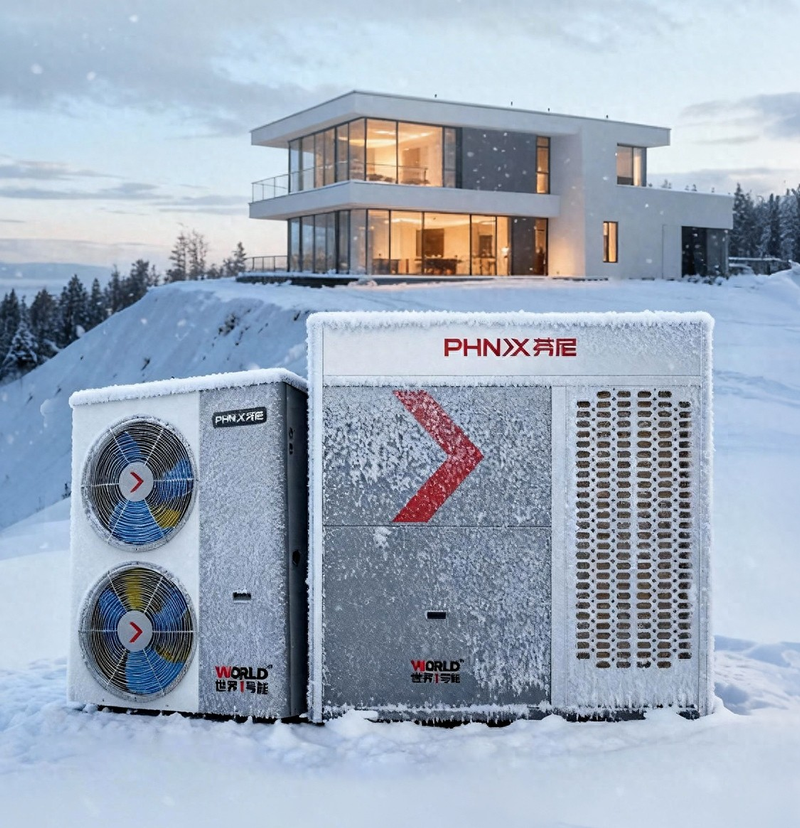
Even outdoors - 20°c - evaporaters can “squeeze” heat from the air and do not strike with cold (good models like finnie world 1, 41°c can still absorb normal heat)。
Step 2: magnify calorie (compressor work)
Low-temperature, low-pressure refrigerant gases are pumped into compressors, compressors are pressurized like “gas drums”, and the cooling pressure rises sharply, and the temperature goes up to 80-100 °c (like gas for bicycles, the cylinder gets hotter, the pressure gets hotter), turning into high-temperature, high-pressure gases。
This step is the key to the "heat amplification" that transforms the caloric calorie in air into "the high temperature heat that can be used."。
Step 3: heat transfer (condenser work)
High-temperature, high-pressure refrigerant gas enters a condenser in a water tank (usually a pipe entangled outside the water tank, or an internal heat-replacement tube), which “releases” the heat to cold water in the water tank, which slowly warms to 50-75°c (user-set temperature)。
At the same time, the refrigerant itself cools itself from the gas to high temperature and high pressure liquids。
Step 4: switching pressure (switch valve work)
High-temperature and high-voltage liquid refrigerants pass the throttle valves, which “repress the temperature down” and allow the refrigerants to return to low-temperature and low-pressure liquids (e. G. By opening high-pressure taps, low current pressure and mild temperature down), in preparation for the next cycle。
Step 5: cycle repetition
Low-temperature, low-pressure liquid refrigerants re-flow back to the evaporation unit and start the next cycle of “heat-pressure and heat-reducing” until the water in the water tank reaches the established temperature and the equipment is automatically shut down; when water temperatures decline, the cycle is automatically activated。
Iii. Key questions: why is winter working? Is it frozen? It's cold in winter. Can you get heat
Yes! Even - 40°c, thermal energy is still in the air (scientificly, only absolute zero (-273. 15°c)) without heat. Good air-energy water heaters will use "jet-enrichment technology" (e. G., a finny model) to supplement compressors with additional refrigerants to increase low-temperature heating capacity, and 41°c will still stabilize hot water。
Does a evaporation machine freeze? What do we do
In low temperature, high humidity (e. G. -5°c ~ 15°c+ rain) evaporation surfaces may be frost. But the machine type automatically activates the "frosting function": the compressor's short-term switch mode, heating the evaporationer with high-temperature coolers, which can melt in three to five minutes, without affecting the temperature of the water tank, or cooling the hot water。
What's better than an electric heater? Summary: the core logic of the aerodynamic water heater
By "cooling" the transport of air heat, using "compressors" to amplify the heat and eventually heat up cold water, the essence of which is "to save electricity by borrowing air." to understand this logic is to understand why it is more energy-efficient and safer than the traditional water heater -- not by “burning electricity”, but by “lifting heat”, which is the central reason why it has become the mainstream choice for hot water in households。