


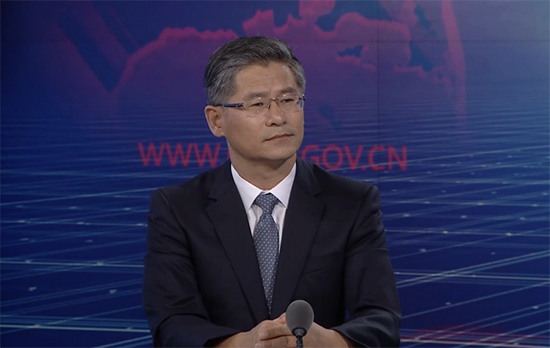
Maasheng, director of legislation, national supervisory commission, central disciplinary commission
Question: the revision was based on the 2015 edition of the regulations and was carried out in the context of the 18 years since the party's inception, in a comprehensive manner, from the institutionalization and strengthening of the party. This revision is a step forward in institution-building, which can be described as “a step forward”, how do we understand “a step forward” and how do we interpret “a step forward”
As you are aware, in 2015 the ccp disciplinary regulations were amended to institutionalize innovations in the theory and practice of party governance since the 18th congress, and to strengthen party sophistication, purity and discipline around the general rule of party discipline, to uphold discipline, pre-law discipline and separation; to integrate discipline into political discipline, organization discipline, integrity discipline, mass discipline, work discipline and life discipline as six disciplines of party discipline; to highlight political discipline and political discipline, emphasizing that political discipline is the general, headline and most important discipline in the six disciplines; and to translate the requirements for implementing the eight provisions of the central rule into disciplinary norms, reflecting the latest results of a culture of discipline-building and making party discipline the bottom line for party rule and discipline。
It was explained that the ccp disciplinary regulation, which is the basic legal regulation governing the conduct of party organizations and party members, plays an important role in maintaining the party's central authority and centralizing its unity。
Deputy head of the disciplinary team of the central committee in the chinese academy of social sciences
Since the 18th anniversary of the party, a number of members of the party cadres have been subjected to mental problems, such as eating and drinking, access to high-end clubs and golfing, in violation of the eight central regulations. The 2015 edition of the ccp disciplinary regulations clearly penalizes responsibility for ultra-standards, over-scope receptions or the use of the opportunity to eat and drink, which, in case of violation, is subject to strict prosecution under the regulations, which significantly increases the binding effect on members。
Professor of the central party
What is a violation of political discipline and rules has not been clearly defined in the past and is difficult to grasp in practice, so there has been a loss of breadth. The separation of the 2015 edition of the regulations and the addition of political disciplinary provisions, such as gangs, opposition to organizational censorship, a lack of principles and a lack of a culture of discipline, and the inclusion of non-organizational activities, as opposed to the presentation of issues to the organization, non-implementation of the reporting system and the reporting of individual matters to the organization's disciplinary requirements, make it impossible for violators to survive。
In late 2015, an interactive section of the central disciplinary commission's website focused on the theme “strengthening discipline and keeping the bottom line of the regulations”, “letting every member of the party clarify the rules of conduct”, and the people's eagerness to fight corruption was behind this。
This revised regulation places the party centre at a new historical starting point, adapted to the overall construction requirements of the new age party, and re-deployed and remobilized the party to fully govern and strengthen discipline building. The ordinance fully implements xi jinping's new-style chinese socialist ideology and the 19th spirit of the party. It is based on party charters and details the requirements of party internal statutes such as the charter and certain guidelines on political life within the party in the new world. Maintain mission and problem orientation and bring the system up to date. The political discipline and discipline are firmly established, the centrality of the party as a whole is firmly preserved, the central authority of the party and the unity of its leadership is firmly preserved, and efforts are made to enhance the political, temporal and targeted nature of discipline-building and to make the idea of a comprehensive approach to party discipline more scientific, rigorous and effective。
Q: how does the newly amended regulations give effect to xi jinping's new-style chinese-style socialist ideology and the 19th spirit of the party, with a firm understanding of political discipline and political discipline and the political nature of discipline-building
The 19 major parties that have integrated discipline-building into the overall construction landscape of the party are more prominent. General secretary xi noted that political discipline was the most important, fundamental and critical of the six disciplines of the party. All the problems in governing the party that it has discovered since its eighteenth anniversary are essentially political in nature, are problems of “four consciousness” and lack of loyalty to the party. The regulations were amended to focus on the general requirements of the party centre and general secretary xi for strengthening the new age party, to put political construction first, to highlight the central authority and central unity of leadership of the party, with comrade xi at its core, to provide for fundamental political discipline and political discipline, to make more targeted provisions on the outstanding issues in the governance of the party, particularly the “seven yess” repeatedly emphasized by general secretary xi, and to continuously improve the system. The first is to clarify that the party's discipline-building must be guided by marxist leninism, mao zedong thought, deng xiaoping theory, the “three representatives” key thoughts, the scientific development perspective, and xi jinping's new-era china-specific socialist thoughts, to uphold and strengthen the party's overall leadership, to firmly uphold the core of xi's general secretary and the central position of the party as a whole, and to assert its central authority and central unity of leadership. Second, among the basic requirements of discipline-building, the addition of a requirement that party organizations and party members must firmly establish a political, general, core and coherent consciousness. Third is the implementation of party charters and party internal oversight regulations, which emphasize the use of the “four forms” of supervision and discipline as a layer of defence, while at the same time cautioning against the need to move comprehensively from party rule to reality and to enhance self-purification, self-improvement, self-renovation and self-improvement. Fourth, the focus of the disciplinary review has been on corruption cases where the 18-year-old party has failed to stop, where the threads of the problem have been concentrated, where there has been a strong public response, where political and economic issues have intersected, and where the spirit of the eight central provisions has been violated. Fifthly, in political discipline, the opening words stipulate that disciplinary action should be taken in cases where the party's centre is consistent with the principle of principle and has actual expression, behaviour or adverse consequences. Article 50, article 51, and article 55 further stipulate that the party's leaders should act in their own right, in their own right, in their own place of government or in the departments under their authority, and should be disciplined if they refuse to implement the policy guidelines established by the party's centre, even if they do not follow the guidelines set by the party centre, if they are not determined to deploy the party's central decision-making, discount or alter it, if they have adverse or serious political consequences, or if they are not loyal to the party, and if they fail to act in good faith, they should be punished. Sixthly, disciplinary action should be taken against anyone who creates, disseminates or disseminates political rumours, undermines the unity of the party, has bad political character, makes false accusations anonymously, intentionally frames or creates other rumours, causes damage or has a negative impact. Through strict political discipline and political discipline, the party has been guided by the “four consciousness” of the party as a whole, and the party's organizations and party cadres at all levels have been motivated to maintain a high degree of conscious agreement with the party's centre on political positions, political orientation, political principles and the political path, to ensure that the party is banned and to ensure that the party's central authority is sound and its authority is set。
Director of disciplinary inspections and regulations of the national supervisory board of the central regulatory commission
In the course of the revision, we have carefully studied the important statements made by the general secretary of xi jinping on the building of discipline, systematized the elements of discipline in the charter of the party, carried out an in-depth review of new practices in monitoring the conduct of public affairs, conducted an in-depth analysis of the problems reflected in the report of the central disciplinary commission on the confession of officials responsible for serious disciplinary offences and breaches of the law since the 18th congress of the party, and identified institutional gaps, consulted widely and studied changes over time。
Explanatory note: there are 142 articles in the regulations, 11 new, 65 amended and 2 consolidated compared to the previous regulations。
Deputy director of the department of rules and regulations of the national supervisory commission of the central disciplinary commission
Each amendment to the regulations is subject to in-depth and detailed investigation and, in accordance with the commission's leadership requirements, each of the comments and suggestions sought is carefully studied, repeatedly argued and tried to meet the test of practice and history。
From the snow of rheumatism to the bright spring, from summer to autumn, there has been repeated research and discussion for almost a year, in which the revised text has been enriched, refined and matured
Question: since its eighteenth year of existence, the party's centre has adhered to a people-centred approach to development, focusing on the most immediate and realistic interests of the people, with a series of new demands and new deployments. How can the newly amended regulations implement a people-centred approach to development and reflect the age of discipline-building
The general secretary of xi stated that the aspiration of the people for a better life is the goal of our party. It is essential to uphold the people's dominant position, to pursue the fundamental purpose of serving the people with all of its heart, and to adhere firmly to the concepts of innovation, coordination, greenness, openness and shared development and to safeguard and improve people's lives in development. Corruption and impropriety around the masses, such as those fighting against poverty and in the field of livelihood, seriously erode the purpose of our party and the sense of access of the people. The regulations are closely linked to the new requirements of the new mission of the new era, and additional penalties have been introduced for violations of the public interest. One is the imposition of heavy or aggravated penalties for failure to implement innovative, coordinated, green, open and shared concepts of development and for failure to observe issues within the scope of their responsibilities. The second is the resolute punishment of corruption around the population, the increase of the penalties imposed on the best and best friends in the fight against poverty, and the increase of the penalties imposed on the public in the event of the withholding of goods or the charging of fees in violation of the relevant provisions. The third is to combine the punishment of “fly greed” with the suppression of evil and to add penalties for the use of clans or black forces to oppress the population, or for condoning criminal activities and acting as “a protective umbrella” for black forces. These provisions reflect a distinct era of discipline-building。
Zhang zhang xin:
During the inspection, some party leaders were found to have deliberately circumvented collective decision-making, some even acting in the name of a group in violation of democratic concentration, and the newly amended regulations provided for clear penalties for such acts. At the same time, the increased number of disciplinary provisions that interfere with the inspection or fail to comply with the requirements for the overhaul of the inspection has increased the brightening of the inspection sword。
Mr. Chengdu, deputy secretary of the quantuan district council
Violations of the interests of the population in the area of poverty alleviation seriously undermine the ties between the masses; the forces of evil and evil and the umbrella behind them have been hated by the people. This new revision of the regulations provides a strong guide and basis for our work by addressing these infractions in an aggravated manner and responding to social concerns。
Q: how can the newly amended regulations draw on party-building practices and enhance the relevance of the system
Since the 18th anniversary of the party's 18th anniversary, the party centre, with comrade xi at its centre, has fully strengthened its leadership and party-building. It has achieved significant results in terms of its rule. The overwhelming trend in the fight against corruption has developed and consolidated, but the problems revealed by the cases of disciplinary offences that have been brought to light. The regulations further draw on practical experience, sharpen discipline and tighten institutional cages. One is to regulate, in the context of organizational discipline, the deliberate circumvention of collective decision-making, collective irregularities in the name of collective decision-making and other violations of the principle of democratic concentration; to further clarify the violation of the rules governing the selection and appointment of cadres, and to impose penalties for acts such as cronyism, rejection of dissent, feudal wishes, intervention, high-ranking runners, surprise promotion or adjustment of cadres. Second, in the context of integrity discipline, the supervision of the profit-making activities of party cadres should be strengthened, the use of information available in the decision-making process on the restructuring of enterprises, targeted growth, merger investment, land-use concessions, and the sale of shares, the use of authority or office influence to impose penalties for irregular profit-making through the purchase of trust products, funds, etc.; the imposition of disciplinary sanctions for the use of funds, housing, vehicles, etc., to obtain substantial returns from management and service clients, or financial activities such as private borrowing, which affect the impartial performance of public functions; and the imposition of disciplinary sanctions for the "four winds" in the form of disguised public travel in the form of study training, study and research, as well as employee rehabilitation, and for the participation in study visits by enterprises under the management, organizations of subordinate units and so forth, in violation of the provisions of the central viii. Thirdly, in working discipline, the focus is on formalism and bureaucratic overture, the increased implementation of party central decision-making deployments has been limited to non-implementation, public opinion campaigns, appearances, and mere meetings, document implementation and lack of action in practice; and the imposition of heavy or heavier penalties for those who report, encourage, suggest, force subordinates to make false statements or false statements. Fourth, the aim is to guide a broad range of party cadres to a greater sense of self-discipline and strict discipline in order to better implement the core values of socialism, increase the focus on family culture in life discipline, and impose penalties for, inter alia, spouse, child and spouse neglect。
Q: how does the newly amended regulations integrate discipline and enforcement and consolidate the development of discipline and discipline-based outcomes
Since the 18th congress of the party, general secretary xi has repeatedly stressed the need to ensure discipline and law enforcement in strict accordance with disciplinary and legal standards. Discipline and the essence of the law are consistent, and party discipline is the prelude to national law. The rule of law goes hand in hand, first and foremost by maintaining discipline and discipline, reinforcing day-to-day management and oversight, and catching up early and protecting against microblogging. It is important to avoid further mistakes by party cadres through disciplinary enforcement. Comrade zhao emphasized the need to implement seriously general xi's call for discipline to be put in the forefront and for daily supervision to be carried out in a serious and serious manner, so that the party and the people would suffer less, so that party cadres would make less personal mistakes, so that many comrades would be saved and so that they would be cared for. This amendment, in keeping with the requirement to maintain the word “strictly” on a permanent basis, tightens the institutional cage so that the majority of the members of the party are disciplined, feared, and secures the untouchable line. The ordinance, while maintaining discipline, provides for disciplinary proceedings by party organizations in which serious disciplinary violations by party members are detected and suspected of having committed offences, in principle the decision of disciplinary action by the party is taken and, in accordance with the provisions of the act, the matter is referred to the relevant state bodies for legal action. In disciplinary proceedings, it is made clear that members of the party who are suspected of having committed offences against the law, such as corruption and bribery, abuse of authority, negligence in the exercise of their duties, power-seeking, transmission of benefits, fraud, waste of state wealth, etc., shall be given a penalty of dismissal, suspension or dismissal from the party and shall be effectively linked to the monitoring law。
Three years later, the party's central centre has once again amended its disciplinary regulations, reflecting the determination and commitment of the party's central government to move the party from the strictest to the highest level of responsibility. It has given the whole party a strong signal that it will always be on the road. It has helped to strengthen the party's sophistication, purity and cohesion, its ability to fight, to build our party stronger, to enable it to stand the risk test and to better serve its historic mission of leading the entire people to the great chinese people's revival. In accordance with the requirements of general secretary xi, we must ensure that the regulations are disseminated and enforced, that discipline and discipline are further strengthened, that the system is “long teeth”, that discipline is “powerful”, and that discipline is used as a tool for the construction and management of discipline, that iron discipline is truly translated into daily habits and self-obligation among party cadres, and that party cadres are used to working in supervised and disciplined environments。



