The central government had recently issued a newly amended regulation on disciplinary action by the communist party of china (hereinafter referred to as the regulation) and decided to implement it as of 1 october this year. The last revision of the regulations was in october 2015. In less than three years, why is it revised again in such a short time? It is understood that this is due to a series of major innovations in the theory, practice and system of party discipline-building since the last revision, which are urgently awaiting consolidation in the form of party discipline。
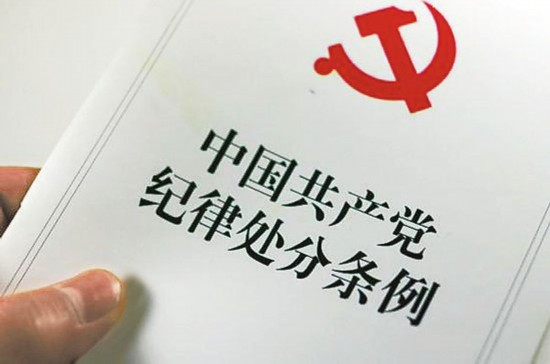
As the basis for the regulation of party organization and membership, the party disciplinary regulations play an important role in our internal system of party regulation, which has evolved over the past 20 years and has been revised several times and is now the fourth generation of “upgrade”。
Retroactively, as early as february 1997, the central government had issued the regulations on disciplinary action by the communist party of china (temporary). A total of 172 articles of the pilot regulations classify disciplinary offences into seven main categories: errors in the political category, errors in the organizational category, errors in the personnel category, errors in the economic category, errors in the category of loss of job, errors in the categories of violation of the rights of party members, errors in the civil rights category, serious violations of the socialist moral category, errors in the social management order, etc。
On 31 december 2003, the ccp disciplinary regulations were officially promulgated, removing the “test trial” hat. This version of the ordinance, which contains 178 articles, classifies disciplinary offences into nine main categories: violations of political discipline; violations of organizational, personnel and personnel discipline; violations of the rules of integrity and self-regulation; corruption and bribery; breaches of the socialist economic order; violations of fiscal discipline; omissions, malfeasance; violations of the rights of party members and citizens; and acts against the social management order。
For more than a decade, the regulations have not been amended. After the 18th anniversary of the party, the old regulations were no longer adapted to the requirements of the new situation, as the party's rule of law continued. One of the most striking manifestations is that the internal rules of the party are mixed with the national laws, that party rules are used in “french and french”, and that many of the provisions of the former regulations overlap with those of the law. In october 2015, the central government issued a new and revised ccp disciplinary regulation. The revised regulations have undergone significant changes: it was reduced from 3 original titles, 15 chapters, 178 articles, and 24,000 words to 3 titles, 11 chapters, 133 articles and 17,000 words; it was consolidated into political discipline, organizational discipline, integrity discipline, mass discipline, work discipline and life discipline in party chapters and other party statutes; it was maintained in discipline and discipline before the law was passed, and it was removed from the law and duplicated by national laws; it was refined and concretized, and it was translated into discipline, reflecting the latest results of a culture of discipline, so that discipline in the party became the basis of conduct for the rule of the party and all its members。
It's more political and more scientific. The eight highlights of the revision are of interest
Following the issuance of the regulations in 2015, the party central enacted and amended important party internal laws and regulations, such as certain guidelines on political life within the party in the new circumstances, the regulation on internal oversight of the communist party of china, and the 19th congress of the party incorporated the party's discipline-building into the overall construction layout of the party, which was supplemented in the revision of its chapters. Since its eighteenth anniversary, the doctrine, practice and institutional innovations of party discipline need to be consolidated in the form of party discipline. It is therefore imperative that the regulations be amended in the light of new circumstances。
A total of 142 new regulations have been amended, with 11 new and 65 amended and 2 consolidated compared to the previous regulations. The features of the revised version, which is more political, more scientific, more logical, more guiding and operational, can be summarized as follows:
“one thought”, i. E. The addition of the words “guided by the chinese socialist idea of the new era of xi jinping”
“both stand firmly by”, i. E. By adding the words “severally upholds the centrality of the centre of the general secretary of xi jinping, the centrality of the whole party, the central authority of the party and the central unity of its leadership”
(a) “three focus points”, which are about to be closed and closed, and the problem leads reflected in concentrated, popularized, and politically and economically intertwined corruption cases are included as priority reviews in the regulations
The “four consciousness” “four forms”, i. E. The addition of “party organizations and party members must firmly establish political consciousness, general awareness, core consciousness, awareness” and the application of the “four forms” of oversight
(a) five disciplinary acts, i. E., the alignment of party discipline with national law, which is detailed in articles 27 to 30 and 33, such as the addition of provisions requiring party organizations to detect serious infractions by party members in disciplinary proceedings, to decide, in principle, on disciplinary action by the party and, in accordance with those provisions, to refer them to the relevant state bodies for legal action
(b) six serious measures, namely, organizing, using religious activities against the party, undermining national unity, organizing or bribing organized and public funds, violating the interests of the population in the area of poverty alleviation, making it unfair to guarantee the livelihood of the population, organizing the use of clan forces against the central policy, undermining the building of grass-roots organizations, and imposing severe or aggravated penalties for six dereliction of the new concept of development
“seven yes”, i. E., to supplement in the regulations the disciplinary provisions on “seven yes” issues, which the secretary-general has repeatedly emphasized with caution
Eight typical violations, i. E. Interference with a visiting mission, party members ' religious beliefs, the use of management and client money, housing, vehicles, etc., private borrowing, large returns, the exploitation of clans, nefarious forces to oppress the population, formalism, bureaucracy, and the neglect of family culture and the imposition of penalties for eight new types of infractions, such as family neglect。
The term “de-listing” is not equivalent to “de-listing”, the term “violation” is accompanied by `violation' and many amendments are innovative
What difference does it make to look at the regulations and find expressions of both “de-listing” and “de-listing”? It is understood that “de-listing” is one form of disciplinary action and that “de-listing” is not a form of punishment. As with the objective result of both, neither party member nor party member has been expelled. However, under section 13 of the ordinance, members of the party are subject to dismissal from the party and cannot rejoin the party for a period of five years, without the exclusion of the party member。
So what is the difference between “violation” and “violation”? It is understood that “violation” refers to breach and violation, that “violation” refers to non-conformity and non-compliance, that “violation” is generally matched with “party discipline” in combination with “violation” in the regulations。
There are also a number of areas of concern in the revision of the regulations. For example, in the case of light or light sanctions, article 17 incorporates article 39, paragraph 2, of the former regulations, which amends the phrase “in the process of initial verification, in which a member of the party suspected of a disciplinary offence is able to cooperate with the investigation, and in the event that the organization is in possession of the fact that he or she has committed a major disciplinary offence, he or she may do so” to the phrase “in the course of the organization's verification, examination of the case, and in the event that he or she is guilty of a disciplinary offence,” to read “in the course of the organization's examination of the case,” to read as follows: “in the event of a minor or mitigating circumstance,” the expression “infraction” is added on the basis of a “breach of discipline” and the word “incorporation” is amended to read “cooperation”. It is understood that this is a revision based on the practice of recent disciplinary reviews. A number of party cadres, including middle-ranking cadres, have recently surrendered voluntarily since the promulgation of the monitoring act. The amendment of this provision will help to increase the number of officials suspected of violating the law by giving the organization the facts of the violation。
In addition, article 41 stipulates that when a disciplinary decision is taken, it shall be announced within one month to all members of the party whose members have been disciplined and to themselves, and that it shall be added that “who is a member of the leadership shall also declare to the leadership of the party whose members have been disciplined” and that the rules governing the leadership cadres are stricter。
Another change of interest is article 42, paragraph 2, which adds that “members of a party who are not in compliance with a disciplinary decision of the party may lodge a complaint in accordance with the statute of the party and the relevant provisions”, which guarantees the rights of members。
With regard to the implementation of the provisions relating to the overall rule of party responsibility, article 67, which was moved from the former section on working discipline to the section on political discipline, added, in addition to the primary responsibility, provisions on the penalties for non-compliance with the obligation to exercise full party oversight or the inadequate duty to exercise full party oversight, further strengthens the implementation of full party responsibility。
In the section on integrity discipline, articles 88 and 89 added provisions on marketable securities, equity and other financial products in the case of receipt of property, article 94 added provisions on “the sale of shares with information held in the process of approval, the sale of assets, the use of office or office influence through the purchase of trust products, funds, etc.”, and article 95 added provisions on the use of office or office to influence “the acquisition of benefits for relatives and specific persons in connection with approval supervision, resource development, financial credit, bulk purchasing, land tenure concessions, real estate development, engineering tenders and public finance expenditures”。
More than a month later, the new revised regulations are about to be implemented, and how will that affect more than 89 million party members and more than 4. 5 million grass-roots party organizations? Let's see
Ginger