


Last issue we brought everyone together to understand:
I wonder if you're still impressed? It's time to review and start today's study。
Previously on love..
Today we will learn about the processes and tools of literature search, helping to clarify the search thinking and making it more efficient。
So let's get to the point of today
Steps and tools for literature retrieval
Click to play the course video
01
Documentation retrieval steps
- the literature search process--
Overall literature search process:
Analysis of search requirements, selection of search tools, selection of databases, identification of access, development of search strategies, search, retrieval of literature and analysis of search results, and feedback modification of search patterns
After learning about the overall process of literature retrieval, let's look at the skills and attention in each step of literature search。
1. Analysis of research and search requirements
In this process we need to address three issues:
1) analysis of the subject matter of research, such as diseases specifically targeted by research。
2) identification of the type of documentation required for research subjects, such as, for example, when research subjects are basic theoretical studies, they require the retrieval of periodicals and conference papers, and when research topics are innovation or technological innovation studies, the search of patent literature is required。
3) on the basis of background information on the subject of the study, determine whether the time frame for searching the literature is long, near, distant or peak。
2. Selection of search tools and data library
The search tool is the sum of the tools and equipment used to report, store and search for literature leads, including library catalogues, journal indexes, computer retrieval, etc。
In selecting a database, the following three points need to be identified:
1) sources and characteristics of the literature。
2) type and time frame of documentation。
3) the rates and availability of the original language。
3. Identification of access
There are several ways to access the literature:
1) classification: retrieved by the category of disciplines to which the literature belongs。
2) author channel: retrieved through known authors。
3) serial numbering: retrieved through the number compiled at the time of publication。
4) thematic approach: retrieval by title of the literature。
5) retrieving by title: retrieving by title。
6) other means of searching through categories such as source, type of publication, date of publication, country, language, etc
4. Development of search strategies
The key to developing a search strategy is to express the demand for information and to obtain the required search results by constructing search formats that are different in their role。
The actual search process begins with a conceptual analysis, the selection of the search words, and then the search expression is constructed using logical operators, position operators, transwords, etc。
Here we highlight four common search methods:
1) bull logical search
Boolean logical retrieval refers to the method of connecting search words with a boolean logic operator, whereby the corresponding logical calculations are performed by the computer to find the required information, and is the most commonly used method in the machine inspection system。
There are three logical operators applied to the boolean logic retrieval:
2) location operator retrieving
Location operator retrieval is a method of expressing the proximity between the search word and the search word with a specific operator。
There are two logical operators that are used for location operators to retrieve: "with" and "near " :
Logical operational priorities range from high to low: not, and, near, with, or, in addition, brackets can be used to change the order of operations, i. E., the contents in brackets should the brackets exist, otherwise they are performed according to the logical operational priorities above。
3) field qualified search
Field-defined search refers to the search for search words limited to one or more fields in a database record。
In the field qualification search, we usually divide searchable fields into subject indices that characterize the content of the literature and supporting indices that characterize the literature:
Each field has a code in two letters corresponding to the table below。
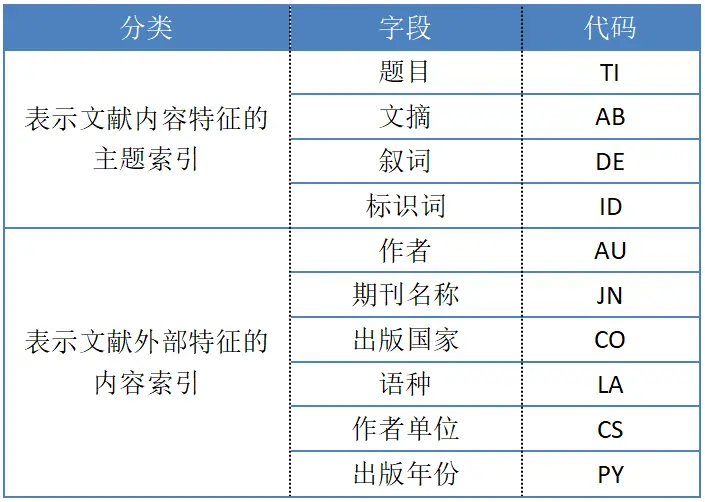
When retrieved, field codes in the form of prefixes or suffixes may be used to limit the search area for search words, search formats or search steps representing the search steps。
4) interword search
Interword search is also referred to as word-dry search or character-shielding search as a method of making search words for a given word-drying and finding all records containing that word-drying。
Interword search has the advantage of expanding the scope of search, increasing the overall rate of detection, reducing the volume of search word input and saving search time。
Interception, by location, can be divided into three types of post-interception, pre-interruption, and mid-cut-off, i. E. End-to-head, middle-to-end transliteration。
The crosswords are divided into an unlimited crossword “*” and a limited crossword “?”:
Depending on the use of different amplifiers, transliterators can be retrieved in a limited manner, with intermediate and unlimited terms:
5. Finding, retrieving relevant literature and analysing search results, as well as feedback modifications to search formats
This is the entire process of the literature search process, and the application of the search tool is indispensable during the search process, and we are following in the search tool。
- the literature search tool -
The figure below is a common medical literature search tool。
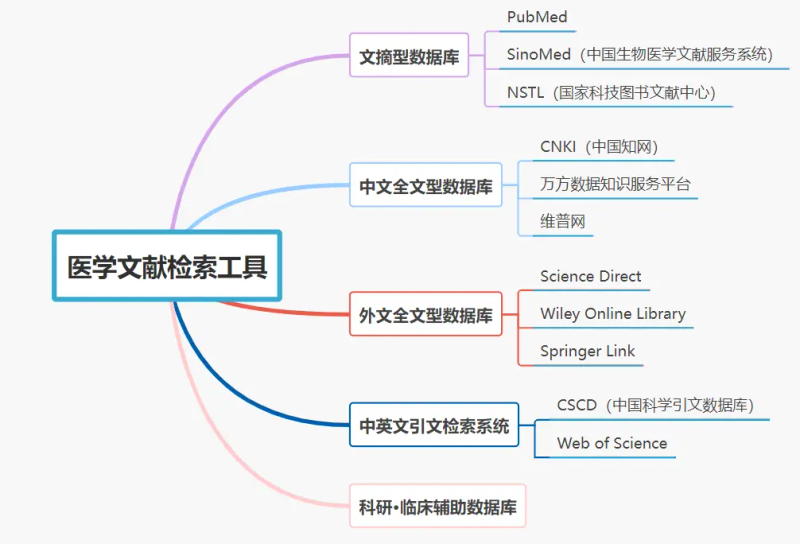
Two common databases, pubmed and cnki, are presented below to illustrate the specific operation of the literature search。
1. Pubmed
It is a database that provides research and digests of biomedicine, with the core theme of medicine, but also other medical-related fields, such as nursing or other health disciplines。
Characteristics: enrichment of information resources, wide coverage, quality of information, timeliness of updates, flexible access and availability of services in the original language。
Methods of use:
When you enter the pubmed page, you can see a general search box above and an advanced search box, followed by some hotspot articles and new entries in high-impact magazines。
Basic search is the entry of a keyword directly into the search box. Simple and vague searches generally produce more results and it is difficult to find suitable literature。
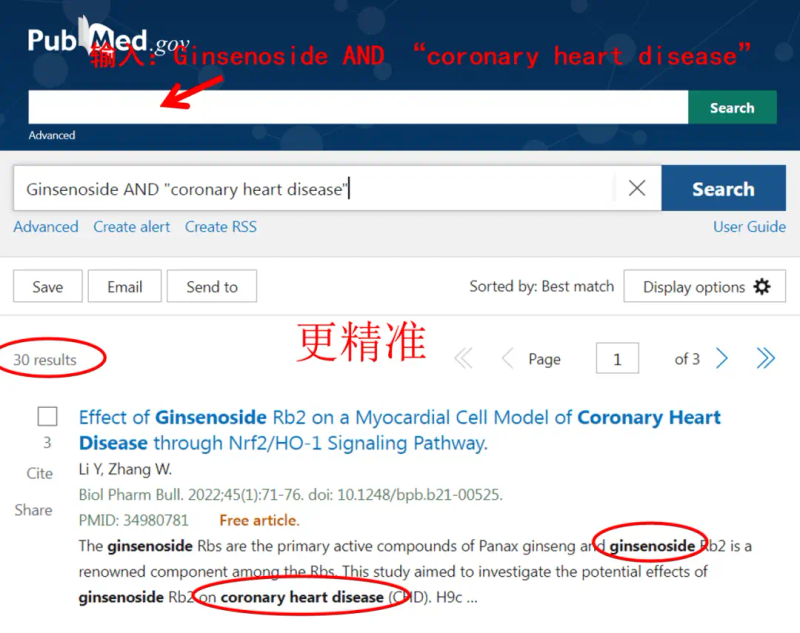
Retrieving can be done at this time, making it more efficient. For example, we can enter keywords ginsenoside and coroNary heart disease, then some literature relating to these two keywords can be obtained and results can be ranked or limited according to their needs。
The results of this method are often inconsistent or missing terms, so we can improve the search method by using the previously mentioned search format to enter ginsenoside and “coro”A search (i. E., "and" coronary heart disease") can yield more precise results without inconsistency or omission。
For advanced search, clicks on advanced, in the first search box, “add terms to the query box”, can select a search method and thus achieve complex search; in the second search box, “query box”, it can write an autonomous search style; and the following (“history and seach data”) records historical search and retrieval formats, which can be preserved and used directly。
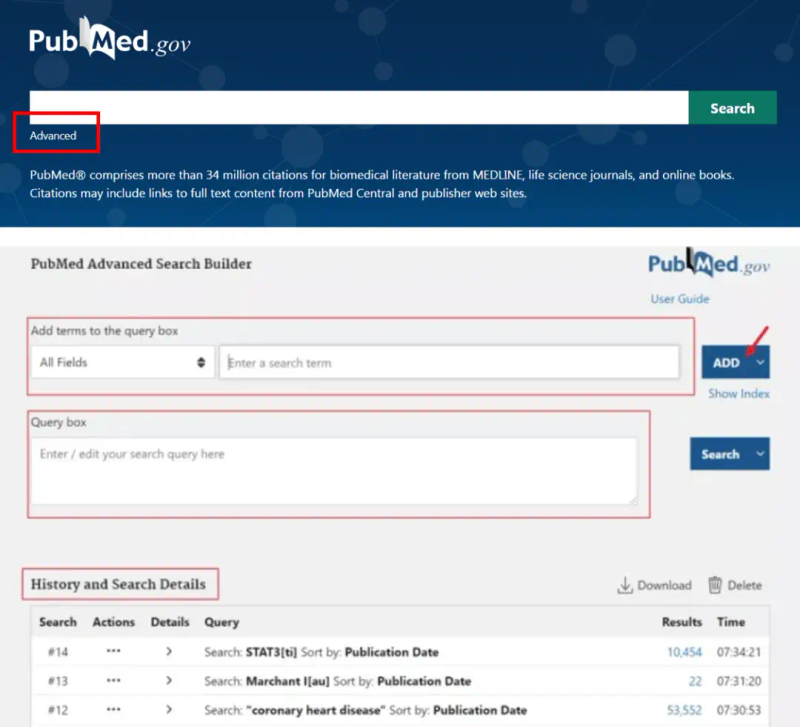
For example, if there is a need to retrieve the literature published in j enzyme inhib med chem with the title of stat3, we can use the following settings in the search box to get the results。
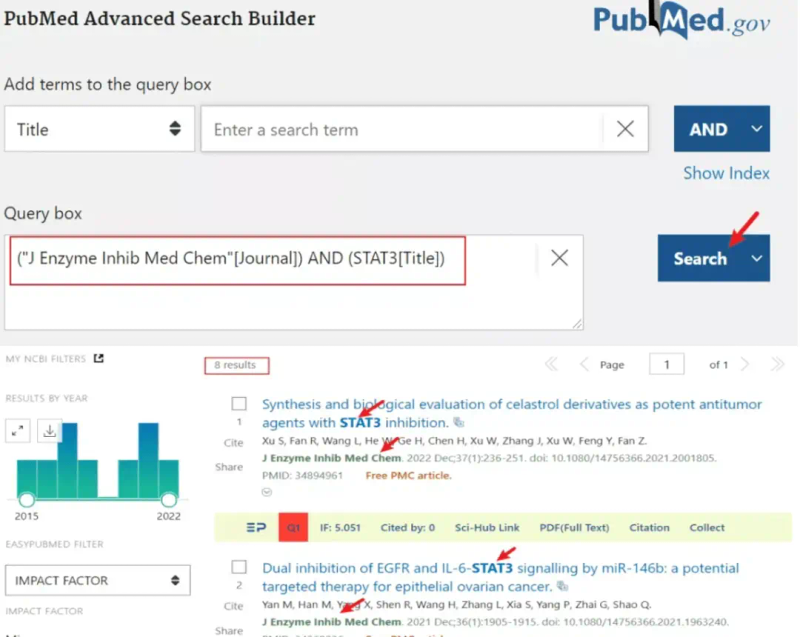
In addition, we can use pubmed to retrieve mesh theme words and find “mesh datab” on pubmed's home page"ase" portal, click into the search interface。
In the case of diabetes, “diabetes mellitus”, click on the required results, look at information between sub-themes and subject words, click on the required search conditions, such as “diagnosis” and “herapy”, and then click “add to search builder” on the right side of the page in the “pubmed seach builder” toolbar and then click “search pubmed”。
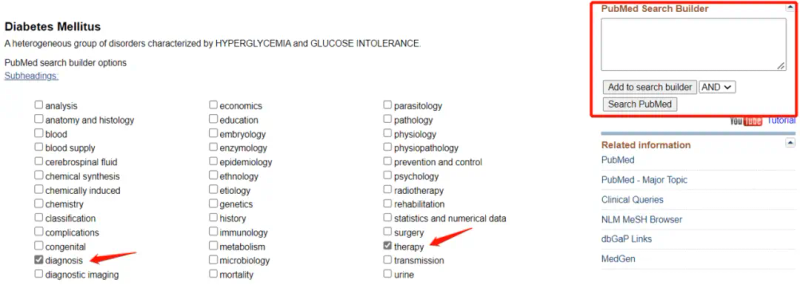
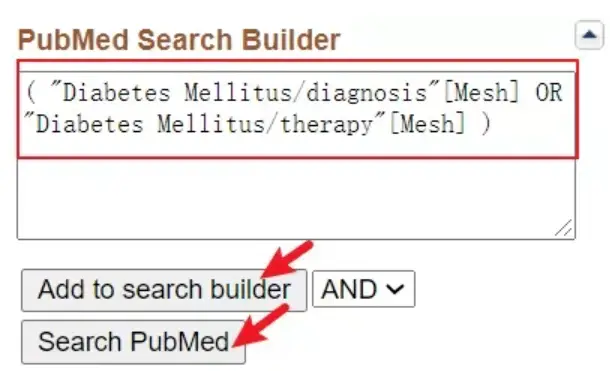
To show the results of the pubmed database more intuitively, two small plugins are shared here:
1) scholascape, where this plugin is installed, can perform a variety of functions, filter and sort articles by impact factor on the search result page, display impact factor directly, and read abstract directly. On the pages of the literature, you can download the literature directly, manage the literature and import endnot。
2) easypubmed, which displays the jcr division, influence factors, full full-text summaries and translation functions on the search page, and automatically searchs the literature on the sci-hub website for full-text PDF。
Pubmed is a common database for the search of english literature, which is illustrated below by the chinese knowledge network。
2. Cnki china information network
The network's database resources are comprehensive, mostly full-text databases of chinese periodicals and full-text databases of outstanding and successful chinese degree papers, as well as other databases。
Bibliography, knowledge meta-research and citation are available at the internet search portal。
The basic search process is relatively simple and can be retrieved by entering content directly into the search column on the first page of the network and selecting a database。
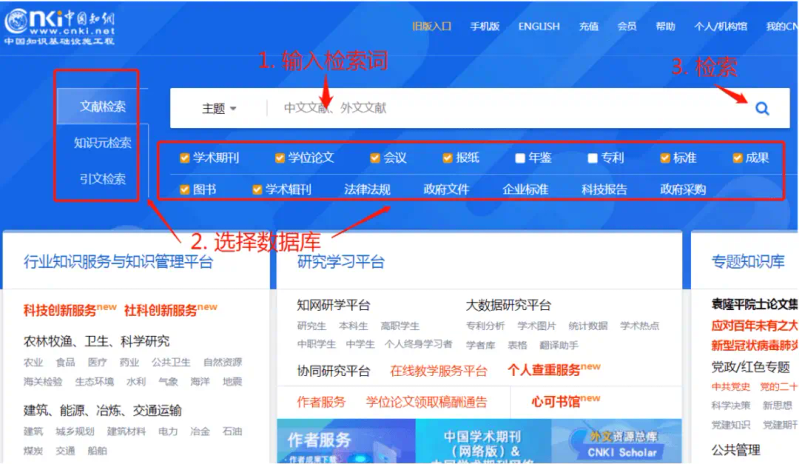
For advanced search of the know-how network, click on the "advanced search" on the right side of the search box to search for information such as a theme, keyword, title, etc., as required, and to search accurately with an operator。
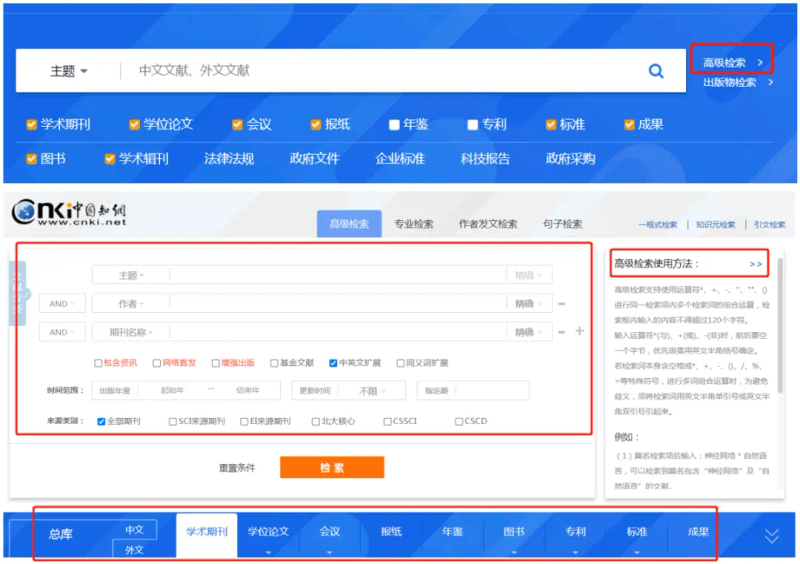
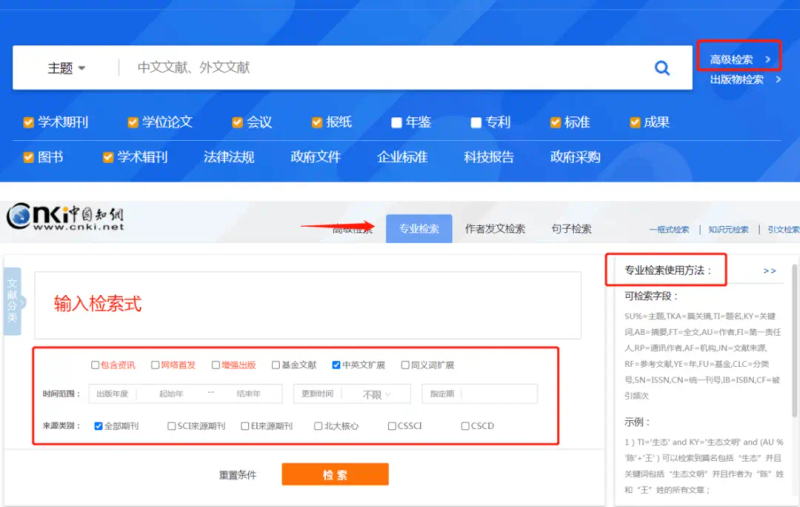
With regard to professional search of the know-how network, it is possible to select the "professional search" above by clicking on the "advanced search" on the right side of the search box, so that the search format can be entered for precise search。
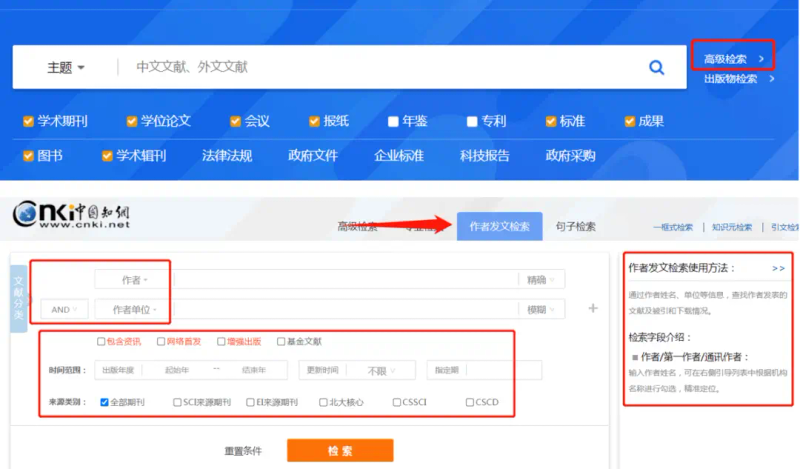
The processes to be searched by the author are similar and the author's text search is selected by clicking on advanced search, and input of the author, author's unit, etc. Allows the author to retrieve the relevant literature in the database。
In addition to pubmed and the knowledge network, a number of other database sites and access guides are made available here for self-reference。
Sinomed (china biomedicine documentation service)
Web of science
Global database



