Other organiser
Introduction to books
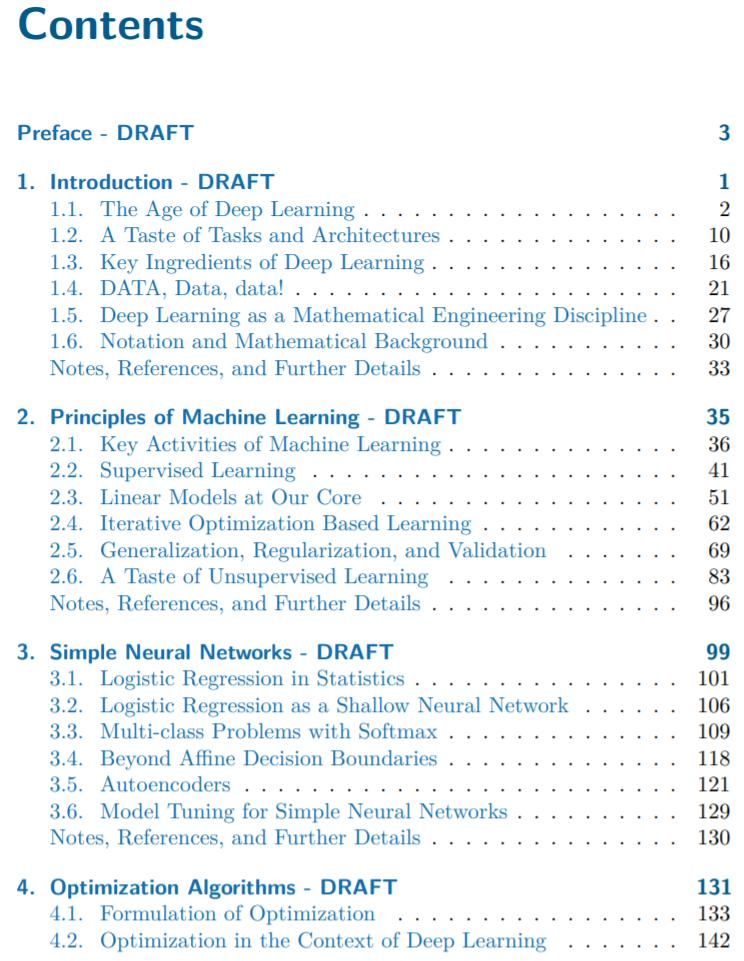
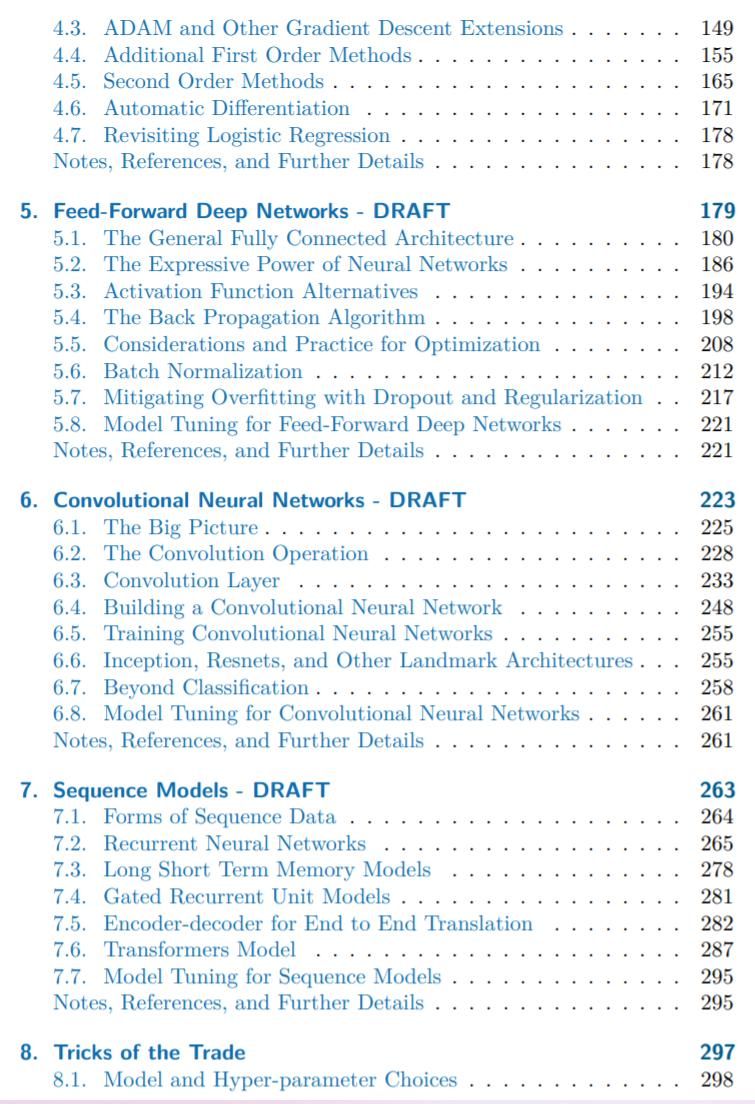
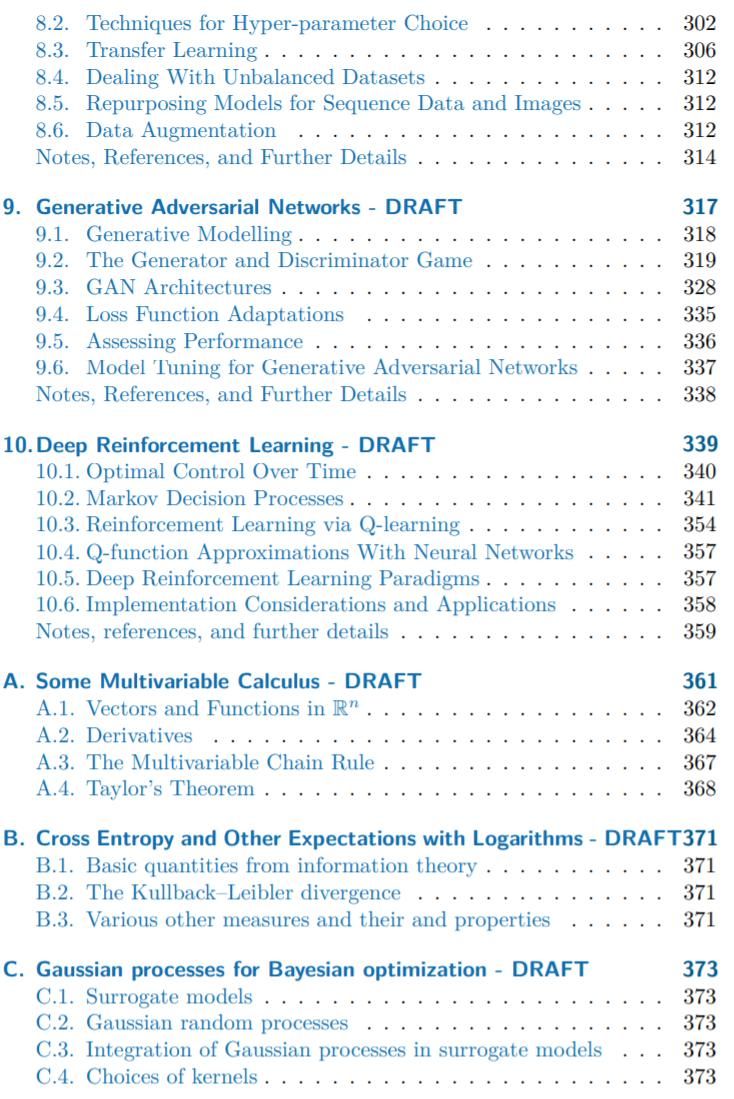
The book consists of 10 chapters and 3 appendices. Chapters 1-4 describe the areas of in-depth learning, outlining key concepts of machine learning, the optimization concepts required for in-depth learning, and focusing on basic models and concepts. Chapters 5-8 address core models and architecture for in-depth learning, including full-connected networks, volume networks, circular networks, and outline aspects of model adaptation and application. Chapters 9-10 cover specific areas, i. E. Generating counter-networks and intensive in-depth learning. Appendix a-c provides mathematical support。
Specifically:
Chapter 1 introduction: this chapter provides an overview of in-depth learning, demonstrates its key applications and investigates ecosystems associated with high performance computing. In addition, the chapter discusses big data and high-dimensional data, key terms including data science, machine learning and statistical learning, and places them in the context of the book。
Chapter 2 mechanical learning principles: deep learning can be considered as a sub-scientific of machine learning, so this chapter outlines key machine learning concepts and paradigms. Readers were introduced to the general concepts of supervised learning, non-supervised learning and learning optimization based on an iterative basis. In addition, the chapter presents concepts such as training packages, test sets, and the rationale for cross-validation and model selection. This chapter focuses on linear models that can be trained through iterative optimization。
Chapter 3 simple neural network: this chapter focuses on logical regression of the binary classification and associated softmax regression models for multiple types of issues. The rationale for in-depth learning, such as cross-breeding losses, decision boundaries and simple cases of reverse transmission, is presented here. It also describes a simple non-linear automatic encoder structure. Various aspects of model adjustments were also discussed, including feature engineering and super-parameter selection。
Chapter 4 optimization algorithms: the training of in-depth learning models involves optimization of learning parameters. Thus, there is a need for a solid understanding of optimization algorithms, as well as of specialized optimization techniques applicable to in-depth learning models such as adam algorithms. This chapter will focus on these technologies and on a second-tier approach that is slowly moving into practice。
Pre-chapter 5 feeding depth network: this chapter is at the heart of the book and defines and describes the general front-to-end depth neurological network. After exploring the expression capabilities of the deep neural network, this chapter provides insight into the details of the training by understanding the reverse diffusion algorithms used for gradient assessment and exploring other aspects (e. G., initialization of weights, dropout and harmonization)。
Chapter 6: the success of in-depth learning can be attributed to a condensed neural network. The chapter will explore the concept of volume and then understand it in the context of an in-depth learning model. This chapter introduces the concept of corridor and filter design and then explores the most commonly advanced architecture that has significant impact and is still in use. In addition, the chapter explores key tasks related to imagery, such as targeting。
Chapter 7 sequence model: sequence model is essential in nlp. The chapter explores circular neural networks and their broaderization, including short- and long-term memory models, door-control cycle units, automatic encoders for end-to-end language translation and attention models with transformer。
Chapter 8 trade techniques: following the introduction of front feed networks, volume networks and various forms of circular networks, this chapter explores common ways of adapting and integrating these models in applications。
Chapter 9 generates anti-networks: this chapter investigates and explores the generation of anti-networks (pan), which can synthesize seemingly authentic false data. This chapter discusses several can structures and interesting mathematical aspects that arise in adjusting the loss function。
Chapter 10 intensive learning: the final chapter will explore the principles of intensive learning。
Introduction by the author

Benoit liquet, sarat moka, yoni nazarathy
Benoit liquet, professor of mathematical statistics, university of mccorry. Major studies include model selection and variable selection, multistate models and survival analysis, downscaling methods, beyers modelling, machine learning, computational ecology and statistical methods of environmental science。
Sarat moka, a doctorate at mccorry university, focused on the application of probabilistic theory in data science, statistics and monte carlo simulations. Its research content is closely related to in-depth learning, monitoring learning, non-supervisory learning, the mcmc methodology, the bayesian reasoning, unbiased estimates, the theory of large deviations, and differential reduction techniques。
Yoni nazarathy is an associate professor at the faculty of mathematics and physics of the university of queensland and specializes in machine learning, application probability, statistics, operational preparation, simulation, scientific computing, control theory, etc. In addition, nazarathy co-authored with julia a new book, statistics with julia: fundamentals for data science, machine learning and technical intelligence。
Finally, a catalogue of books is attached: