The “two-high” update of the judicial interpretation of offences against intellectual property, covering offences such as trademarks, fraudulent patents, copyrights, and commercial secrets。
On 24 april, the supreme people's court and the supreme people's procuratorate jointly issued the interpretation of certain issues of the law applicable to criminal cases of violations of intellectual property rights (hereinafter referred to as the interpretation)。
The vice-president of the supreme people's court, mr. Tao kai, explained that the people's courts and people's procuratorates at all levels throughout the country had full jurisdiction and prosecutorial functions. Between 2013 and 2024, 691 criminal cases of violation of intellectual property rights were filed and 646 criminal cases of violation of intellectual property rights were concluded at first instance。

“at present, there is a certain degree of vulnerability to abuses in the field of intellectual property, where criminal behaviour is characterized by novelty, complexity and technological sophistication, and where there is a growing need for innovative creators from all sectors of society to strengthen criminal protection of intellectual property.” tokai stated that the interpretation act, which was enacted under amendment (xi) to the penal code, was an entirely new and systematic interpretation of offences against intellectual property rights, incorporating and consolidating the provisions of the previous three legal interpretations, while repealing the first three in order to facilitate the operation of judicial practice, effectively regulate criminal cases and ensure uniform standards of application of the law。
The above-mentioned interpretation consists of 31 articles and is divided into five parts: the first is the provisions relating to trademark offences. The interpretation further clarifies the identification criteria for “same goods, services” and “registered trademarks”, which are more controversial in practice, and adds, on the basis of the incorporation of pre-existing judicial interpretations, the threshold for trademark offences such as false services registration trademarks。
Secondly, there are provisions relating to fraudulent patent offences. The interpretation lays down the specific circumstances of “false patenting of others” and the threshold of incrimination for the offence of false patenting, with an appropriate lowering of the threshold of incrimination depending on the circumstances。
Thirdly, there are provisions relating to copyright offences. The interpretation further clarifies the more controversial criteria for identification, such as “reproduction” without the consent of the author, and establishes the incriminating criteria for copyright offences, based on the consolidation of the original judicial interpretation。
Fourth is the provision relating to the offence of commercial secrecy. The interpretation further clarifies the criteria for the identification of improper means such as “theft” of “electronic intrusion”, sets out specific rules for the “gravity” of violations of commercial secrets, and identifies criteria for the identification of the amount of loss, the amount of the proceeds of the violation, etc。
Fifthly, there are provisions on the commonality of intellectual property offences. The interpretation further provides for specific rules for the determination of joint offences against intellectual property, mitigating penalties, the application of fines, unit offences, confiscation and destruction, as well as the amount of illegal business, the amount of the proceeds of the offence, the amount of the sale, etc。
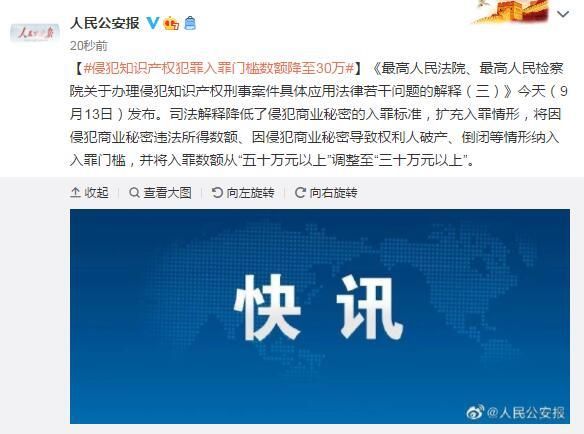
Tokai stated that the code of interpretation's incriminating standard for intellectual property offences follows mainly the provisions of the original judicial interpretation, lowering the threshold of partial criminality, curbing the root causes of intellectual property offences and highlighting the concept of strict intellectual property protection. At the same time, the criminal policy is being implemented in a comprehensive manner, with heavy and light penalties, which are broader and more severe, ensuring consistent penalties。
The interpretation also provides further clarity on the more controversial criteria in practice, such as the “number of markings”, “the amount of proceeds obtained in violation of the law”, to ensure the effective implementation of the relevant criminal law provisions。