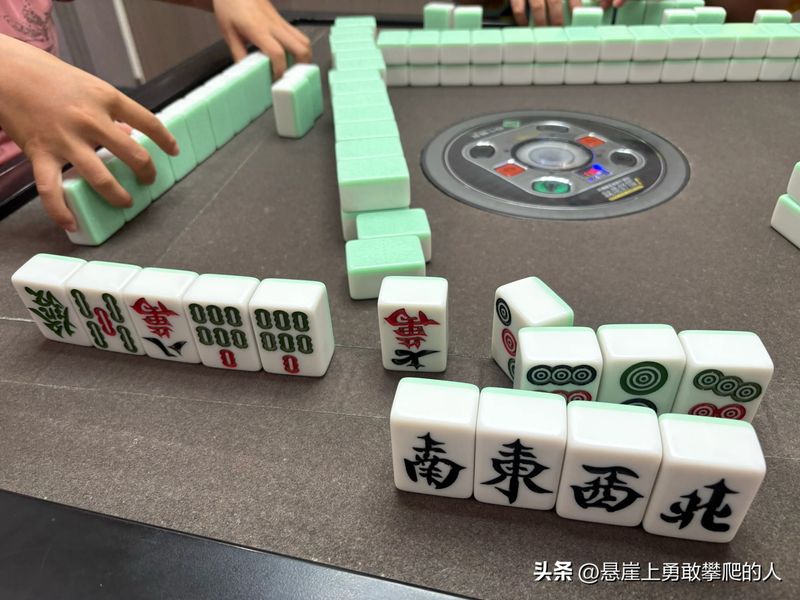
Many people play mahjong, one thing at a time: gambling。
If you start a good hand, you'll have to be happy and feel like you won the whole game today; if you start a bad hand, you'll lose your head and you'll sit down and you'll get your gun. Having lost money after playing cards, it can only be concluded that today's bad luck is too bad。
I've played leisure mahjong for more than a decade, and i've seen so many mahjongs win and lose, and today i'm telling the truth: mahjong is a real master, and he never plays with luck
Those who have always won and rarely lost a great deal are not born with good luck or mastery, but simply eat through the three underlying logics of mahjong's core。
Most ordinary people can only touch cards, play cards, touch cards, and do it all by feeling. You're lucky, you're lucky to lose more than a dozen, you're lucky to lose, you're lucky to lose, you can't control the game。
Today we share the three core essences of mahjong, with no complex formula, no hard-to-understood terminology, all of which can be used in combat and learned by ordinary people. Just remember these three points and quit the bad habit of gambling, and your mahjong level will go up one step directly, and the odds of losing cards will drop dramatically。
First of all, the first core: no greed. It's better to listen late than to listen to it
This is why 90% of the players lose the number one, and it's the deadliest disease of the newcomers。
There's only one thing in a lot of people's eyes: listen to the cards
Regardless of the type of card, its quality, its quality and the stability of the situation, it is important that the cards be drawn, whether they be single-handed or strangulated, in a hurry to listen to them. I always thought the sooner i heard it, the sooner i heard it, the better it was。
But the real mahjong, that's not true。
Listening blindly and early is the worst operation. Many times you've listened to the cards, watched the first take the lead, and you've heard the worst. Whether the card is closed or closed, or all high-risk, the opponent is dead or dead。
In the end, you wait for more than a dozen laps of cards, you get to the end of the game, you have to open up your guns。
Real master, never blind speed。
Their methods are very perceptive: good to hear, and bad to hear, rather than listening late or even abandoning。
There's nothing wrong with two more rounds. One more chance to touch cards, one more time to optimize the cards and change the hearing. Even if it is two rounds slower than others, it would be a hundred times better to listen to it than to listen to it earlier if it were to be more sophisticated, bigger and more obscurant。
I've seen too many matches, new players listen to all the dumb-fired cards, masters adjust the cards slowly, and end up with a quick cut。
Remember one sentence: mahjong is faster than anyone who listens to cards, who gets them and doesn't light them. The greedy are always the ones who lose most。
The second core: no hard-on! The timing, the bad cards, the whole defense
Mahjong's worst-case mentality is to lose and to be discouraged。
Many card players, regardless of whether they have a good hand or a bad hand, think about attacking, think about a card, think about winning. The cards are so thin, they're all so lonely, they can't get in there in a few circles, even though the situation is so bad, they have to be hard-lined and forced to listen to them。
Always holding on to luck: in case you touch a good card behind? What if the opponent plays what i want? What if the wind turns over
That's the one that cost us a lot。
The best way to fight is to give up the situation, which has changed rapidly。
There is no rule that mahjong must be a mahjong。
Every game starts with a game of masters who judge the quality of the hand: the cards are ready to attack and the cards are set to hold。
If you have three or four laps of hand, you've been touchin' the cards, you've lost the cards, you've lost them, you've lost them, you've lost them all。
Let's not try to get involved, let's move on to defensive mode。
Play cards only on the table, in a well-established, steady game, with a raw, medium and high-risk card all in their hands, prefers to break them down and keep them safe, and never venture。
A lot of people think it's too bad to waste a game. But let's settle this:
A fair score is far from a big score. Win, win, lose, earn. In mahjong, it's always the truth。
If you know how to review time, stop damage in time, and don't break cards, your overall odds will crush your peers。
The third core: don't hang around! You don't break the hand plate easily
Many newcomers have an error in the sense that the more they touch cards and eat them, the faster the cards move, the faster the hull。
So whatever the cards, if they can touch, eat, operate immediately, they don't look at the handplate structure at all, and they don't consider any subsequent effects. Uncertainty, blind touch is the fastest way to self-destruct。
Mahjong's handplate structure is the foundation of the mahjong. Every time you touch a card or eat a card, you reduce the number of hand cards, compress your adjustment space, and you completely expose your card intentions, so that your opponent can be precise in decorated and shielded。
A lot of cards that could have been slowly optimized and listened to later are simply playing dead cards because of the mess。
And here's the one thing that teaches you to do is to do it directly:
The first four rounds of the operation, in which the situation is unclear, are left untouched, priority being given to keeping the whole handplate and observing the situation before planning
(b) the handplates are compact, broad-based and do not need to touch speed, keep the doors as clean as possible and keep a wide range of listening possibilities
Only handplates are messy and need to be streamlined, and when they are touched they do not affect subsequent, high-security cards, which are then touched decisively。
Don't touch it, don't eat it。
The master's touch is intended to optimize the cards and lock the game; the newcomer's touch is pure blind speed and self-disturbing。
Take care of your hands, don't touch, don't eat, keep the card structure. Your game will be full。
After all, mahjong is really not a game of luck。
So-called handy, which can only affect short-term win and win, and which really determines your long-term win and lose, is always your card thinking, your trade-off mentality, your situational judgement。
Ordinary people play cards by gambling and win and lose; smart people play cards by the core and are stable and manageable。
You can be the one who wins on the card table without losing good luck。
This article is an empirical view of the individual mahjong and does not constitute any recommendations for playing cards or games。