The profession of stockbrokers is disappearing from the industry at a visible rate。
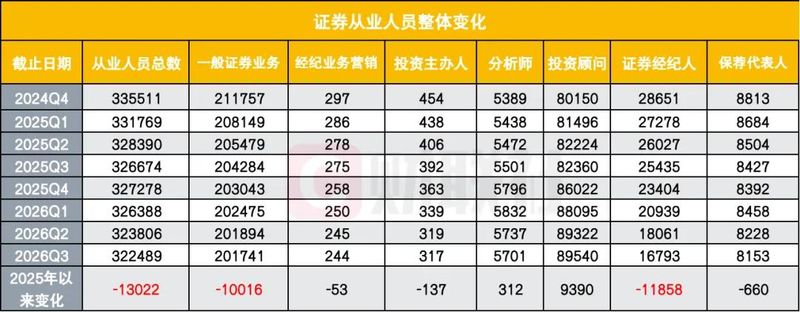
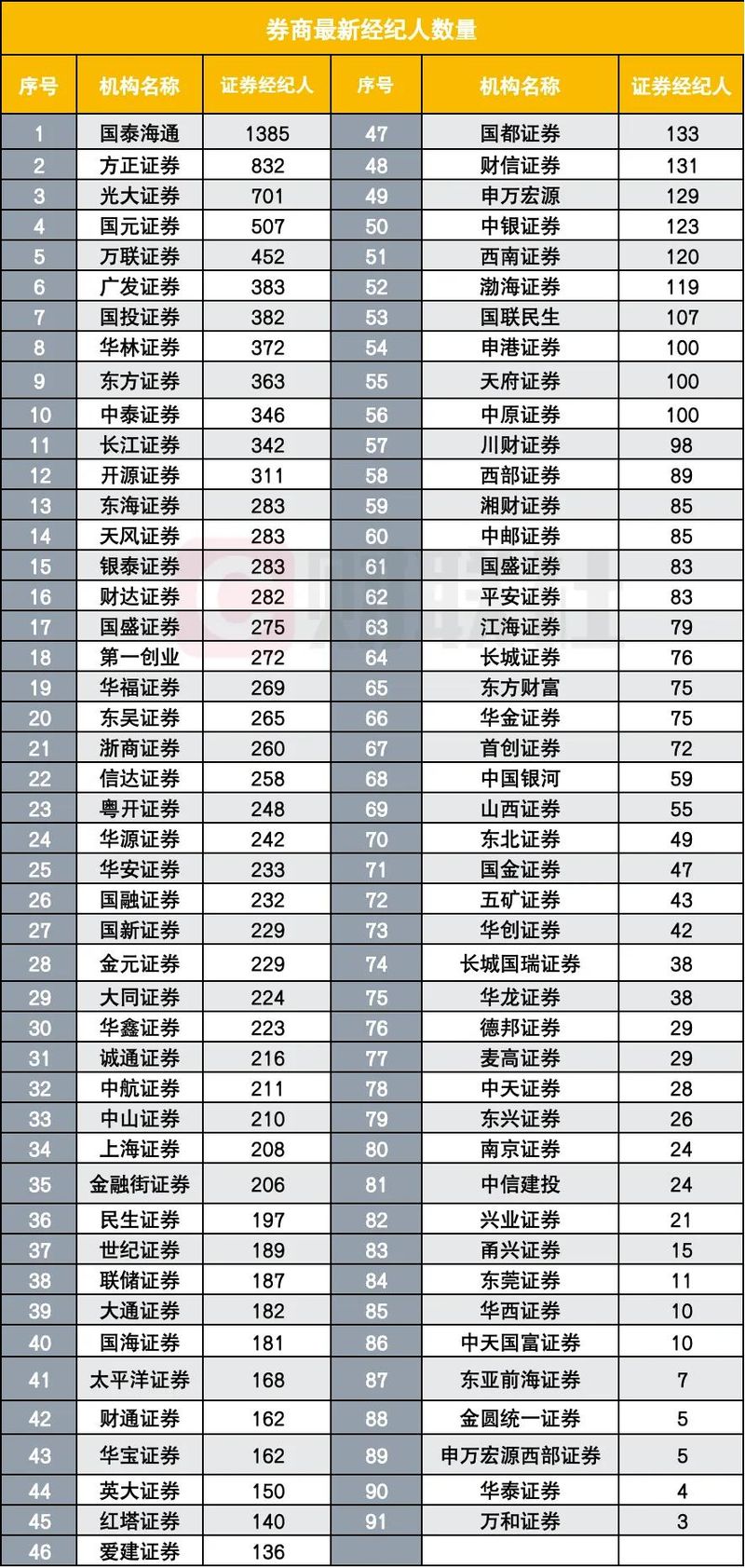
In the first half of 2026, the number of trade-wide securities brokers had fallen by 17,500. In six months, 5674 people left, a decrease of more than 20 per cent。
Since 2025, there has been a cumulative decline of almost 12,000 brokers in the year, contributing almost to the overall decline in the securities industry over the same period。
In other words, this round of human resources in the industry is mostly cleaning up this group。
From the golden jobs everyone used to admire to the high-risk jobs everyone could avoid today
Securities brokers do not exist from the outset。
Prior to 2009, the group had long been in grey areas. In april of that year, the provisional regulation on the management of securities brokers of the cvm was formally implemented, giving them legal status for the first time: natural persons who had been commissioned by a voucher dealer, engaged in customer outreach and basic services, and who were not formally employed by a voucher dealer。
This model allows the issuer to rapidly expand the network and bring in customers at very low human cost。
When the boots of the system landed, the number of brokers expanded at an alarming rate。
At the end of 2009, there were just over 4,000 industry-wide brokers, and by 2017 the number exceeded 90,000. At the beginning of 2018, there were also 950,000 stockbrokers in the industry。
In an era when the mobile internet had not completely subverted the way accounts were opened, and the ministry of commerce was still relying on underline access, the broker was the "breath vessels" of the coupons, which had boosted half of the brokering business。
But after the peak is the cliff。
Starting in 2018, the number of stockbrokers has been declining。
By 2020, it had fallen to 65,000, by 2023 to 37,000, by the end of 2024 to about 28,000, and by 2025 to only 224,000。
By the first half of 2026, that figure had fallen to 20,000。
Over the past eight years, over 70,000 securities brokers have left the industry。
If, at this rate, the position of securities broker is completely eliminated, it is only a matter of time。
The first and most immediate reason for the disappearance of the securities broker:
The pattern of eating on a trade commission is no longer sustainable。
The revenue structure of the broker is simple and is linked mainly to the number of accounts opened, transaction commissions and sales of products. They are essentially the "flow entrance" for the issuers, and the core task is to pull customers and promote transactions. It's a pretty profitable job when it's good, when the commission is high。
In the early years, the head agent earned far more than the average social wage, depending on a commission rate of three or five per 1,000。
But the logic of the commission war has completely collapsed。
The average commission rate in the chinese voucher industry fell from about 3. 8 per 10,000 in early 2018 to around 1. 8 per 100,000 in 2024. The industry-wide average commission rate fell from 0. 024 per cent in 2024 to 0. 0215 per cent in the first half of 2025. The average commission rate in shanghai in october 2025 had dropped to 0. 0192 per cent, falling by two per 10,000 for two months。
What does the commission rate mean
An exchange fee and operating costs are deducted from the commission charged by the issuer for a $100,000 stock transaction. The credit that can be allocated to brokers is already so thin that it is negligible。
The regulatory borders were tightened and grey spaces were completely blocked。
In addition to the collapse of commissions, the strict limits imposed by regulation on the boundaries of broker practice have further reduced the space available for the post。
Under the current rules, securities brokers can only be commissioned by a voucher broker to undertake customer outreach and customer services, and cannot engage in business requiring specific qualifications such as securities investment advice, transaction execution, asset allocation, revenue commitments, etc。
This means that a genuine securities broker can neither offer shares nor help his client with asset allocation, let alone pledge gains. What they can do is pull clients, open accounts, answer basic questions。
It would be difficult for the issuer to manage the broker. They are not regular employees, but there is a commissioning agency relationship with the voucher, which, in case of compliance issues, is equally subject to primary responsibility。
This is why, in 2023, when regulators conveyed to the industry the direction of "adapting to the transition to wealth management, gradually reducing and clearing the stock of brokers", the following strategy was widely adopted by coupons:
When the contract expires, the contract is not renewed, the conditional person is converted to a regular employee or investment adviser, while the others are automatically withdrawn。
Technology replaces, online openings render human tactics ineffective。
If commission and regulation are external pressures on brokers, the development of financial science and technology is a bottom draw。
In the past, the opening of securities had involved queuing, filing and risk assessment at the ministry of commerce, where brokers played an irreplaceable role. Today, however, more than 90 per cent of investors have opened accounts online. Mobile phones, a network of issuers, and third-party guidance platforms are now fully available as substitutes for brokers to complete basic services such as access, opening, risk assessment, and transactional guidance。
The coupons' "human-sea tactics" are completely out of hand with technology。
Deeper changes come from the logic of services in the securities sector。
The shift in wealth management is from "seller sales" to "buyer services", from "paying commission for transactions" to "long-term value added of customer assets". This transition resulted in:
Another aspect of the exit of securities brokers is the rapid expansion of the pool of investment advisers。
Csa data show that by the end of 2025, there were 96,000 sector-wide portfolio investment advisers. During the first half of 2026, the number of visitors continued to increase in reverse, with an increase of over 1,600. In contrast, stockbrokers have decreased by almost 12,000 since 2025。
One post has been withdrawn and one post has been expanded, which is the most visible structural change in the workforce in the portfolio management transition。
But it is not easy for securities brokers to turn to investors。
There are mandatory thresholds for investment: undergraduate and above, two years or more experience in securities, passing the securities investment consultant qualification examination。
This transition threshold is not low for brokers with early entry, low education and habit of soliciting clients. Not all people can change from "raiser" to "professional consultant." this also explains why brokers have lost nearly 70,000 personnel and have increased their participation over the same period by just over 30,000, with huge faults。
The tendency of stockbrokers to halve to zero is essentially a necessary way for the securities industry to move from "broad expansion" to "professional services"。
In the past, issuers used to rely on commission-driven, man-made tactics to obtain customers。
Today, when the commission rate falls to two-tenths, when online openings become mainstream, when clients need asset allocation and long-term company, it is no surprise that this model has disappeared。
In the words of a head issuer:
"it's more of a job transition than a retreat."
Of course, this transition is bound to be accompanied by pain。
For brokers still on duty, the time window is closing。
From 20,000 to 0, how long is the transition period left to small and medium-sized dealers, and no one can give a definitive answer。
It is certain, however, that this post, which had been part of the brokerage business, has reached the end of its career。
References:
Zhexiang financier: "the coupon broker is down to zero, almost 12,000 a year and a half."
The association of financial unions (journey wang): monochrome: multiple coupons are steadily clearing their brokers in accordance with regulatory requirements, reducing their staff by almost 12,000 a year and a half
Where's the stockbroker? From 90,000 to just 25,000 over seven years (11 july 2025)
China securities post: three waves on the coast, accelerating the reshaping of the securities industry (september 21, 2024)
Paperman china (economic report 21st century): “counseler practitioners, reducing sizes more than last year! What happened?” (22 may 2026)
Csrc: keynote address by president wu qing at the annual meeting of the 2025 financial street forum (public information on the direction of regulatory policy)